Higher Ed Leader, Artist, and Owner of a Dog with Attitude: Meet Alsace Touré, New Director of CES |
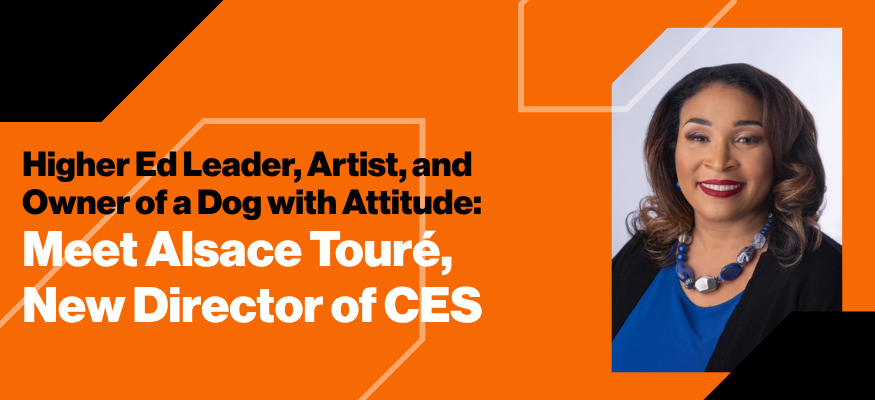
You’ll find a pleasant surprise or two when you talk at length with Alsace Touré, the new Director of the Center for Engagement and Student Success in the Division of Access, Engagement and Success. You might smile, even chuckle to yourself.
Touré has more than 15 years of leadership experience in higher education focusing on student success, academic support, student engagement, peer educator development, and cross-campus collaboration. She’s held leadership positions at the University of Albany, Baldwin Wallace University, the University of New Hampshire, and the University of Cincinnati and is excited to be on the RIT campus, as a part of the CES team and its mission.
Alsace Touré:
Throughout my career, I have seen how transformational it can be when students have access to people and programs that help them understand how to navigate college. Sometimes students need academic support. Sometimes they need cheerleaders. Sometimes they need someone to show them how to self-advocate. Sometimes they need someone to help them develop a plan, connect them with a resource, or simply remind them that asking for help is part of being successful.
For me, our work is not just about helping students get through a semester. It is about helping them develop the confidence, skills, relationships, and sense of belonging that allow them to persist, graduate, thrive beyond RIT, and eventually use what they have learned to support and uplift others.
You have said much of your professional journey in higher education has evolved around one question: “What do students need in order to truly learn and be successful?” It came to you years ago when you were in a doctoral program, teaching classes. Can you share what happened?
During one class, I was lecturing and moving through a PowerPoint presentation when I noticed that several students were becoming visibly frustrated. There was a lot of mumbling in the room, so I stopped and asked what was happening.
They told me I was going too fast and they could not write down everything I was saying.
I remember being genuinely confused at first. They were trying to capture nearly every word I said rather than identifying the important information, processing it, and taking meaningful notes. That interaction made me wonder: Had anyone ever actually taught them how to take notes? Had they been taught how to determine what information was important, how to process new information, or how to think about the way they learn?
That experience sparked my interest in information processing, note-taking strategies, metacognition, and the broader science of learning. This led me to the Learning and Study Strategies Inventory or LASSI. It changed the way I thought about teaching. I began to understand that we sometimes expect students to arrive at college already knowing how to learn, when many have never been explicitly taught those skills. I was one of these students. My study habits in high school were the night before a test, and I had always done well. The D grade at midterms my first semester of college was a big wake up call.
As my career progressed, that interest expanded beyond learning strategies. At Baldwin Wallace University, I had responsibility for both Disability Services and the Learning Center. That experience deepened my understanding of the connection between learning and access. Student success is not simply about teaching someone a better study strategy; it also requires us to recognize and remove barriers, provide appropriate support, and understand that students may need different pathways and resources to reach the same goal. Those experiences helped shape the way I approach student success today.
You are a first-generation college student. What led you to the field of higher education and do you have any advice for others navigating their college journey?
I did not grow up saying, “I want to work in higher education.” In many ways, my own college experience led me here. As a first-generation college student, I learned firsthand how much relationships, representation, community, and access to resources can affect a student’s experience. After transferring colleges, I became connected to a program supporting multicultural students, became a peer mentor, developed relationships with mentors who invested in me, and found a community where I felt that I belonged.
Those experiences changed the trajectory of my college experience, and I never forgot what it felt like to have people who saw something in me, helped me navigate unfamiliar spaces, and encouraged me to persist.
That is a large part of why I do this work today. I want students to have access to those same kinds of people and experiences—and, whenever possible, I want us to build systems so students do not have to stumble upon support by accident.
One of the initiatives we are currently developing in CES is a peer mentor program specifically for first-generation students. The goal is to connect students with trained peer mentors who have successfully navigated college themselves and can provide guidance, encouragement, resource referrals, and another meaningful point of connection to the RIT community. We are taking time to build the infrastructure carefully so that the program has a strong foundation, excellent training, clear expectations, appropriate documentation, assessment, and ongoing support for both mentors and mentees.
FUN FACTS:
When you are not working, how do you enjoy spending your time? Any hobbies?
Outside of work, much of my life is creative. I am a self-taught artist and use Alsace-Lorraine as my artist’s name. I paint, draw, make jewelry (from left over paint), doodle, and I also have an art business, Alsace-Lorraine Artistry. I temporarily shuttered my website during my move to New York but getting it back up and running is high on my list—right after I finish unpacking!
Creating art gives me an opportunity to decompress and use a completely different part of my brain. I also enjoy gardening and caring for my ever-growing collection of plants, and I can happily spend hours in a museum, botanical garden, art festival, or creative market.
I always have my 9 x 12 mixed-media sketchbook with me because there is usually some kind of drawing, painting, or creative idea brewing in my head. It has become a bit of a visual journal of ideas, works in progress, and things that catch my attention. If you stop by my office, feel free to ask to see it—I am always happy to share what I am working on! A few pieces are featured on my Google business page (the right side) https://share.google/kUWmiefsRoWB5akPQ
My creative side influences my leadership more than people may realize. I naturally think about how things are designed, how people experience spaces and programs, and how all of the pieces fit together.
Are you a pet parent? If so, tell us about your pet.
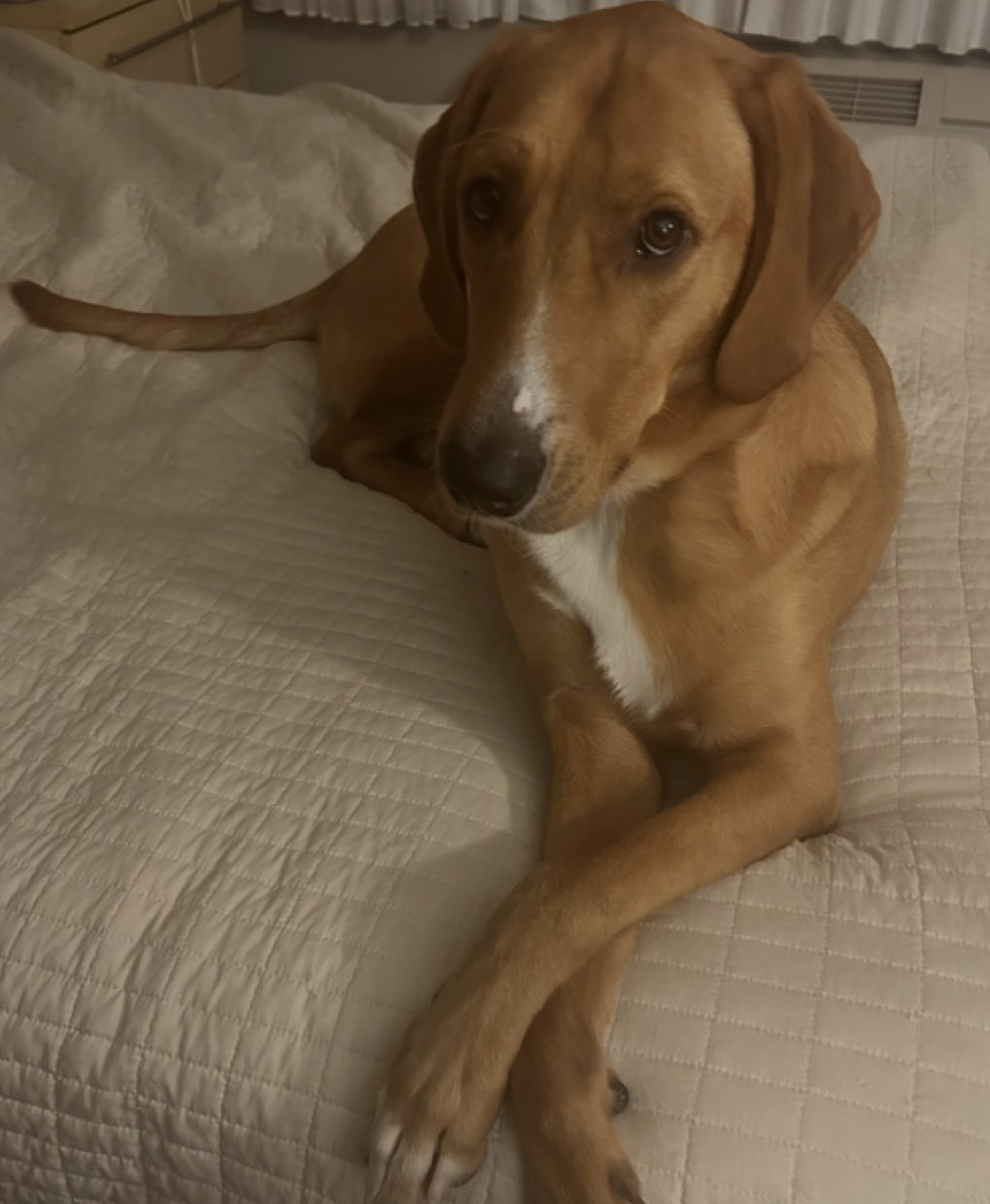 Absolutely. My big homie is JP, my four-year-old, 110-pound dog and self-appointed fierce defender of his mom.
JP has an incredible ability to read people’s energy, and he is quite debonair (peep his pics, this is how he normally sits). He was also ridiculously easy to potty train—one accident in the house as a puppy, and that was basically it.
He actually created his own system for telling me he needs to go outside. He parks himself directly in front of me and gives me his paw. I did not teach him that; he just decided that was our communication system. If I ignore him for too long, I get a short howl to make sure I understand the urgency of the situation.
He loves walks, supervising the neighborhood from the front window, protecting the porch, and taking long car rides. Occasionally, when I come out of a store, I find him sitting in the driver’s seat as though he has decided I am no longer qualified to drive us home.
What book/podcast/movie would you recommend to your friends?
For books, I am a huge fan of FBI Special Agent Aloysius Pendergast. I joke that I sometimes need to keep a dictionary nearby while reading the series, which is probably part of why I enjoy it so much.
My favorite podcast is Therapy for Black Girls—if you know, you know.
Choosing one movie is much harder because I have many favorites, but when I am feeling blue, I can always watch The Wiz. There is something about Michael Jackson, Diana Ross, Nipsey Russell, Lena Horne, Mabel King, Ted Ross, the music, and the whole production that makes it nearly impossible not to sing along and feel a little better by the end.
What would your friends or colleagues be surprised to learn about you?
People are often surprised by the story behind my name. I was named Alsace-Lorraine after my grandmother. She was given the name by her father, who served in France during World War I, when the Alsace-Lorraine region was deeply connected to the conflict. So, my name has been passed down through my family and carries a connection to both my grandmother and my great-grandfather’s history.
I also have more than 30 tattoos, which usually surprises people—especially people who meet “Director Alsace” first!
Another thing people may not know about me is that Christmas is my absolute favorite holiday. I love decorating and it is not unusual to see a tree in every room. Please do not ask how many Christmas trees I have. You insist? Okay, I am happy to share I have eight big Christmas trees and a host of others in varying sizes. Decorating each tree and creating the atmosphere throughout my home is part of what makes the season so special to me. And the lights are so needed during this very dark time of the year.
For more information on the people and programs that make up CES, click here.