Meet the New Minett Professor |

Meet the New Minett Professor-Attorney Langston McFadden
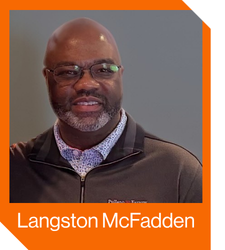 Shock, surprise and profound gratitude. That’s what Langston McFadden says he initially felt when he learned he had been selected to serve as the 2026-2027 Frederick H. Minett Professor at Rochester Institute of Technology. McFadden is a member attorney with Pullano & Farrow PLLC. The Minett Professorship brings distinguished Rochester area professionals to the RIT community to share their knowledge and experience with RIT students, faculty and staff for one academic year. He was selected by former Minetts and appointed to the position this summer by RIT President William Sanders and Vice President and Associate Provost for Access, Engagement, and Success Keith Jenkins.
McFadden has practiced law for more than two decades and has earned numerous honors. He is active with several bar associations, community organization boards and he even finds time to coach youth basketball.
Now he’s ready to share his “coaching and teaching skills” with the RIT community and is finalizing plans now. We asked him several questions beginning with what he hopes the “takeaway” will be with those he interacts with.
Langston McFadden: I hope to immerse myself in the RIT community by engaging with WOCHA and MOCHA students and offering them guidance, advice, and support. I would also like to develop a course that brings together business, philosophy, and the ethical use of artificial intelligence. The course would examine AI’s rapid growth and its role in business transactions and relationships with clients and customers. More broadly, it would ask whether society is better or worse off because of that growth. Human progress has often come through struggle, learning, and ingenuity. If AI begins to do our thinking for us, will we continue to grow as individuals, as a society, and as people?
How long have you been in the legal field and what was it that first sparked your interest?
I have practiced law for more than 23 years, but I knew much earlier that I wanted to become an attorney. Before she passed away, my grandmother proudly showed everyone an essay I had written in third grade declaring that, when I grew up, I would be an attorney—not a lawyer, an attorney. I have always been fascinated by the challenge of developing an idea or position and then defending it vigorously against opposing viewpoints.
You are a member of-and serve in different capacities-with the Rochester Black Bar Association, the Monroe County Bar Association (President) the American Bar Association and the National Bar Association. In addition, you serve on several boards. Please share why you do this-and what your secret is in juggling it all.
Not to sound cliché, but I was raised to believe that much is expected of those who have been given much. In the African American community especially, those of us who have achieved any measure of success have a responsibility to give back. That responsibility includes helping our community and supporting the young adults and children coming up behind us. We should guide them toward opportunities, help them stay on the path to success, and remain a dependable resource when questions or life’s challenges arise.
As a Minett Professor, you may be interacting with a lot of students. Thinking back to your days in college, what advice would you share in terms of making sure their college journey is a successful one?
The best advice I can give students is to stay curious and develop a genuine thirst for knowledge, intellectual growth, and personal development. Take every opportunity to connect with professors, school leaders, and professionals you meet along the way; each interaction can offer a valuable lesson or a new perspective. Socrates taught that the path to wisdom begins by acknowledging what we do not know. Students should never be afraid to say, “I don’t know,” whether the question concerns their education or life more broadly. Recognizing uncertainty opens the door to asking thoughtful questions, seeking answers, and continuing to grow.
If you identify as a “First Gen Student,” any additional advice to share?
Every family has a first-generation student at some point. Being the first in your family to pursue higher education does not mean you have to be the last, nor does it make you any less capable than students whose families have attended college for generations. Always remember that you belong where you are. Your hard work and accomplishments have already shown that you are just as capable as anyone else on campus.
When you are not working, how do you enjoy spending your time?
I consider myself an amateur chef and enjoy preparing a wide range of dishes. In addition to exploring regional American cuisine, I love cooking foods from cultures around the world, including French, Spanish, Portuguese, Italian, Caribbean, and Peruvian.
Last question, what would your friends or colleagues be surprised to learn about you?
Most people do not know - and they are often surprised to learn - that I am actually a very introverted person. I am very uncomfortable in crowds or during speaking events or even at trial, but I took an acting course and a public speaking course while in college and learned to pretend that I was someone else on a stage to overcome the anxiety that I feel in those situations.
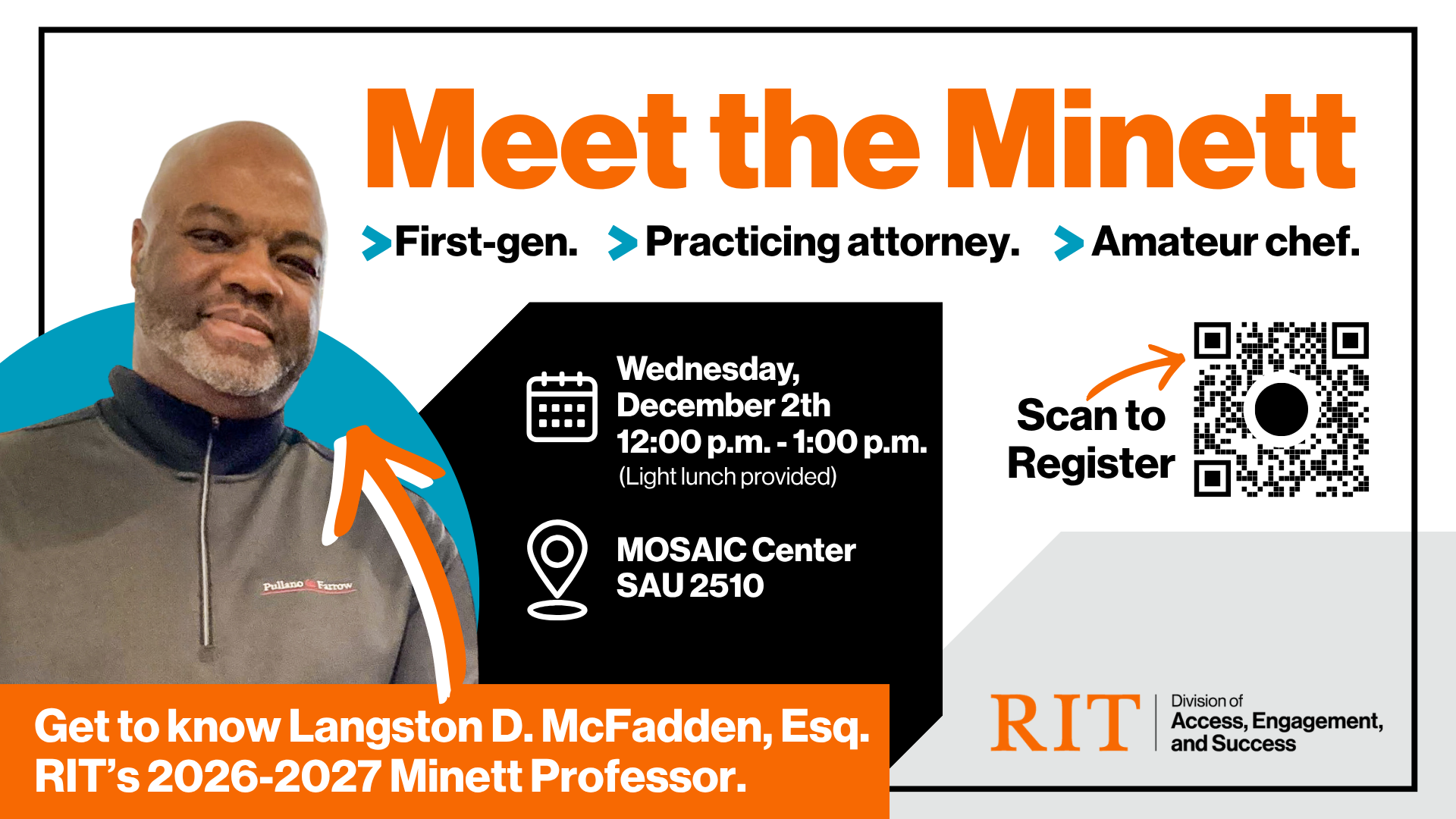
You’re invited to meet RIT Minett Professor Langston McFadden in person! He’s part of a panel discussion for First-Gen Week, this Thursday, November 5, from 5 PM to 6:45 PM in the Bamboo Room. Then, on December 2, McFadden will sit down for what promises to be a lively one-hour chat with AES Journalist in Residence Janet Lomax. It’s happening December 2, beginning at noon in Mosaic Center, SAU 2510. Refreshments will be served. Both events are open to all.