Fundamental Research on Detection and Classification Limits in Spectral Imagery
Principal Investigator(s)
Research Team Members
Chase Canas (PhD)
Scott Brown
Sponsor: National Geospatial-Intelligence Agency (NGA)
Project Description
The aim of this project has been to apply a model-based prediction capability to explore spectral imaging system parameter performance sensitivities and trends with a goal of developing insights into their fundamental limits. During this fourth year of the program, PhD student Chase Canas developed the study framework shown in Figure 1 and applied it to an airborne hyperspectral imaging system looking at detecting subpixel targets in a canonical forest type background.
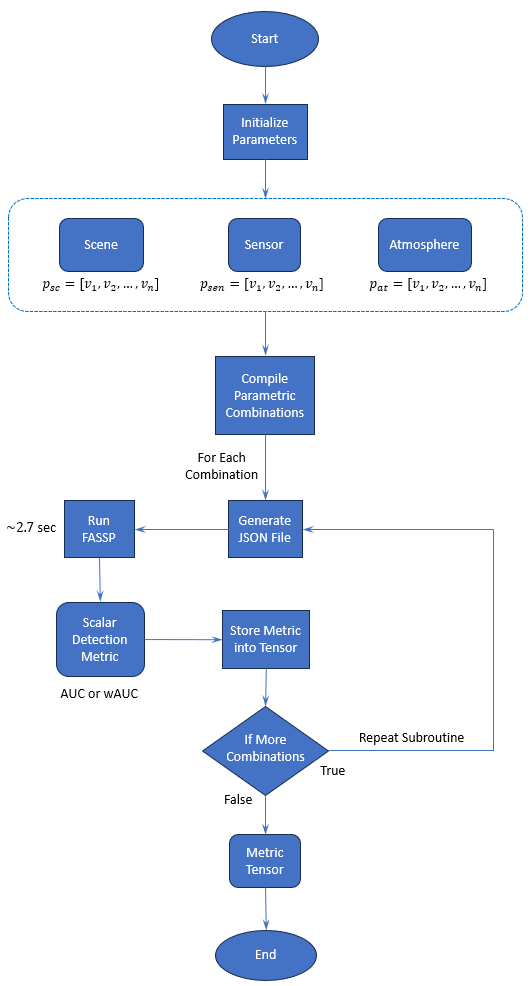
Figure 1: Framework using analytical performance prediction model FASSP to generate tensor cubes of detection performance for range of system parameters.
Figure 2 shows the resulting detection performance cubes showing the dependence of detection probability (as measured by the log-weighted AUC) on system parameters. Canas also developed a method to identify parameter limits as the values that lead to "knees in the curve" beyond which performance changes are minimal. For the airborne case study examined, the most significant parameters and their limits were aerosol visibility (2 to 6 km), target subpixel percentage (15-35%), and background complexity as measured by the t-distribution degree of freedom parameter (3-5). Future work during the upcoming fifth (and final) year includes performing additional validations through empirical data collections and preparing for distribution a version of the performance limit study software.
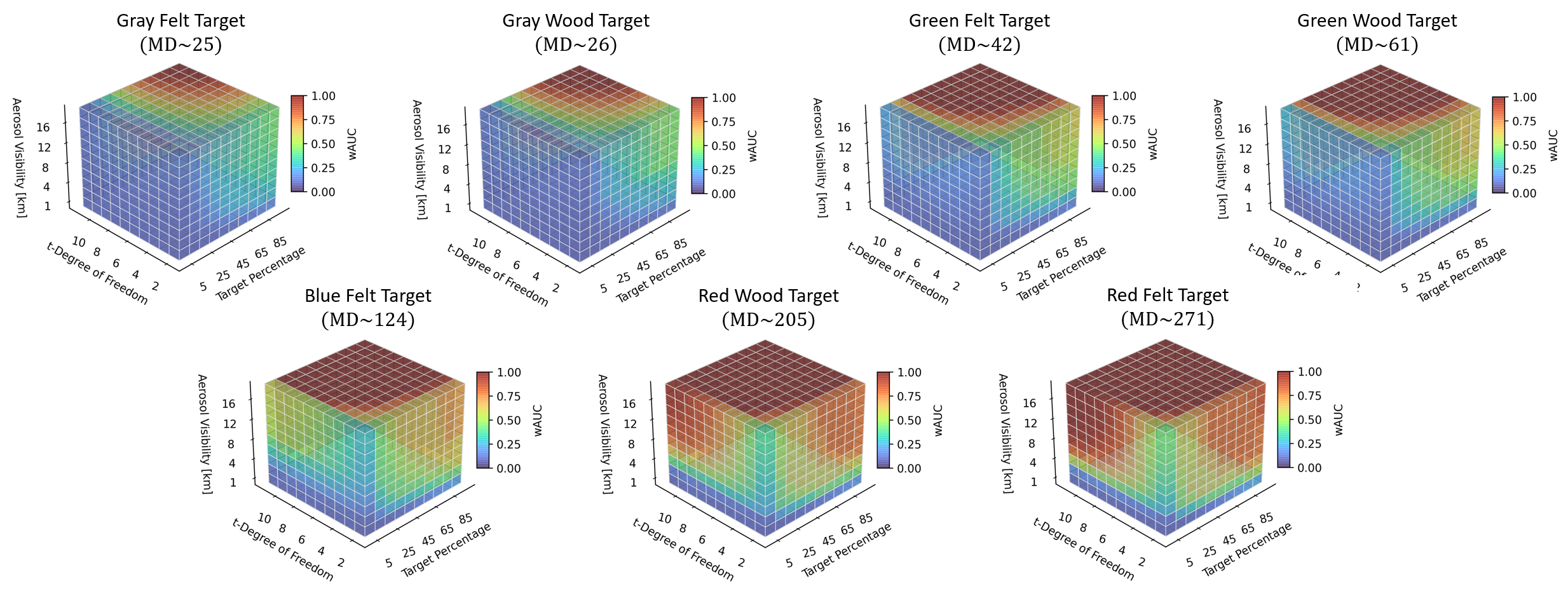
Figure 2: Detection performance cubes showing the log-weighted area under the receiver operating characteristic curve (wAUC) as a function of system parameters. Each cube shows the performance for different targets indexed by their separability from the background as measured by the Mahalanobis Distance - MD. The system parameters represent atmospheric conditions (aerosol visibility), background complexity (t-distribution degree of freedom), and target subpixel percentage.
References
[1] Canas, C. End-to-End Systems Limitations in Hyperspectral Target Detection using Parametric Modeling and Subpixel Lattice Targets for Validation. Thesis, Rochester Institute of Technology, 2025.