HiRes Vineyard Nutrition
Principal Investigator(s)
Research Team Members
Rob Chancia
Timothy Bauch
Nina Raqueno
Mohammad Shahriar
Saif Terry Bates (Cornell U.)
Justine Vanden Heuvel (Cornell U.)
Manushi Trivedi (Cornell U.)
Sponsor: United States Department of Agriculture (USDA)
Project Description
The USA annual grape production value exceeds $6 billion across as many as 1 million acres (>400,000 ha). Grapevines require both macro- and micro-nutrients for growth and fruit production. However, inappropriate application of fertilizers to meet these nutrient requirements could result in widespread eutrophication through excessive nitrogen and phosphorous runoff, while inadequate fertilization could lead to reduced grape quantity and quality. It is in this optimization context that unmanned aerial systems (UAS) have come to the fore as an efficient method to acquire and map field-level data for precision nutrient applications. We are working in coordination with viticulture and imaging teams across the country to develop new vineyard nutrition guidelines, sensor technology, and tools that will empower grape growers to make timely, data-driven management decisions that consider inherent vineyard variability and are tailored to the intended end-use of the grapes. Our primary goal on the sensors and engineering team is to develop non-destructive, near-real-time tools to measure grapevine nutrient status in vineyards. The RIT drone team is capturing hyper and multispectral imagery over both Concord (juice/jelly) and multiple wine variety vineyards in upstate New York.
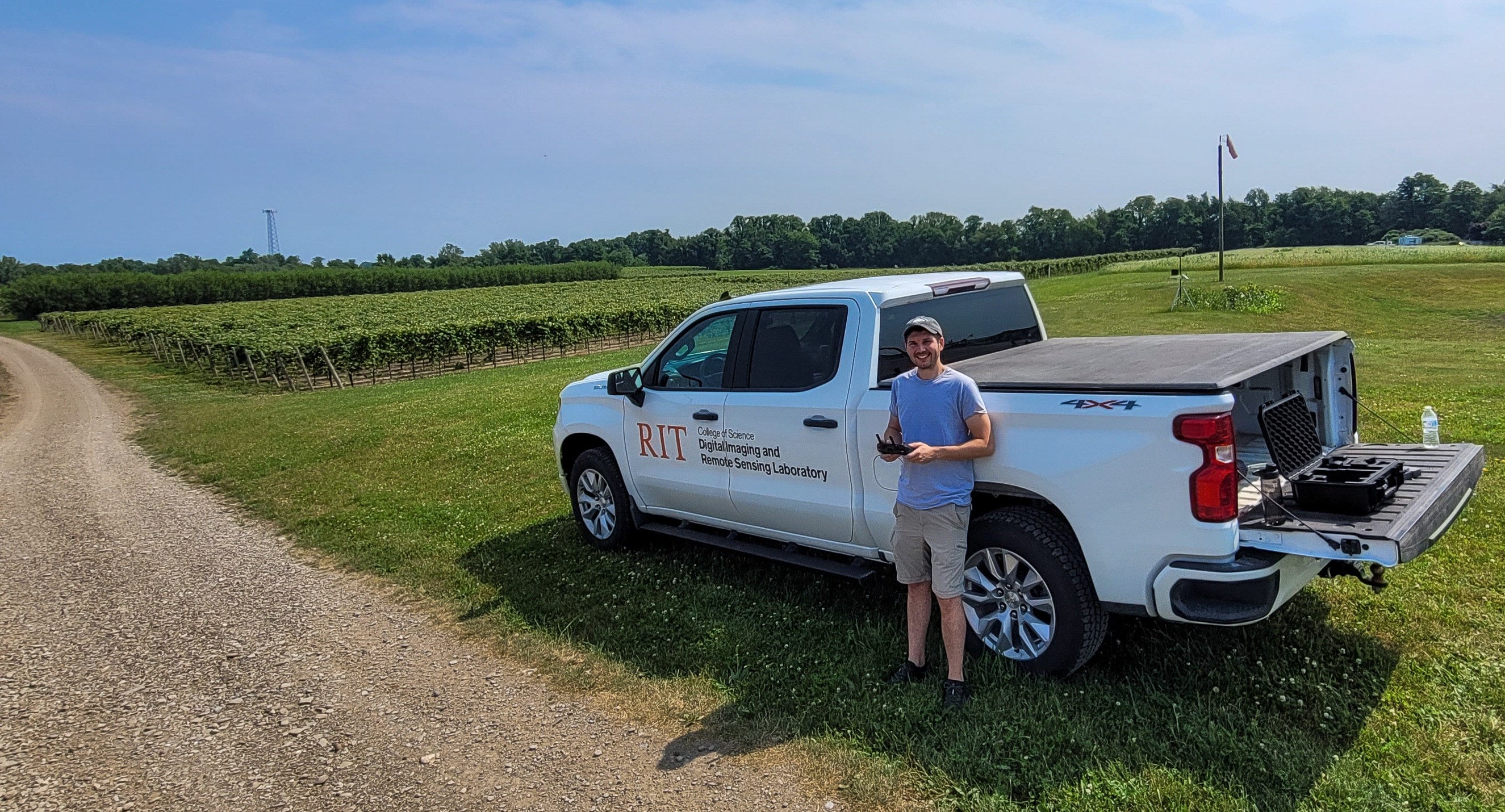
Figure 1: Rob in front of the DIRS truck while monitoring a DJI Mavic 3 Multispectral drone flight over the CLEREL study vineyards in the background. (June 2024)
Over the course of four growing seasons, we have gathered imaging data of grapevines from multiple platforms and modalities coincident with nearly 2000 ground truth nutrition samples. Most imaging data was captured in coordination with field leaf and petiole sampling studies, conducted by Dr. Terry Bates in concord grape vineyards at the Cornell Lake Erie Extension Laboratory (CLEREL). This has resulted in models capable of predicting concentrations of macronutrients, like nitrogen, phosphorous, and potassium, using spectral imagery. In the spring of 2024, the team at CLEREL executed their first variable-rate fertilization based on predictions from the RIT team using the cloud-based GIS application myEfficientVineyard (myEV tool: my.efficientvineyard.com).
The 2024 growing season capped off our final drone data collections for the project (Figure 1). In May of 2025, we presented our progress to the greater HiRes Vineyard Nutrition team and industry advisory committee (Figure 2). The advisory committee invited our group to present during a symposium on vineyard nutrition at the 2026 American Society for Enology and Viticulture National Conference in Boise, Idaho.
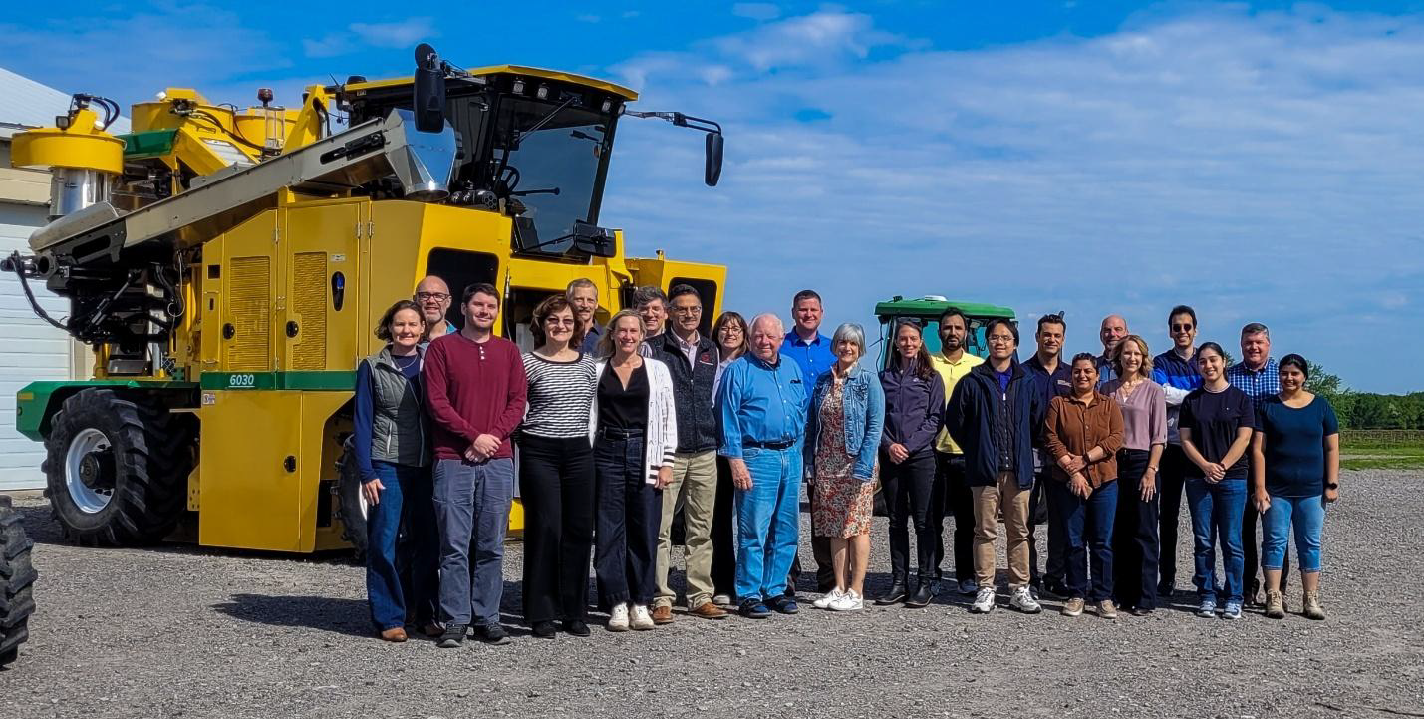
Figure 2: Jan and Rob among the greater HiRes Vineyard Nutrition science teams and advisory committee, posing in front of CLEREL's grape harvester. (May 2025)
References
[1] Chancia, R., Bates, T., Vanden Heuvel, J., and van Aardt, J. Assessing grapevine nutrient status from unmanned aerial system (uas) hyperspectral imagery. Remote Sensing 13, 21 (2021), 4489.
[2] Chancia, R., Vanden Heuvel, J., Bates, T., and van Aardt, J. Unmanned aerial system (uas) imaging for vineyard nutrition: Comparing typical multispectral imagery with optimized band selection from hyperspectral imagery. In AGU Fall Meeting Abstracts (2021), vol. 2021, pp. B55K–1327.
[3] Trivedi, M., Bates, T., Meyers, J. M., Shcherbatyuk, N., Chancia, R. O., Davadant, P., Lohman, R. B., and Heuvel, J. V. Enhancing spatial sampling efficiency and accuracy through box sampling for grapevine nutrient management. In AGU Fall Meeting Abstracts (2024), vol. 2024, pp. IN43B–2263.
[4] Trivedi, M. B., Bates, T. R., Meyers, J. M., Shcherbatyuk, N., Davadant, P., Chancia, R., Lohman, R. B., and Heuvel, J. V. Box sampling: a new spatial sampling method for grapevine macronutrients using sentinel-1 and sentinel-2 satellite images. Precision Agriculture 26, 2 (2025), 35.