L’Ralph In-Flight Instrument Characterization Support
Principal Investigator(s)
Research Team Members
No additional team members
Sponsor:
NASA Goddard Space Flight Center
Project Description
The in-flight characterization and calibration of NASA’s Lucy Ralph (L’Ralph) instrument is essential to a successful science mission. The L’Ralph instrument provides spectral image data of the Jupiter Trojan asteroids from visible to mid-infrared wavelengths from two focal planes sharing a common optical system. The Multispectral Visible Imaging Camera (MVIC) acquires high spatial and broadband multispectral images in the 0.4 to 0.9 micron region. The Linear Etalon Imaging Spectral Array (LEISA) provides high spectral resolution image data in the 1 to 3.8 micron spectral range. The Lucy observatory is currently in flight (phase E) after a successful launch in October 2021 and is in-route to the Jupiter Trojan swarms via multiple Earth Gravity Assists (EGAs). The overall objective of this work is to assist in the continuing characterization and radiometric calibration of the L’Ralph instrument through processing and analyses of in-flight image data. These image datasets are assessed for radiometric and spatial quality. Calibration algorithms are updated as needed to correct any artifacts or radiometric errors found during these image assessments.
The Lucy spacecraft completed its second Earth gravity assist in December 2024, setting up a new trajectory that will take it into the leading Jupiter Trojan asteroid swarm in the coming years. Lucy successfully encountered asteroid 52246 Donaldjohanson in April 2025, with the L'Ralph instrument acquiring several image scans of the object. The PI assisted in image processing of these scans along with characterizing the instrument performance during the encounter. The previously developed de-fringing algorithm developed by the PI was used to compensate for optical fringing artifacts in the L'Ralph/LEISA image data. These correction flat-fields were provided to the Planetary Data System for the standard processing pipeline for science users. The PI will continue to process yearly in-flight calibration data in preparation for upcoming Trojan asteroid encounters.
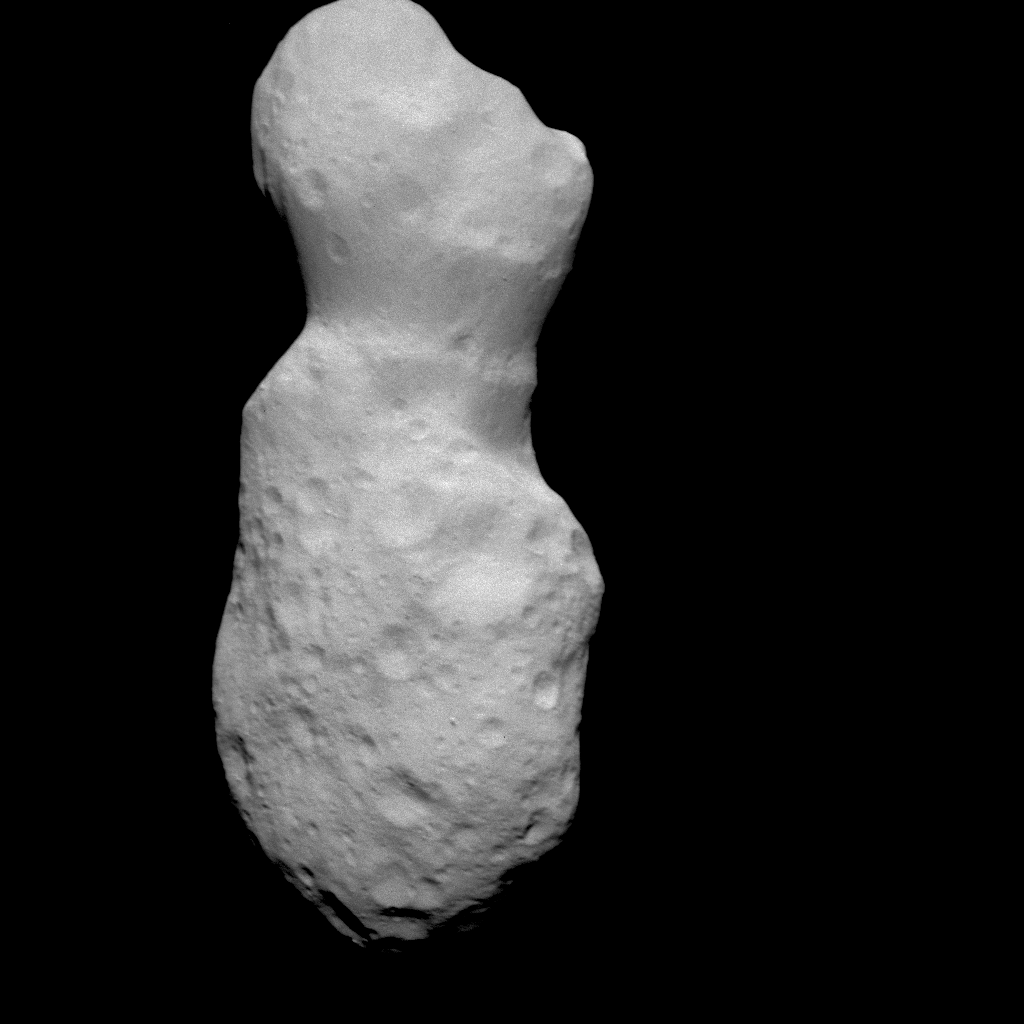
Figure 1: Image of main-belt asteroid, Donald Johanson, acquired by the L’LORRI imager during the close encounter by the Lucy spacecraft in April 2025. Image reproduced by the PI and originally published by NASA in https://science.nasa.gov/image-article/nasas-lucy-spacecraft-images-ast…
References
[1] Levison, H. F., Marchi, S., Noll, K. S., Spencer, J. R., Statler, T. S., Bell III, J. F., Bierhaus, E. B., Binzel, R., Bottke, W. F., Britt, D., et al. A contact binary satellite of the asteroid (152830) dinkinesh. Nature 629, 8014 (2024), 1015–1020.
[2] Simon, A. A., Kaplan, H. H., Reuter, D. C., Montanaro, M., Grundy, W. M., Lunsford, A. W., Weigle, G. E., Binzel, R. P., Emery, J., Sunshine, J., et al. Lucy l ralph in-flight calibration and results at (152830) dinkinesh. The Planetary Science Journal 6, 1 (2025), 7.