Passive Sensing and Image Formation via Starlink Downlink
Project Description
Starlink is a mega constellation of low Earth orbiting (LEO) satellites used to provide broadband internet globally. As of February 2025, there are more than 7,000 Starlink satellites in low Earth orbit (LEO) and 12,000 planned. The user-downlink waveform transmitted by Starlink is a circularly polarized orthogonal frequency division multiplexed (OFDM) signal with 240 MHz of instantaneous bandwidth. In addition to the dense population of satellites providing global coverage and nearly continuous illumination over the most remote locations on Earth, multiple views of an object can be made over a short period of time by exploiting multiple Starlink satellites. This attribute has the potential to greatly increase detection and identification performance. The focus of this research is to provided an initial assessment of the performance of a passive imaging radar system that exploits the high bandwidth down-link signal from Starlink satellites and evaluates its ability to support automatic target recognition (ATR) of military-sized ground vehicles.
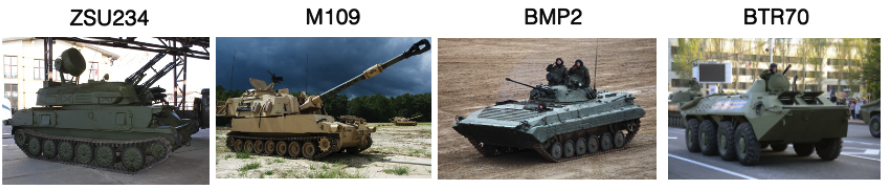
Figure 1: MSTAR target subset used for passive Starlink ATR trade study.
Figure 1 displays the military vehicles used in this study with labels. In order to determine if there is sufficient signal strength for imaging, a link budget analysis was performed for the indirect (transmitter-target-receiver path) and direct (transmitter-to-receiver) signal paths. Assuming an average radar cross section of 10 dBms for the MSTAR military vehicles and an equivalent isotropic radiated power (EIRP) density of -56.2 dBW/Hz.
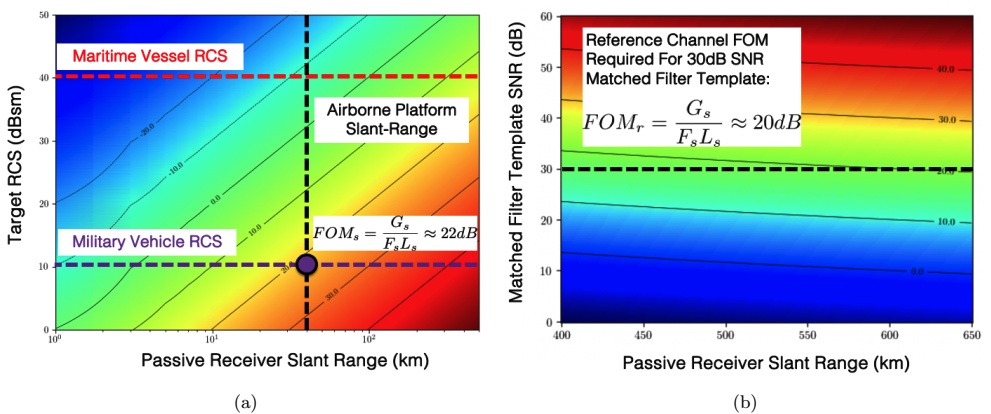
Figure 2: Passive Starlink imaging radar link budget for (a) the surveillance channel and (b) the reference channel. Each indicate the required passive receiver figure-of-merit (FOM) for detection of a point target and high SNR matched filter template, respectively. In both cases, it is assumed that the noise bandwidths, Bs and Br, are equal to the transmit waveform bandwidth (i.e., Bt = 240 MHz).
Figures 2(a) and 2(b) illustrate that the minimum passive receiver figure-of-merit required for typical airborne geometries is 20 dB. Assuming bistatic angles less than or equal to 90.0 degrees for airborne geometries and exploiting the full 240 MHz of instantaneous bandwidth, the range resolution is between 0.62m and 0.88m. While 0.25m resolution is desired for military vehicle ATR, the 15.5 second coherent integration time results in 0.1m cross-range resolution. Therefore, this imaging system only partially resolves the vehicles in Figure 1. To evaluate the potential ATR performance that this novel passive imaging system may provide, bistatic scattering centers were generated in 0.05 degree increments over a 4 degree sector using Xpatch. This resulted in 80 sets of scattering centers for each target per sector. Three target orientations were selected for this analysis: 0 (back-illuminated and front-viewing), 45, and 90 (side-illuminated and side-viewing) degrees. The scattering centers were then used to simulate phase history data and subsequently focused through our python-based image formation processor. Applying principal components analysis to the columnized images and selecting the first three components resulted in the scatter plot shown in Figure 3.
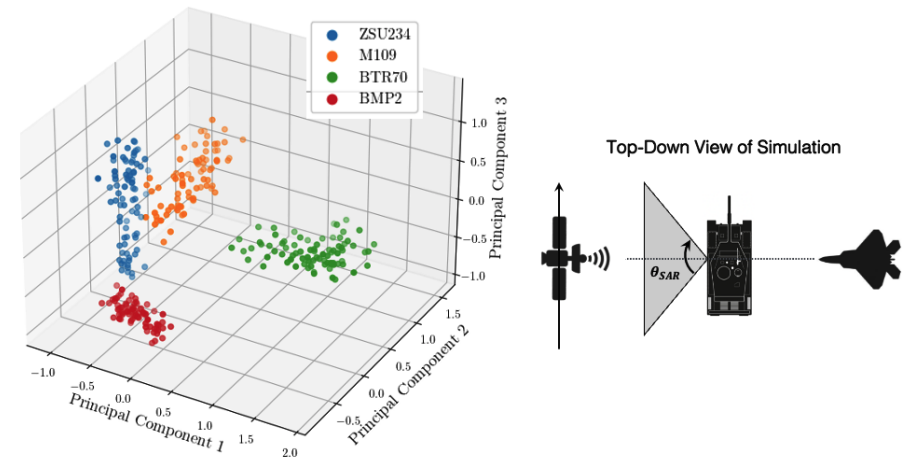
Figure 3: Principal component analysis of targets rotated 90 degrees counter-clockwise around zenith.
This figure demonstrates excellent separation between each of the four classes of vehicles for the 90 degree geometry. Similar results were observed for the other geometries. In summary, Figure 3 demonstrates that this novel passive Starlink imaging system may provide exceptional ATR performance of military-sized vehicles. Future work includes understanding the increase in ATR performance with time by exploiting the multistatic nature of Starlink and evaluating the performance of several popular ATR methods, including one based on deep learning.
References
[1] Albano, J., and Denton, J. Passive sensing and image formation via starlink downlink 2025