Physics-guided Hyperspectral Temporal Imaging for Advanced Biological Sensing
Principal Investigator(s)
Emmett Ientilucci
Research Team Members
Jason Salmanowitz (PhD Student)
David Messinger
Project Description
This project aims to transform biological sensing by developing a physics-guided, manifold learning framework for analyzing hyperspectral temporal data. The objective is to construct a structured, lower-dimensional latent space that captures subtle biological changes over time, particularly in vegetation, by integrating real and simulated data. Current state-of-the-art approaches rely heavily on statistical models and PCA/ICA-based dimensionality reduction (Sicong et. al. 2019). These methods often treat hyperspectral cubes independently, lack temporal modeling, and fail to incorporate physical constraints, leading to limited interpretability and generalization. This project addresses these limitations by combining manifold learning with physics-based modeling (e.g., PROSPECT, DIRSIG). The proposed framework will analyze and model changes in the latent space, enabling the detection of biologically meaningful changes while reducing computational complexity.
While manifold embeddings are often used in change detection for the purpose of dimensionality reduction and to decorrelate hyperspectral imagery (Erturk and Gulsen 2021), never before has the graph structure of the embedding itself been used to identify changes in hyperspectral images. The focus of this project thus far has been decomposing the graph corresponding to a hyperspectral image into component eigenvectors and eigenvalues, then using the eigenvalues as feature vectors on which to perform change detection. Early results have demonstrated that non-linear manifold embedding ISOMAP (Tenenbaum et. al. 2000) outperforms linear embeddings such as PCA for identifying leaf senescence in time-series hyperspectral imagery. These results will be presented at Frontiers in Optics 2026 and are shown in accompanying figure. Additionally, a metric has been developed (the "Eigenvalue Discounted Manhattan Distance") which has been shown, using the eigenvalue spectra of hyperspectral images as inputs, to outperform spectral angle mapper for the purposes of identifying plant disease in hyperspectral vegetation imagery. Work detailing this metric is pending conference acceptance. Future work on this project involves leveraging this new metric for multi-temporal data in order to perform change detection at earlier stages of vegetation disease progression.
Figures and Images
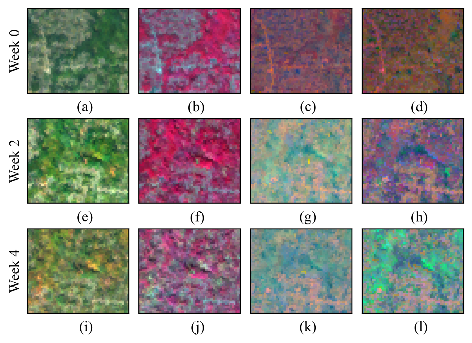
RGB images from hyperspectral forest imagery collected over Greece, NY over a four-week period (a, e, and i), false-color infrared images of the scenece (b, f, and j) false color images generated from principal components 2, 4, and 5 of the PCA embedding (c, g, and k), and false color images of the hyperspectral imagery from latent dimensions 2, 4, and 5 of the ISOMAP embedding (d, h, and l). Note that leaf senescence, as shown by the color green in the false color infrared imagery, is closely tracked by the green portions of the false color ISOMAP images. The false color ISOMAP images are also able to detect regions with less senescence visible in the RGB imagery that are masked by other features in the false color infrared imagery.