Unexploded Ordinance (UXO) and Landmine Detection using Drones and Multi-modal Imaging
Principal Investigator(s)
Research Team Members
Sagar Lekhak (Ph.D.)
Sponsor:
Peter Blacksberg
Project Description
It has been noted that explosive ordnances (EOs) have killed or injured 7073 people worldwide in 2020 alone. Recent estimates show that there are more than 100 million pieces of explosive ordnance worldwide unaccounted for. Moreover, the leading cause of civilian casualties in Ukraine, for example, is antivehicle and antipersonnel land mines. In addition to the large amounts of EO still prevalent, it is estimated that, using current technology, removal and clearance of land mines alone could take up to 1100 years. This is clearly unacceptable. The issue will soon manifest itself when the Ukraine war draws to a close.
Project Status: Recently, we collected landmine data at the Center for Fire and Explosives, Forensic Investigation, Training and Research (CENFEX) in Oklahoma. The seeded test field had 143 diverse items, including inert landmines, submunitions, UXOs, and IED’s. The team spent one week collecting data with hyperspectral, multispectral, LiDAR, SAR, Thermal, and metal detector sensors (i.e., the EM61Lite). We analyzed the metal detector data, where finding were published in the journal, Remote Sensing. We found that while airborne systems, like the EM61Lite, shows promise for landmine and UXO detection, their current limitations pose challenges to their integration into technical demining workflows. Our study demonstrated that airborne metal detection systems could achieve results similar to tried-and-true manual handheld methods, with the added benefit of significantly faster surveys—up to ten times faster.
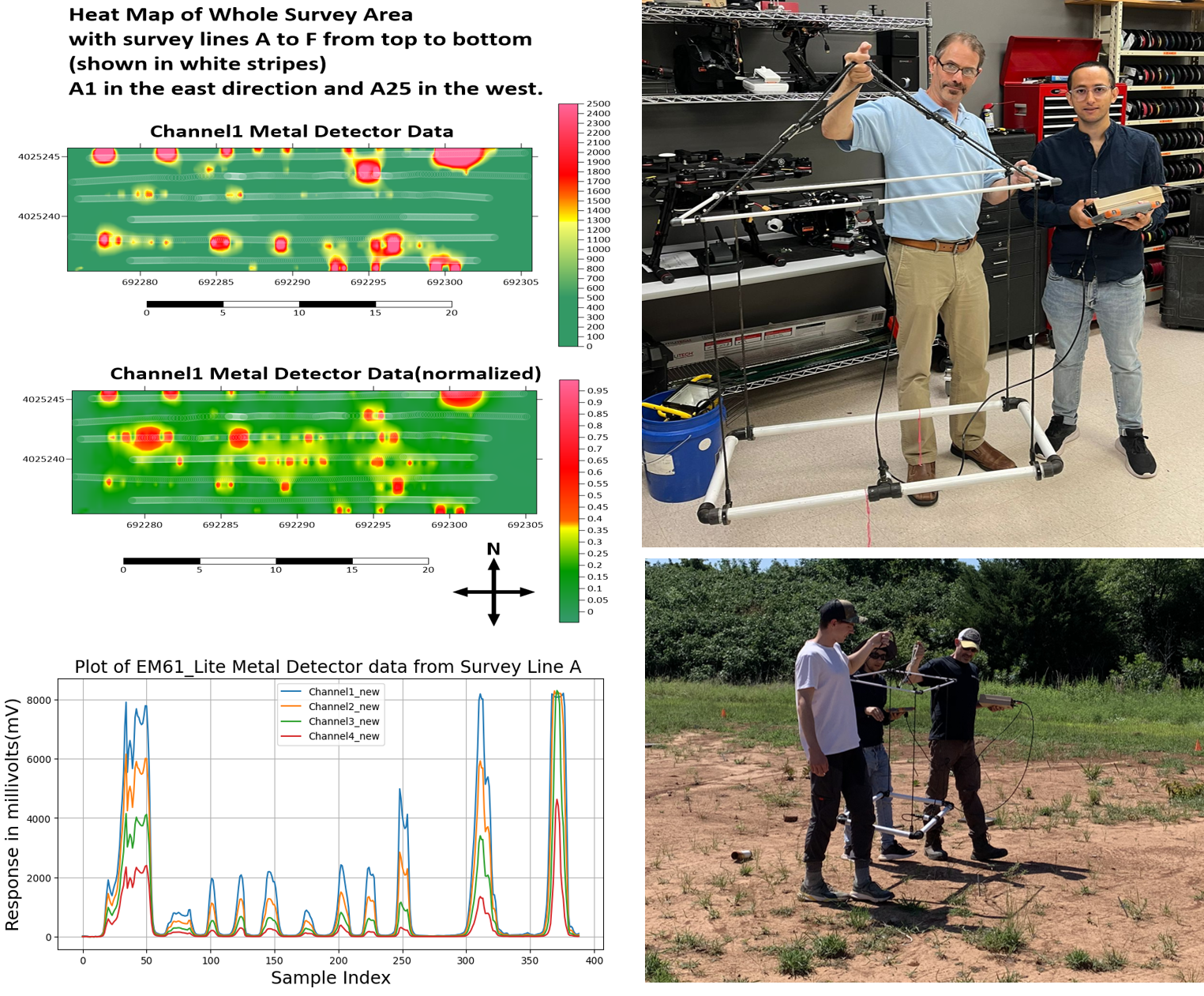
Figure 1: (left) Photo from the GICHD global humanitarian demining meeting in Geneva, Switzerland. The yellow circle shows the location of PI Emmett Ientilucci. (right) Condensed grid for visualization of placement of each UXO/Landmine item at the CENFEX (Oklahoma State) seeded test field. Objects were scattered (in a known manner) throughout a large area. Some were buried at known depths while others were left on the surface. A small sampling of objects includes M6A1 and M83 rockets, pipe bombs, M228 frag and M18 grenades, riot grenades, PFM-1 landmines, shell casing, IED’s, various submunitions, anti-personnel mines, and various clutter to act as confusers.
References
[1] Lekhak, S., and Ientilucci, E. Advancing landmine and uxo detection: A comparative analysis of uav-based and handheld metal detectors. In Applied Geophyical Union (Washington, DC, December 2024), AGU, Ed., AGU.
[2] Lekhak, S., Ientilucci, E., and Brinkley, T. Viability of substituting handheld metal detectors with an airborne metal detection system for landmine and unexploded ordnance detection. Remote Sensing 16, 24 (2024), 4732.