
Ashish Agrawal
Assistant Professor, Electrical, Computer, and Telecommunication Engineering Tech
Dean’s Office
College of Engineering Technology
585-475-2147
Ashish Agrawal
Assistant Professor, Electrical, Computer, and Telecommunication Engineering Tech
Dean’s Office
College of Engineering Technology
585-475-2147
Currently Teaching
EEET-115
Circuits I
3 Credits
This course develops student skills to analyze and design DC and AC circuits. DC topics include resistance; Ohm’s Law; current and voltage division; simplification of series, parallel, and series-parallel circuits; Kirchhoff’s Voltage and Kirchhoff’s Current Laws, and nodal analysis. Additional circuit analysis concepts covered include Thevenin theorem, superposition theorem, and R-C and R-L transient analysis. AC circuit analysis topics include sinusoidal waveforms as forcing functions; basic resistive, capacitive, and inductive elements; phasors; average power and series AC circuit analysis. Reactance and impedance are introduced and used to solve AC series circuits.
EEET-116
Circuits I Lab
1 Credit
This laboratory develops skills and practice in the construction, measurement, and analysis of DC and introductory AC circuits. Standard laboratory equipment is introduced and utilized to measure resistance, voltage, and current in basic and relatively complex circuit configurations. Measurements are employed to demonstrate Ohm's Law, Kirchoff’s Voltage Law, Kirchoff’s Current Law, current division, and voltage division. Circuit simulation software is used to support calculations and establish a baseline for comparison. Students collaborate within teams during the laboratory experience.
EEET-125
Circuits II
3 Credits
This course develops the skills to analyze and design AC circuits used in electrical systems. Topics include R-L and R-C transient analysis in relation to the differential equation; reactance and impedance; series, parallel, and series-parallel R-L-C circuits; mesh and nodal analysis. Additional circuit analysis concepts covered include Norton, Maximum Power Transfer, and Superposition theorems. AC power and power factor, resonance, frequency response, and bandwidth are also covered. Transformers are introduced.
EEET-126
Circuits II Lab
1 Credit
This laboratory develops skills and practice in the construction, measurement, and analysis of AC circuits. The function generator and oscilloscope are used to measure resistance, voltage and current in a variety of circuit configurations. Measurements are employed extensively to verify Ohm's Law; Kirchhoff’s Voltage and Kirchhoff’s Current Laws and to demonstrate current and voltage division. Circuit simulation software is used throughout to support calculations and establish a baseline for comparison. Students collaborate within teams to research technology areas of curiosity, observe trends about the changing world and inform their peers via verbal presentations.
ESHS-788
Thesis Planning
3 Credits
Students will rigorously develop their thesis research ideas, conduct literature reviews, identify and plan methodologies, prepare schedules, and gain a clear understanding of the expectations of the faculty and the discipline. Each student will be required to prepare a committee approved thesis research proposal and may begin work on their thesis.
PHYS-790
Graduate Research & Thesis
1-4 Credits
Graduate-level research by the candidate on an appropriate topic as arranged between the candidate and the research advisor.
PHYS-791
Continuation of Thesis
1 Credit
Graduate-level research by the candidate on an appropriate topic as arranged between the candidate and the research advisor.
PHYS-799
Physics Independent Study
1-4 Credits
This course is a faculty-directed tutorial of appropriate topics that are not part of the formal curriculum. The level of study is appropriate for a graduate-level student.
RMET-790
Thesis
3 Credits
Thesis is based on thorough literature review and experimental substantiation of a problem, by the candidate, in an appropriate topic. A written proposal has to be defended and authorized by the faculty adviser/committee. The proposal defense is followed by experimental work, a formal written thesis, and oral presentation of findings. The candidate should have completed the requisite courses for the program before enrolling for the thesis.
In the News
-
August 27, 2026
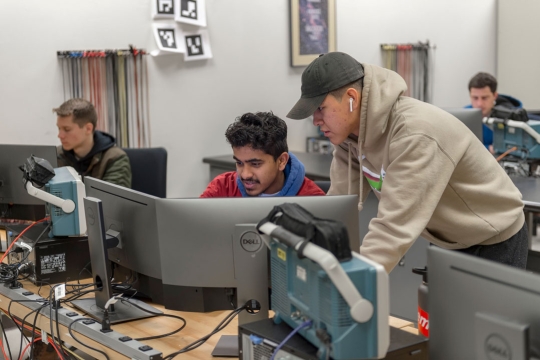
RIT researchers study teamwork skills in engineering education
The new research hub will improve engineering education to close skills gaps and address how artificial intelligence is impacting the workplace.
-
February 17, 2025

Engineering technology faculty addressing green skills shortage in engineering education through new grant
Integrating the development of eco-friendly practices with social and economic facets of sustainability, could further transform engineering education by equipping future engineers with the skill set required for the profession today.