Universal AI

Universal AI is a new research traineeship program established through a partnership between Gallaudet University and RIT.
About Universal AI
Artificial Intelligence (AI) is increasingly integrated into daily life with significant impacts on both individuals and society. As such, it is important that AI is accessible to all users. However, ensuring that everyone can utilize AI systems presents research challenges and requires new ways of training the next generation of AI developers and researchers. This National Science Foundation Research Traineeship Institutional Partnership Pilot (NRT-IPP) award, led by Gallaudet University and Rochester Institute of Technology (RIT), will create an integrated and interdisciplinary training curriculum for a new master’s program track to develop innovative skills for creating broadly accessible AI. It will address gaps in graduate training to ensure that future AI developers consider the full range of users’ sensory abilities. The project anticipates training 100 Master of Science (MS) students, including 25 funded trainees, from Accessible Human-Centered Computing, Neuroscience, Education, Cognitive Science, and related STEM disciplines.
Credit: Carlos Ortiz, RIT University Photographer
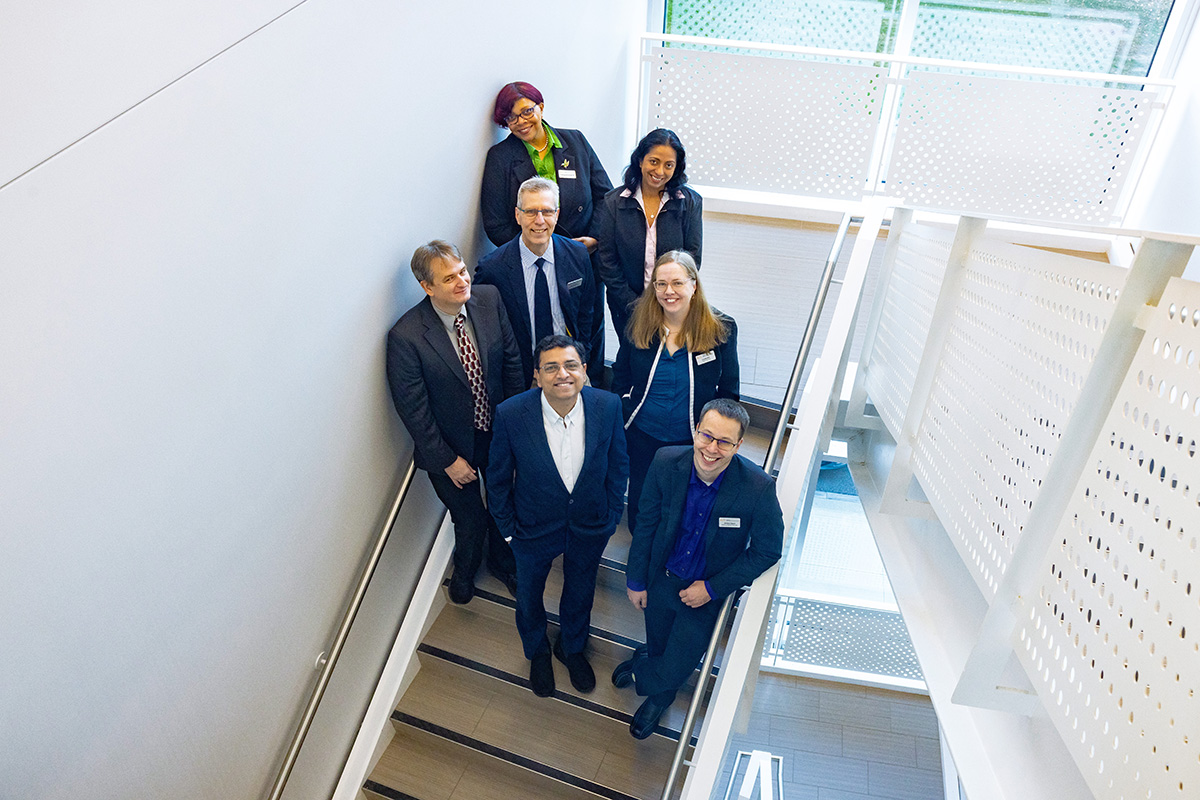
Universal AI Team
Back row: Angelique Armstrong (Project Coordinator, RIT), Charmaine Mendonsa (Project Coordinator, GU)
Middle row: Esa Rantanen (RIT team), Cecilia Alm (Co-PI, RIT lead)
Front row: Christian Vogler (Co-PI, GU), Raja Kushalnagar (Lead PI, GU), Jamison Heard (RIT team)
Missing from RIT in photo: Reynold Bailey (Co-PI, RIT), Ferat Sahin (RIT team)
This material is based upon work supported by the National Science Foundation under Award No. DGE-2440601. Any opinions, findings, and conclusions or recommendations expressed in this material are those of the author(s) and do not necessarily reflect the views of the National Science Foundation.