
MD Ahasan Habib
Assistant Professor, Mechanical and Mechatronics Engineering Tech
MD Ahasan Habib
Assistant Professor, Mechanical and Mechatronics Engineering Tech
Bio
Dr. Habib achieved his Bachelor's, Master's, and Doctoral degrees in the field of Industrial and Manufacturing Engineering. His research revolves around digital intelligent manufacturing, particularly focusing on Additive Manufacturing (AM). He has put forth numerous methods to enhance the efficiency of resource usage within the AM technique using his industrial and manufacturing background. His primary interest lies in the application of this manufacturing approach to bio-manufacturing. To achieve the advanced manufacturing systems capable of producing large-scale functional tissue scaffolds, he is investigating suitable biomaterials and related process parameters to ensure seamless coordination between interconnected manufacturing steps using mechatronics, robotics, and automation. Additionally, he is actively incorporating machine learning principles to identify optimal digital manufacturing parameters and materials.
Education
- Ph.D. in Industrial and Manufacturing Engineering (IME), North Dakota State University, USA.
- B.Sc. and M.Sc. in Industrial and Production Engineering (IPE), Bangladesh University of Engineering and Technology (BUET).
Select Scholarship
US Patent
- Khoda, Bashir, Nazmul Ahsan, Md Habib, and X. I. E. Ruinan. "Automatic metal wire bending (AMWB) apparatus to manufacture shape conforming lattice structure with continuum design for manufacturable topology." U.S. Patent 11,752,534, issued September 12, 2023.
Journal Articles
- Rohauer R., Schimmelpfennig K., Woods P., Sarah R., Habib A., Lewis C.L. 2026, Photo-crosslinkable hybrid hydrogels for high-fidelity direct-write 3D printing. J. Functional Biomaterials.
- O’Neil J, Villasmil LA, Woods P, Rohauer R, Habib A., 2026. Six-axis robotic extrusion of hybrid hydrogels for biomimetic airway model fabrication. J. Biomat App (Sage).
- Pervaiz S., Goyal K., Bae J.H., Habib A., 2026. Foundations for Future Prosthetics: Combining Rheology, 3D Printing, and Sensors. J. Manuf. Mater. Process.
- Limon, S.M., Sarah, R., & Habib, A., 2025. Integrating decision trees and clustering for bioink rheology optimization. J. Manuf. Sci. Eng.
- Sarah R., Schimmelpfennig K., Rohauer R., Lewis C.L., Limon S.M., Habib A., 2025. Machine learning–driven property prediction of hybrid hydrogel bioinks for extrusion-based 3D bioprinting. Gels.
- Sarah, R., Rohauer, R., Schimmelpfennig, K., Limon, S. M., Lewis, C. L., & Habib, A., 2025. Data-driven optimization of bioink formulations for extrusion-based bioprinting. J. Manuf. Sci. Eng.
- Xu Y., Sarah R., Habib A., Liu Y., Khoda B. 2024. Constraint-based Bayesian optimization of bioink precursor. Biofabrication.
- Habib, A., R. Sarah, S. Tuladhar, B. Khoda, S.M. Limon, 2024. Modulating rheological characteristics of bio-inks for enhanced bioprinted scaffold fidelity. Bioprinting.
- Quigley, C., Limon, S., Sarah, R., & Habib, M. A. 2023. Factorial Design of Experiment Method to Characterize Bioprinting Process Parameters to Obtain the Targeted Scaffold Porosity. J. of 3D Pri. & AM.
- Mankowsky,J., Quigley, C., Clark, S., & Habib, M. A. 2023. Identifying Suitable 3D Bio-Printed Scaffold Architectures to Incubate in a Perfusion Bioreactor: Simulation and Experimental Approaches. J. of Medical Devices.
Awards and recognitions
1. Research student received best poster talk award at Rochester Section Inc. of the American Chemical Society, 2025.
2. Finalist of the best Student Research Paper, IISE, 2022
3. Best track paper award, IISE, 2018.
4. NSF student travel award for SEM-NAMRC and SFF 2018.
5. Best poster paper awards (3rd) twice (2017 & 2018) at IEEE red river valley poster competition
Currently Teaching
In the News
-
February 17, 2026
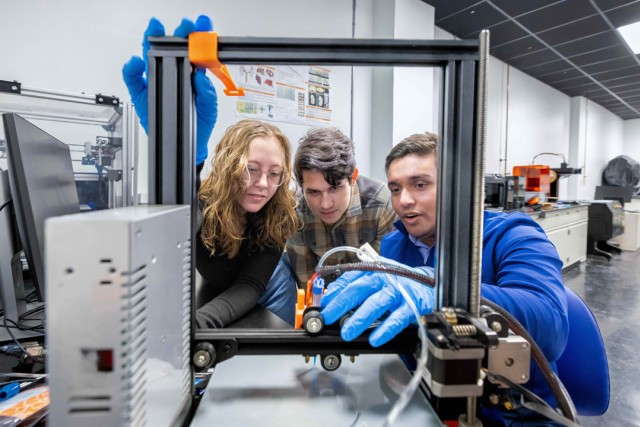
RIT researchers formulate a new “recipe” for stronger bio-printed tissue
Researchers have developed a solution to finding a compatible gel medium to host human cells and a device that can print the delicate cells safely.