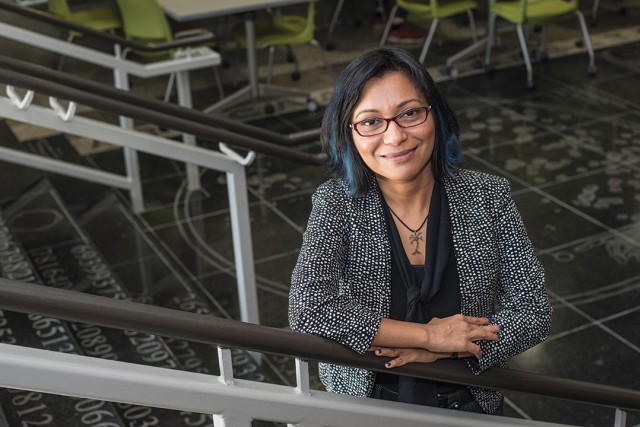
Moumita Das Headshot

Moumita Das

Professor

School of Physics and Astronomy
College of Science
Director, Physics Ph.D. Program
Program Faculty, School of Mathematics and Statistics
Fellow, American Physical Society

Office Location
Office Mailing Address
School of Physics and Astronomy,\n Rochester Institute of Technology,\n Rochester, NY 14623

Moumita Das

Professor

School of Physics and Astronomy
College of Science
Director, Physics Ph.D. Program
Program Faculty, School of Mathematics and Statistics
Fellow, American Physical Society

Education

BS, MS, Jadavpur University (India); Ph.D., Indian Institute of Science (India); Postdoc, Harvard University, UCLA, Vrije Universiteit Amsterdam (The Netherlands)

Bio

Biological cells and tissues are soft and squishy yet highly resilient and robust. My research seeks to uncover the physical principles that enable their remarkable properties and their adaptability. Using statistical and soft matter physics, mechanics, and quantitative biology, we create mathematical models and biophysics theories for network-like structures such as the cytoskeleton of cells and extracellular matrix of soft tissues. Our analytical and computational methods study their emergent properties and dynamics, aiming to understand the biophysical rules of life and replicate these in synthetic materials with experimental collaborators. I am a Fellow of the American Physical Society. 


Areas of Expertise

Currently Teaching

MATH-790
0 - 9 Credits
Masters-level research by the candidate on an appropriate topic as arranged between the candidate and the research advisor.
PHYS-450
1 Credits
This course is a preparation for the two-semester physics capstone project to be carried out in the following year. It includes selection of a project and faculty mentor, preparation of a feasibility study, preparation of a paper, and a public oral presentation.
PHYS-451
3 Credits
In collaboration with faculty mentor(s), students will carry out the first phase of an experimental, theoretical, or computational physics research project, will prepare an interim paper, and will present a short talk on their progress to physics faculty and students. The projects are those planned during the capstone preparatory course taken during the prior Spring semester.
PHYS-452
3 Credits
In collaboration with faculty mentor(s), students will carry out the final phase of an experimental, theoretical, or computational physics research project, will prepare a written paper and present an oral report on their progress to physics faculty and students. The projects are those planned during the capstone preparatory course taken during the prior Spring semester and commenced during the prior Fall semester.
PHYS-601
1 Credits
This course is the first in a two-semester sequence intended to familiarize students with research activities, practices, and ethics in university, government, industry, and other professional research environments and to introduce students to research tools and skill sets important in various professional environments. As part of the course, students are expected to attend research seminars sponsored by the School of Physics and Astronomy and participate in regular journal club offerings. The course also provides training in scientific writing and presentation skills. Credits earned in this course apply to research requirements.
PHYS-602
1 Credits
This course is the second in a two-semester sequence intended to familiarize students with research activities, practices, ethics in university, government, industry, and other professional research environments and to introduce students to research tools and skill sets important in various professional environments. The course is intended to help students develop a broad awareness of current professional and funding opportunities. As part of the course, students are expected to attend research seminars sponsored by the School of Physics and Astronomy, to participate in regular journal club offerings, to engage in outreach activities, and to participate in visits to regional laboratories and companies. The course provides training in proposal writing and presentation skills. Credits earned in this course apply to research requirements.
PHYS-640
3 Credits
This course is a graduate-level study of the concepts and mathematical structure of statistical physics. Topics include the microcanonical, canonical, and grand-canonical ensembles and their relationships to thermodynamics, including classical, Fermi, and Bose-Einstein statistics. The course includes illustrations and applications from the theories of phase transitions, solids, liquids, gases, radiation, soft condensed matter, and chemical and electrochemical equilibria. The course also treats non-equilibrium topics including the kinetic theory of transport processes, the theory of Brownian motion, and the fluctuation-dissipation theorem.
PHYS-790
1 - 4 Credits
Graduate-level research by the candidate on an appropriate topic as arranged between the candidate and the research advisor.
PHYS-791
0 Credits
Graduate-level research by the candidate on an appropriate topic as arranged between the candidate and the research advisor.

In the News