
Stefan Schulze
Assistant Professor, Biology
Stefan Schulze
Assistant Professor, Biology
Education
BS, University of Potsdam, Germany; Ph.D., University of Munster, Germany
Bio
My research and expertise in the fields of proteomics, bioinformatics, and cell biology, focus on understanding protein glycosylation in prokaryotes. This interdisciplinary work aims to integrate advanced proteomics techniques with computational tools and cell biological assays, allowing for a comprehensive analysis of glycoproteins. This system-wide approach is crucial for unraveling the complexities of protein glycosylation, a post-translational modification that is highly diverse in prokaryotes (comprising bacteria and archaea). Since the importance of protein glycosylation in health and disease has been shown broadly, shedding light on the roles of glycoproteins in prokaryotes will open new paths to biomedical and biotechnological applications.
Collaboration and openness are central to the philosophy of the Schulze lab. We are committed to making our data and bioinformatic tools openly available to the scientific community, adhering to FAIR data sharing principles. Furthermore, we value a diversity of perspectives and background that drive innovation and discovery.
My own academic journey as a first-generation college student began in Germany at the University of Potsdam (B.S. in Biochemistry in 2010) before completing my further degrees at the University of Muenster (M.S. in 2013, Ph.D. in 2017). As an international scholar, I became a postdoctoral scholar at the University of Pennsylvania in 2017. In 2022, I started the Schulze lab at RIT. During these times I have worked on phage-bacteria interactions, microalgal proteomics, archaeal cell shape and biofilm formation, as well as bioinformatic tool development. Across my career stages, I have benefited not only from this interdisciplinary expertise, but also from exceptional mentors, and I am dedicated to mentoring the next generation of scientists in the same spirit.
For more information, please visit the Schulze lab website.
Select Scholarship
Currently Teaching
In the News
-
November 12, 2025
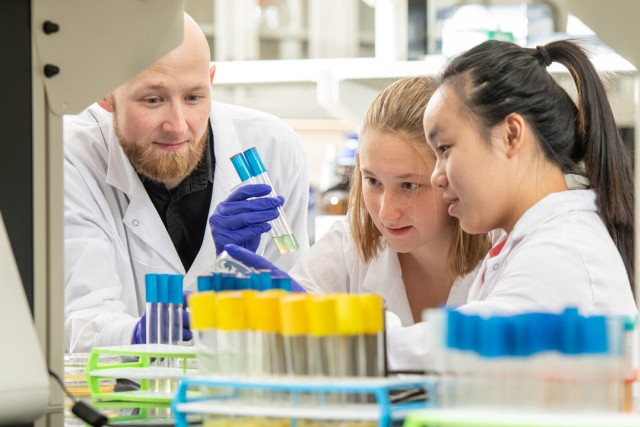
Stefan Schulze’s lab aims to build the foundation for new biomedical treatments
Backed by an award from the National Institutes of Health, Assistant Professor Stefan Schulze is using his expertise in the structure and function of proteins to work with a bacterial pathogen commonly associated with antibiotic resistance.