Stefan Schulze’s lab aims to build the foundation for new biomedical treatments
Assistant professor received NIH funding for his work in proteomics
Carlos Ortiz/RIT
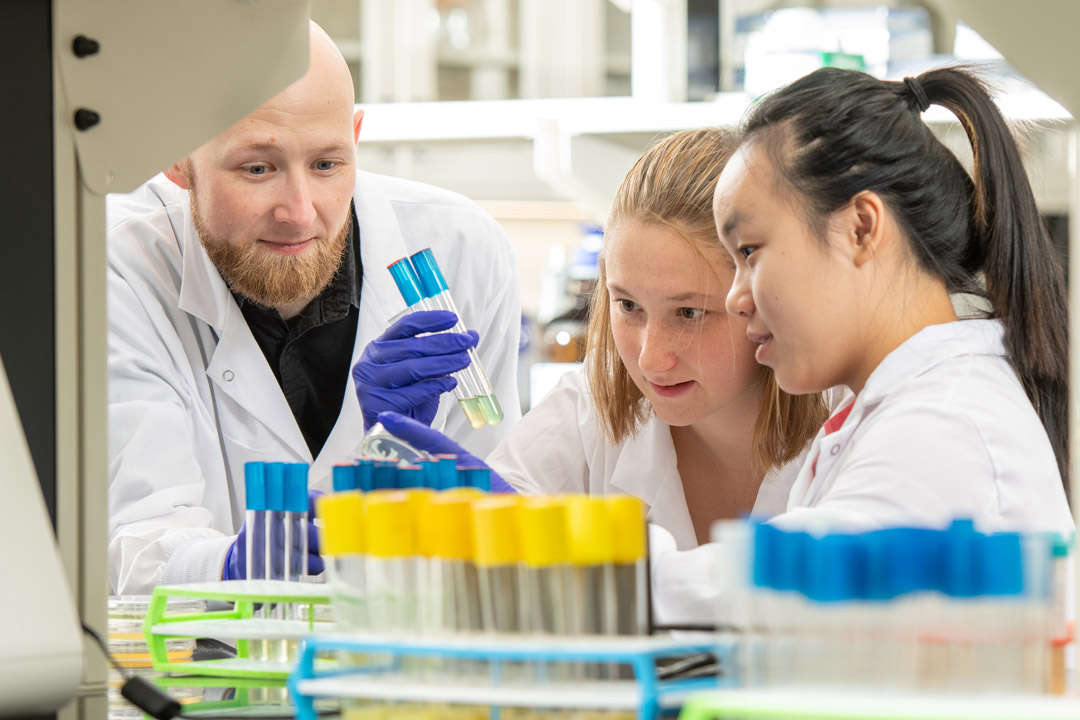
Assistant Professor Stefan Schulze, left, advises undergraduate students in his lab. Both Lorelei Robinson, biotechnology and molecular bioscience, middle, and Chenxin Wang, biomedical sciences, right, gain valuable hands-on experience learning about proteomics.
Stefan Schulze, assistant professor in the Thomas H. Gosnell School of Life Sciences, is working at the molecular level to hopefully provide targets for new biomedical treatments.
Backed by an award from the National Institutes of Health, Schulze is using his expertise in the structure and function of proteins to work with a bacterial pathogen commonly associated with antibiotic resistance. By looking into the sugar modifications of the proteins, or protein glycosylation, the goal is to help show which glycoproteins play vital roles in the formation of biofilms and in withstanding antibiotics.
Understanding the complete working of proteins in a cell or organism provides a strong starting point for discoveries in biomedicine. This field, called proteomics, is named so for its combination of proteins and genomics. It is a relatively new field that has only existed for the past 50 years and combines methods from molecular biology, biochemistry, and bioinformatics. Because of its interdisciplinary nature, proteomics relies heavily on student involvement from various majors to help the field grow.
Students are essential in Schulze’s research and get hands-on experience in the lab and in working through computations and datasets that are central to the interdisciplinary nature of proteomics. The lab currently includes students studying biotechnology and molecular biology, biology, biomedical sciences, bioinformatics and computational biology, applied statistics and data analytics, computer science, and software engineering.
“The combination of undergraduates and master’s students is an important component of the work,” said Schulze. “They are at the forefront.”
Collaboration with other experts and institutions is vital to the field, too. In another research project, funded by the National Science Foundation, Schulze is working alongside Kylie Allen, a researcher at Virginia Tech, to better understand the process of methane production in specific archaea (single-celled microorganisms). Modifying these microorganisms could increase the yield of methane, improving their potential to be used as an energy source.
The goal of the project is to see how nickel is involved in methane production by examining the pathways of how nickel is taken up by the cell and moved between the proteins, and then to try to modify the process. Since methane is a gas that can be used for energy production, the hope is to modify the archaea to produce more of it.
As a first-generation college student in Germany, Schulze studied biochemistry at the University of Potsdam before earning his master’s degree and Ph.D. from the University of Münster. He first came to the U.S. as a postdoctoral scholar in 2017, where he joined a research group at the University of Pennsylvania. Now, at RIT since 2022, he is running his own lab and research group where he continues to emerge as a leader in microbial proteomics while introducing the field to the next generation of scientists.
“To understand how cells work, we need to analyze their functional components, which means their enzymes, receptors, and structural building blocks, most of which are proteins,” said Schulze. “Proteomics always fascinated me, because it provides a window into the inner workings of a cell.”