Student spotlight: RIT AI grad student helps humans and robots communicate
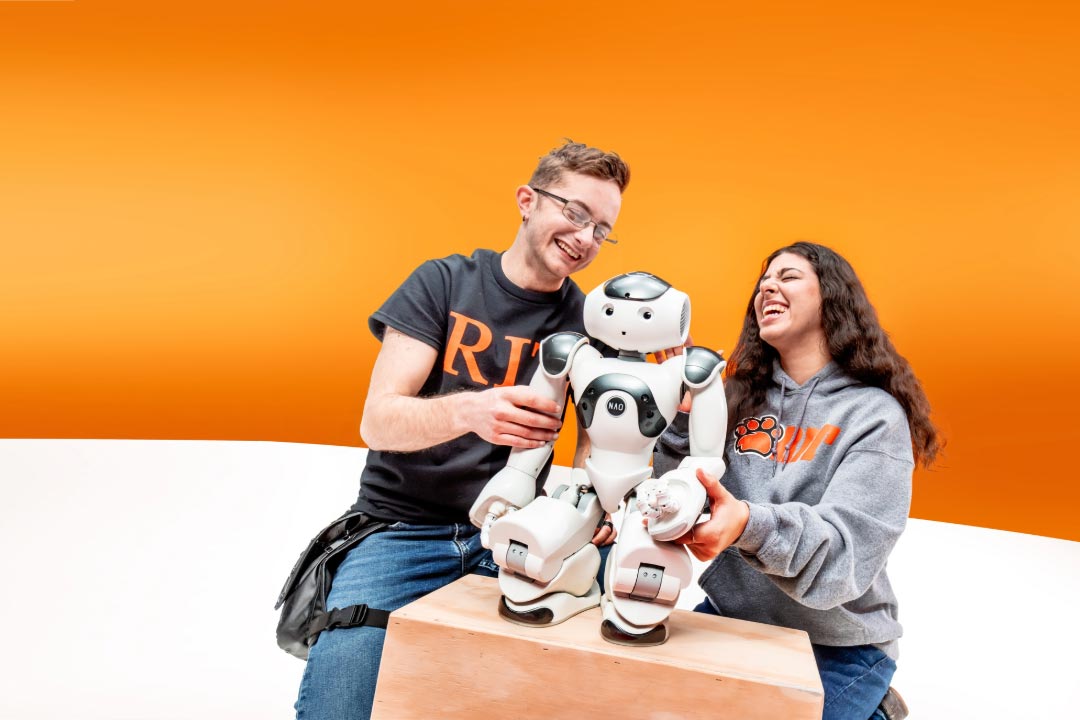
Victor Lockwood is gaining hands-on lab experience with the Nao robot, building conversational programs that allow users to chat with the robot verbally.
Scott Hamilton
Through his work on memory architectures for robots and social robotics, Victor Lockwood works to help humans and robots communicate.
Victor Lockwood is an MS student in artificial intelligence from Cato, NY. His research in the AI program is focused on memory architectures for social robotics.
What made you want to study AI?
This actually goes back to my childhood! I was in early middle school when I knew I wanted to be in computing and technology when I grew up, but the specific direction wasn’t clear to me until around 8th grade. At that time, I was introduced to the video game Portal 2 and the book "I, Robot" by Isaac Asimov. I fell in love with robotics, and I wanted to create a world where robots and humans lived side-by-side. Specifically, I wanted to program the brains of intelligent robots, which to me meant going into artificial intelligence.
How did you become interested in memory architectures for social robotics?
Social robotics has always been an area of interest for me, and I saw that the literature on memory architectures for social robots was pretty sparse, especially cognitively grounded solutions. I was at first interested in memory grounded in robot embodiment – meaning, memory that’s built around how a robot senses and interacts with its environment. During my time at RIT, I gradually shifted my attention over to affective states and how they affect what memories are stored, how they’re stored, and how a memory architecture built around affective states would impact the ways a human perceives an interaction with a robot.
What projects are you working on in AI at RIT?
Currently, I’m working on my thesis and AWARE-AI research, which is on developing a more cognitively plausible memory architecture for social robots. I’m also a part of a social robotics research group headed by Dr. Jamison Heard (head of the Adaptive Human-Robot Teaming Lab). I've worked a lot with a Nao robot we have access to in the lab, for which I’ve previously made conversational programs that allow users to have a chat with the robot verbally. I got to show a couple of these programs off at the last Imagine RIT with the AWARE-AI group and at last year’s opening of the Research Building.
What do you hope to do in the future?
After my PhD, I see myself either pursuing tenure-track faculty positions in academia or founding a robotics and VR startup. In my personal life I’ve been involved in the VR space since the Oculus Go, and I see some exciting use cases for intertwining robots and VR.