Students form Interfaith Council
Learning about the beliefs of others will build mutual respect and understanding
Pete Schuck/RIT
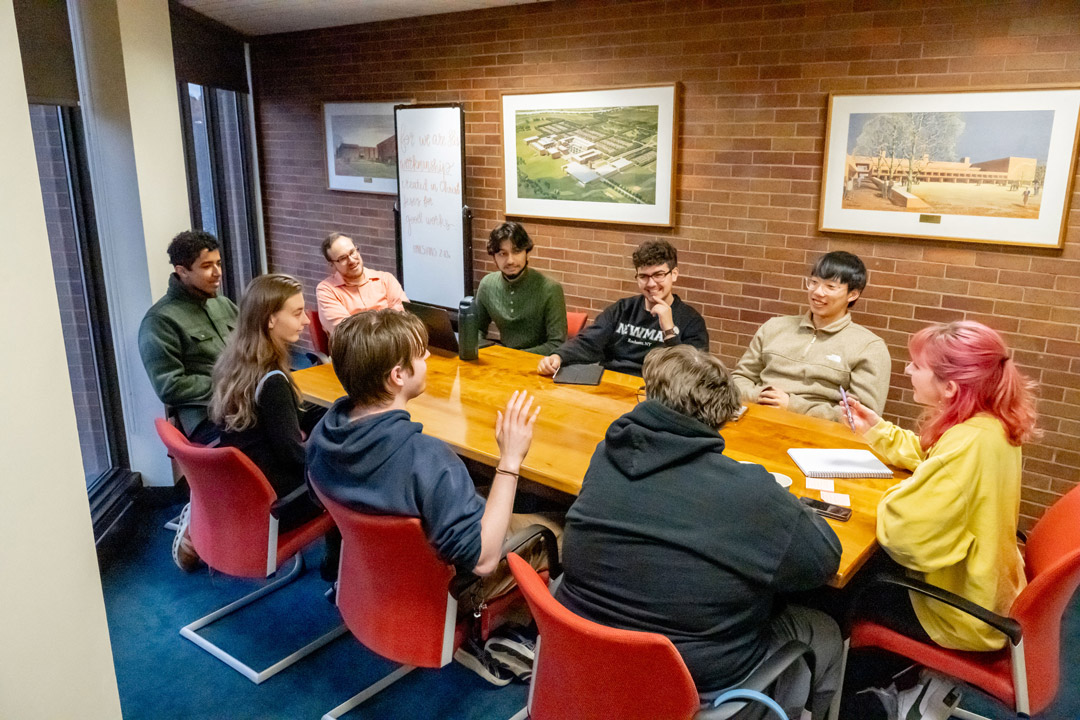
Members of the Interfaith Council, including its president, Perry Lindstrom, far right, meet to discuss upcoming events to help educate the RIT campus about various religions, faiths, and spirituality.
Nearly 2,500 RIT students engage in spiritual programs and services on campus.
Now, many of those students in the 23 religious communities on campus have a unified voice in the Interfaith Council, the university’s newest Major Student Organization, specifically designated as a Campus Life Council. The council is run by students to promote activities, events, and programming regarding interfaith dialogue and leadership skills for students.
“We want to raise awareness, spread knowledge, and get more people involved to know we have faith groups on campus,” said the council’s president, Perry Lindstrom, a second-year English major from Rockville, Md., who helped create the council’s constitution. “I think we have a lot of great representatives, but we’re still growing as of now and doing more outreach to involve students of additional faiths. Now that we’re official, we’re looking to collaborate with other groups. We all connect very well.”
Lindstrom said more awareness of different faiths, cultures, and spiritualities helps build mutual respect and understanding and will help graduates work with diverse groups of people on civic issues within a pluralistic society.
“I believe it is incredibly important for RIT as a community to accept one another both on and off campus in whichever walks of life one may take,” she said. “Religion, spirituality, and culture tend to draw lines between people due to differing beliefs and biases. Once you are able to look past and bridge the divisions that these cause, we can build a healthy and supportive community.”
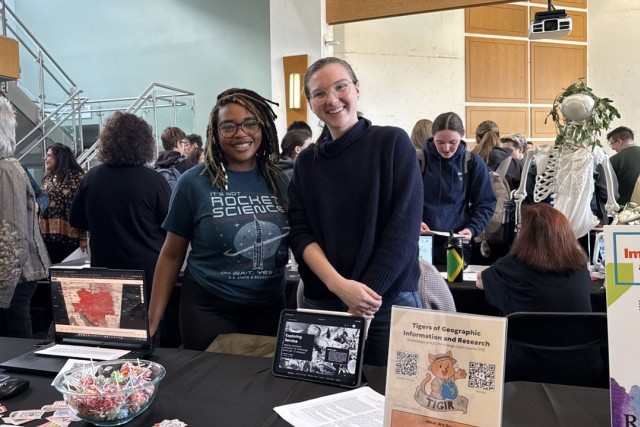
The council recently held its first interfaith fair to reach out and provide opportunities for students to engage with one another in a safe setting.
“We also invited religions and temples in the Rochester community where we don’t have established religious communities on campus such as Orthodox Christians, Universalist Unitarians, Baha’is, and Latter-Day Saints,” said University Chaplain Andrew Cirillo, who oversees Spirituality and Religious Life. “We know we have students in those groups on campus, and they’re asking for this,”
The origins of the council go back to 2019, when the assistant director for Spirituality and Religious Life formed “Dept. 42,” which got its name from the answer to the ultimate question of life in The Hitchhiker’s Guide to the Galaxy. The students held existential discussions and played pop culture games. The group rebranded in 2022 and, this semester, were officially recognized as an official student council, meaning they are eligible to receive funding from student activity fees in addition to advocating for their membership and exercise their initiatives as a fully student-led organization.
Lauren Reger ‘24 (environmental science) was one of the previous presidents of the original group. She said it was started to help educate the community to combat hatred, fear, and discrimination, which are rooted in a lack of understanding.
“People tend to look for validation in culture and spirituality by searching for what is righteous and wrong,” Reger said. “However, some people may believe that there is only one right way and that others who act or think differently are ‘wrong’ and ‘bad.’”
The council, which meets every other Friday, recently held events to reach out to the campus community, especially to inform about how best to engage with one another across differences. They recently hosted a free dinner for students to play Interfaith Jeopardy, featuring questions about a wide range of religious and spiritual trivia questions to help correct misconceptions.
And Cake for Questions was held on the Quarter Mile. Passersby were asked cultural questions, told about services and upcoming events, and given a piece of cake or other baked good.
The council also plans to hold discussions and events to learn about other groups within spirituality and religious life on campus. A webinar, in coordination with Spirituality and Religious Life and University Advancement, is planned in December with a discussion with current chaplains, students, and alumni talking about the impact spirituality has had on their lives. And in May, an art installation will be erected from various interfaith communities on campus, including the council.
This comes as RIT’s Schmitt Interfaith Center celebrates its 40th year.
“The faith community here has just blossomed over time,” Cirillo said. “What began with a solely Protestant chaplaincy in 1941 and, by 1954 added a Catholic Newman and Jewish Hillel community, now has a Pagan congregation, two Buddhist groups, Hindu, and Muslim practitioners. And all have been allowed to flourish over time.”
“As we embark on the 40th year of Schmitt Interfaith Center, we pay homage to the premise it was founded in: To have interfaith dialogue,” Lindstrom said. “Despite all of our differing beliefs and biases, we are still capable of coming together to share our cultures and backgrounds in order to broaden perspectives on the wider world outside of RIT.”