RIT launches hands-on Bachelor of Science degree in artificial intelligence
New BS program will equip students with technical depth to build and improve AI systems
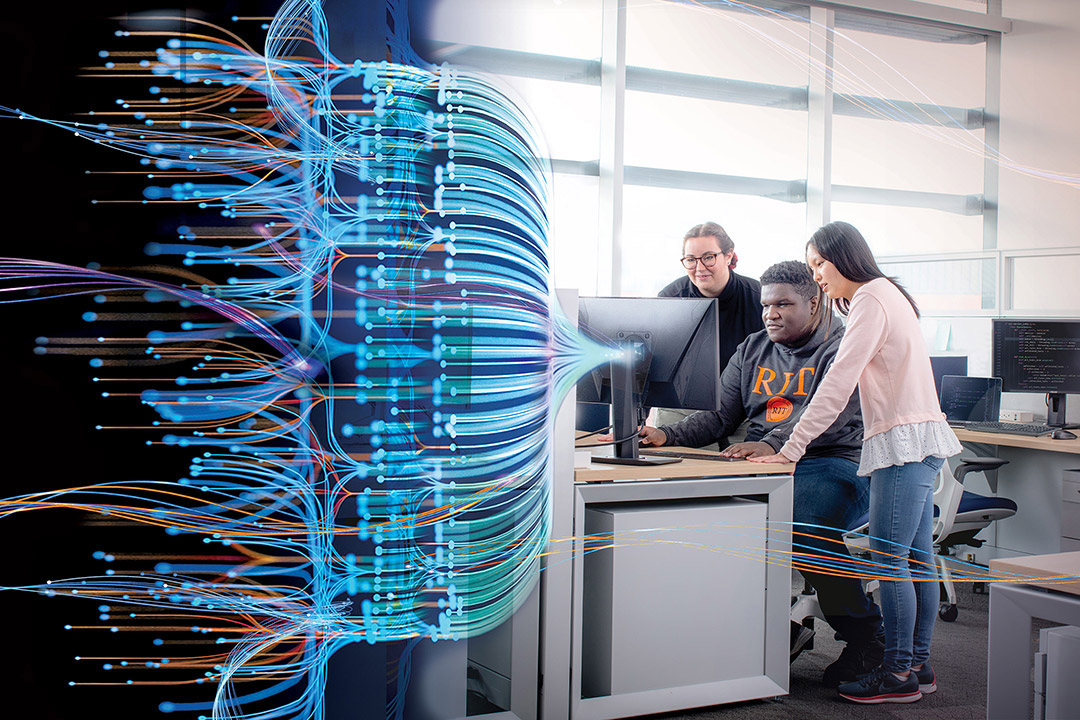
RIT now offers a technically comprehensive undergraduate degree in artificial intelligence, geared toward aspiring AI professionals in a variety of careers.
Published: March 25, 2026. Updated: Aug. 17, 2026.
Austin Cirrincione came into Rochester Institute of Technology as an engineering exploration student but soon realized that wasn’t the field he wanted to go into. Next, he considered cybersecurity. It was closer, but not exactly right.
In March 2026, when RIT developed an undergraduate major in artificial intelligence, he knew that was for him. Now in his second year at RIT, Cirrincione is one of about 20 students starting the new artificial intelligence (AI) bachelor’s degree program this fall.
“I am excited about AI because I feel if it is used appropriately as a tool, it can have many benefits in a whole host of fields,” said Cirrincione, who is from Cheektowaga, N.Y. “I am interested in learning how to build LLMs myself and how AI is being integrated with robotics.”
The interdisciplinary undergraduate program blends core programming and algorithmic principles with the chance for specialized study in areas like agentic AI and robotics. Students in the major will work on hands-on projects building and applying AI with real impact.
“In our program, students will learn the nuts and bolts of what’s behind the AI,” said Erik Golen, principal lecturer and AI undergraduate program director. “We don’t want to have AI build more AI. We need professionals who can build models, validate them, and make sure they are usable by humans in a range of applications.”
Building upon a strong foundation in computer science, software engineering, and data modeling, AI majors will be able to design systems that turn data and algorithms into practical value for individuals and organizations. The curriculum aims to fully equip students with what industry is looking for from college graduates.
Gyan Mistry, a third-year student from North Andover, Mass., is also switching into the AI major. He said he’s always been more interested in AI from the get-go and RIT made it easy for him to change majors from software engineering.
“It’s the future of technology,” said Mistry. “Everything is based around it now and the whole economy is building off it. I want to get in that sector and start a company.”
Building AI to solve real-world problems
Minor in AI
RIT’s computing college also offers a minor in AI. The six-course minor provides a rigorous technical foundation in core methods and computational principles that power modern AI.
Students enrolled in the minor will study:
- Supervised and unsupervised learning
- Machine learning techniques and approaches
- Applications in natural language processing, computer vision, geospatial computing, cybersecurity, and generative modeling.
The minor in AI is open to all RIT majors, with enrollees needing to meet foundational programming experience requirements.
RIT has long been recognized as one of the nation’s best colleges for computing degrees. In 2026, U.S. News & World Report rankings named the computer science program No. 54.
The university’s first courses in AI were taught in 1986. RIT also created the nation’s first undergraduate programs in information technology and software engineering.
“We’re excited to continue that legacy of curriculum innovation with our BS in AI, which will prepare students to innovate with the latest AI technologies and create the next generation of AI systems,” said Matt Huenerfauth, dean of RIT’s Golisano College of Computing and Information Sciences (GCCIS). “Our AI degree is informed by industry needs, and expertise from across our college, and features the hands-on curriculum that is a hallmark of an RIT education.”
Core courses in the BS in AI program focus on optimization algorithms, security of AI, and large language models, reinforcement learning, and machine learning. Students will also select elective courses that tailor their experience to specific domains of AI. While some students focus on computer vision and robotic systems, others may choose to study natural language processing or AI policy and law.
In the first year of the program, students get to take an AI Explorations course that covers the history, ethics, data, and key algorithms of the field. The goal is for future AI professionals to recognize and consider the ethical and economic impact of AI solutions in global, environmental, and societal contexts.
“Graduates of our new AI major will gain the technical depth to build, improve, and innovate AI systems,” said Michael Yacci, senior associate dean for Academic Affairs in GCCIS. “Importantly, they will also learn processes to assess the accuracy and validity of an AI solution.”
The 122 credit-hour undergraduate program typically takes four years to complete. Like with many RIT degrees, AI majors will also complete two blocks of co-op, or cooperative education—a paid work experience related to a student’s field of study.
In 2023, RIT began offering a master’s degree in AI. Additionally, many other RIT degree programs, minors, and immersions allow students to study and apply AI.
For more information on the BS in AI, go to the artificial intelligence Bachelor of Science degree webpage. Students with questions about how to be considered can contact the office of Undergraduate Admissions.