Artificial Intelligence Bachelor of Science Degree

In the BS in artificial intelligence you’ll be prepared for emerging tech careers with hands‑on learning in areas like agentic AI and large language models (LLMs).
Overview for Artificial Intelligence BS
Why Pursue a Bachelor's in Artificial Intelligence at RIT?
AI with Real Impact: At RIT, our faculty and students use AI to drive advances in areas like health care, cybersecurity, and robotics.
Technical depth in areas like optimization algorithms, machine learning, AI law, AI security, and concurrent and distributed AI. You will learn to build systems that allow intelligent machines to improve through experience and deep learning.
A Legacy of Innovation: RIT has a history of being first, launching the nation’s first undergraduate programs in information technology and software engineering. We taught our first AI classes in 1986 and introduced our MS in AI in 2023.
New courses featuring AI tools and techniques, exploring generative models, and autonomous agents.
Experiential Learning: With one of the best university co-op programs in the world, you’ll pair your degree with full-time, paid work experience.
STEM-OPT Visa Eligible: The STEM Optional Practical Training (OPT) program allows full-time, on-campus international students on an F-1 student visa to stay and work in the U.S. for up to three years after graduation.
Artificial intelligence has quickly transformed the way we live and work, leading to advancements in multiple industries and everyday technology. At RIT, the bachelor of science in artificial intelligence builds on our strengths in computing, engineering, and innovation to prepare students who want to architect, improve, and lead breakthroughs in AI systems.
The bachelor of science in artificial intelligence is designed to equip you with the technical depth and industry-informed experience to lead in this high-growth sector. The major focuses equally on principles and applications of AI. You will learn how to build intelligent systems while developing specialized expertise in advanced topics like:
- Speech and natural language processing
- Robotics
- Agentic AI
- Generative AI
- Large Language Models (LLMs)
- Software engineering pipelines
- Ethics of emerging technologies
The fields of computer science and software engineering focus on the building of systems, software, and infrastructure. Building atop this foundation, our BS in AI program focuses on how machines learn, reason, and make autonomous decisions.
What You Will Study in the BS in Artificial Intelligence
The curriculum in RIT’s bachelor of science in artificial intelligence is comprehensive, blending core programming and algorithmic thinking with application-oriented projects. Graduates are prepared to design systems that turn data and algorithms into practical value for individuals and organizations.
The BS in AI will develop a foundation of knowledge in areas like predictive modeling, optimization, algorithmic reasoning, and data‑driven decision‑making. Through interdisciplinary work, you’ll study how to turn real-world problems into AI solutions by designing systems that connect human needs with technical innovation.
Double Majoring in AI
Because artificial intelligence is transforming every industry, pairing a BS in AI with a second major allows you to apply advanced technical skills in a meaningful, discipline‑specific context. Whether combined with business, communications, science, health care, or another RIT BS degree, a double major with AI can help you translate AI capabilities into real‑world impact—designing smarter systems, improving decision‑making, and solving complex problems within your chosen field. This interdisciplinary approach prepares you to collaborate across disciplines, understand ethical and human implications, and lead AI‑driven innovation rather than simply support it. The result: You will be a more versatile, career‑ready graduate who can bridge technology and practice in a rapidly evolving workforce.
-
Meet Us on Campus
Learn about academics, co-op and internships, financial aid, and more at one of our on-campus open houses.
October 12 | October 24 | November 14
-
Apply for Fall 2027
Early Decision I and Early Action deadlines are November 1.
Careers and Cooperative Education
Typical Job Titles
| Machine Learning Engineer | Data Scientist | Automation Engineer |
| AI Solutions Architect | AI Software Engineer |
Cooperative Education
What’s different about an RIT education? It’s the career experience you gain by completing cooperative education and internships with top companies in every single industry. You’ll earn more than a degree. You’ll gain real-world career experience that sets you apart. It’s exposure–early and often–to a variety of professional work environments, career paths, and industries.
Co-ops and internships take your knowledge and turn it into know-how. Learn more about computing co-ops and how hands-on experience in a range of AI positions will enable you to apply your AI knowledge in professional settings while you make valuable connections between classwork and real-world applications.
Students in the BS in artificial intelligence are required to complete two blocks of cooperative education experience.
Curriculum for 2026-2027 for Artificial Intelligence BS
Current Students: See Curriculum Requirements
Admissions and Financial Aid
This program is STEM-OPT Visa Eligible when studying on campus and full time.
First-Year Admission
Already Admitted to RIT for Fall 2026?
Admitted incoming first year and transfer students for fall 2026 can request a change of major to the BS in artificial intelligence by emailing Undergraduate Admissions at admissions@rit.edu.
Not Yet Applied to RIT?
We are currently accepting applications for the BS in artificial intelligence for the fall 2026 semester, which begins in August.
First-year applicants are expected to demonstrate a strong academic background that includes:
- 4 years of English
- 3 years of social studies and/or history
- 4 years of mathematics is required and must include algebra, geometry, algebra 2/trigonometry, and pre-calculus. Calculus is preferred.
- 2-3 years of science is required and must include chemistry or physics; both are preferred.
- Computing electives are preferred.
Transfer Admission
Transfer applicants should meet these minimum degree-specific requirements:
- A minimum of precalculus is required. Calculus is preferred.
- Chemistry or physics is required.
- Computing courses are preferred.
Currently Enrolled RIT Students Looking to Transfer into BS in AI
The BS in artificial intelligence is accepting internal transfers for students currently enrolled in RIT.
- If you are currently in your first or second years in the Golisano College of Computing and Information Sciences (GCCIS), you may be able to change programs with little delay toward graduation.
- For third-year students and beyond, the college's advisors can work with you to find a path, but please note that your time to graduation may be affected.
Next Steps: If you are interested in switching, please contact Senior Associate Dean, Mike Yacci (mayici@rit.edu), to discuss your specific course history and timeline.
Financial Aid and Scholarships
100% of all incoming first-year and transfer students receive aid.
RIT’s personalized and comprehensive financial aid program includes scholarships, grants, loans, and campus employment programs. When all these are put to work, your actual cost may be much lower than the published estimated cost of attendance.
Learn more about financial aid and scholarships


Related News
-
October 14, 2026
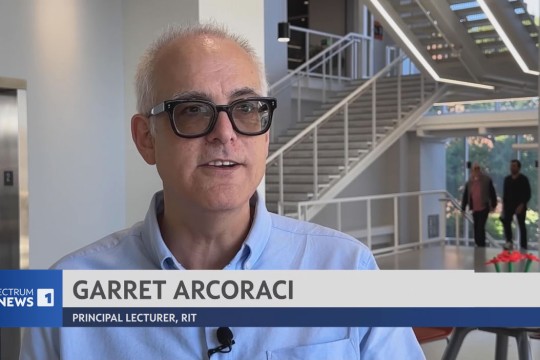
Upstate university students, faculty address the issues they're facing with AI
Spectrum News speaks with Garret Arcoraci, principal lecturer in the School of Information, and students in RIT's artificial intelligence program about AI ethics, potential risks, government oversight, and preparing students to develop and use the technology responsibly.
-
September 23, 2026
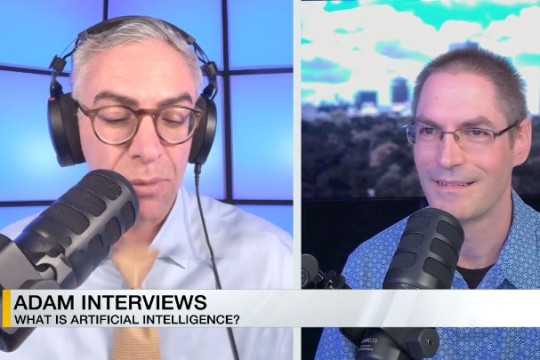
Adam Interviews: What is AI, really? RIT professor breaks it down
WROC-TV speaks with Erik Golen, principal lecturer and director of RIT’s artificial intelligence bachelor’s degree program, about how AI works and its expanding applications and the importance of safeguards as the technology advances.
-
July 16, 2026
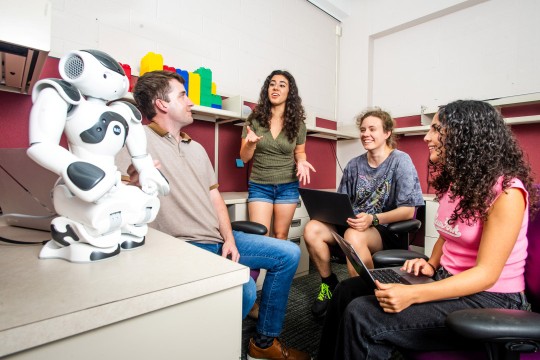
Undergrads from colleges across the U.S. come to RIT for summer research
RIT is hosting four Research Experience for Undergraduate (REU) program sites this summer, which are designed for students to develop a passion for research and receive guidance for pursuing graduate careers. The university has a longstanding history hosting REU sites, which are funded by grants from the National Science Foundation.
Contact

School of Information