Research

Our research focuses on the most extreme phenomena in the universe, including black hole mergers, gamma-ray bursts, core-collapse supernovae, active galactic nuclei, and the formation of cosmic structure.
These events probe the fundamental laws of physics through multiple messengers - gravitational waves, electromagnetic radiation, neutrinos, and cosmic rays. By combining large-scale simulations, advanced data analysis, and theoretical modeling, we investigate how these extraordinary systems evolve and shape the universe across cosmic time.
Binary Black Holes
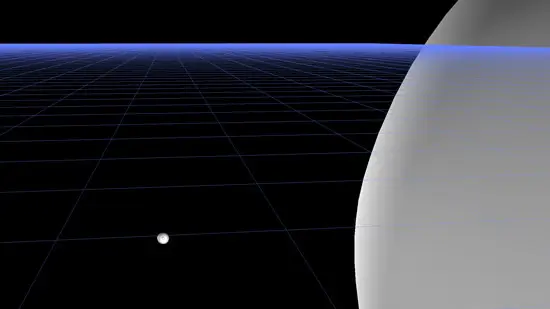
We develop advanced numerical relativity methods to simulate the inspiral, merger, and ringdown of binary black holes in the strong-field regime of General Relativity. Our research investigates systems with extreme mass ratios, rapidly spinning black holes, orbital precession, and large gravitational recoil velocities, producing highly accurate gravitational-wave predictions for current and next-generation detectors. By combining algorithmic advances with large-scale supercomputing, we improve our understanding of black hole dynamics, test General Relativity in its most extreme regime, and provide the theoretical foundation for gravitational-wave and multimessenger astrophysics.
Image: H.P. Bischof, RIT
Binary Neutron Stars
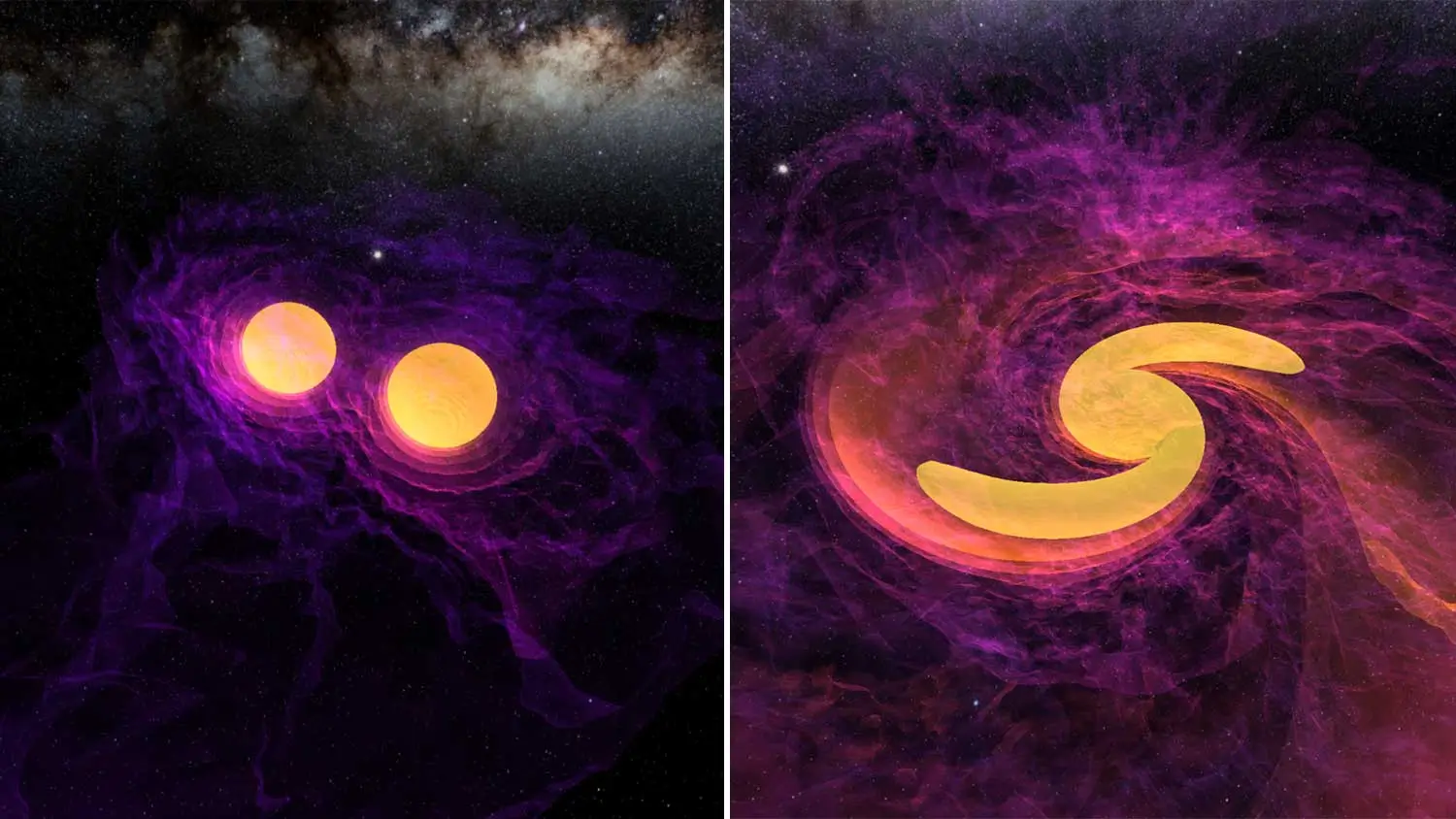
The dramatic mergers of neutron stars reveal clues for long standing mysteries about our universe: Where do heavy elements come from? How do we describe matter in the dense cores of neutron stars and their merger remnants? What links the gravitational waves and electromagnetic flashes emitted from these events? We explore these questions through General Relativistic Magnetohydrodynamic (GRMHD) simulations coupled to advanced neutrino transport methods, modeling the full lifecycle of these systems from their inspiral to their turbulent post-merger aftermath.
Image: A. Wen, RIT
Gravitational-Wave Astronomy and Data Analysis
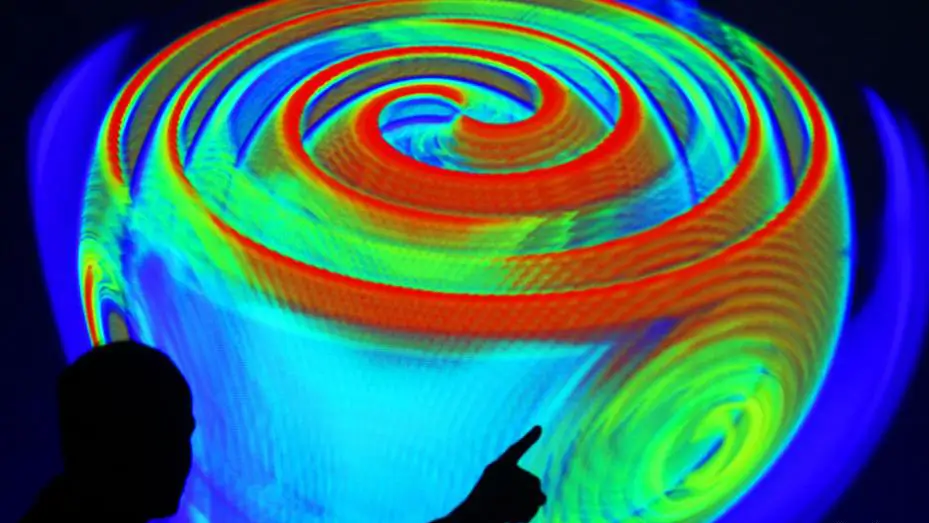
Gravitational-wave observations provide a transformative window into the most energetic phenomena in the universe. We develop advanced computational and statistical methods—including Bayesian inference, parameter estimation, signal processing, and machine learning—to detect and characterize gravitational-wave signals with high precision. By combining robust data analysis pipelines with numerical relativity, electromagnetic observations, and astrophysical modeling, we infer the properties of compact objects and reconstruct the formation channels and evolutionary histories of binary black holes and neutron stars. Our research also employs population synthesis and hierarchical population inference to explore the demographics of compact-object populations, advancing our understanding of their origin and evolution in the era of multimessenger astronomy.
Image: picture-alliance/dpa/M. Hanschke
Pulsar Timing, Magnetars, and Continuous Waves
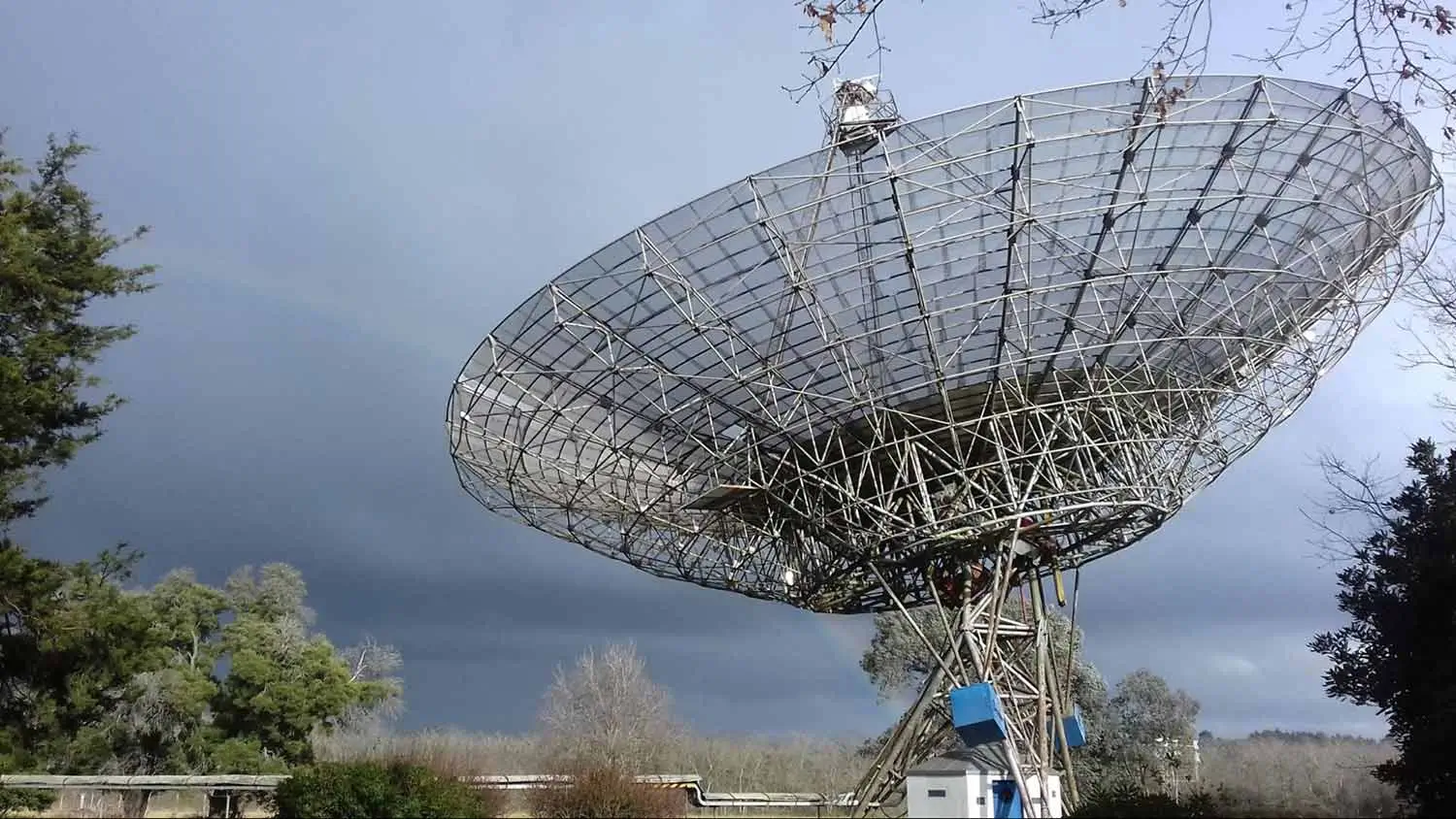
Neutron stars are extraordinary laboratories for probing fundamental physics under extreme conditions. We combine precision pulsar timing, radio observations, and advanced data analysis techniques to search for continuous gravitational waves from rapidly rotating neutron stars and to investigate the physics of pulsars and magnetars. Our work spans signal detection, timing analysis, machine learning, and theoretical modeling, providing new insights into dense matter, ultra-strong magnetic fields, and gravitational-wave emission. Through our collaboration with the PuMA project and the Argentine Institute of Radio Astronomy (IAR), we contribute to pulsar science, stochastic gravitational-wave background searches, and multimessenger studies of the dynamic universe.
Multi-Messenger Astrophysics
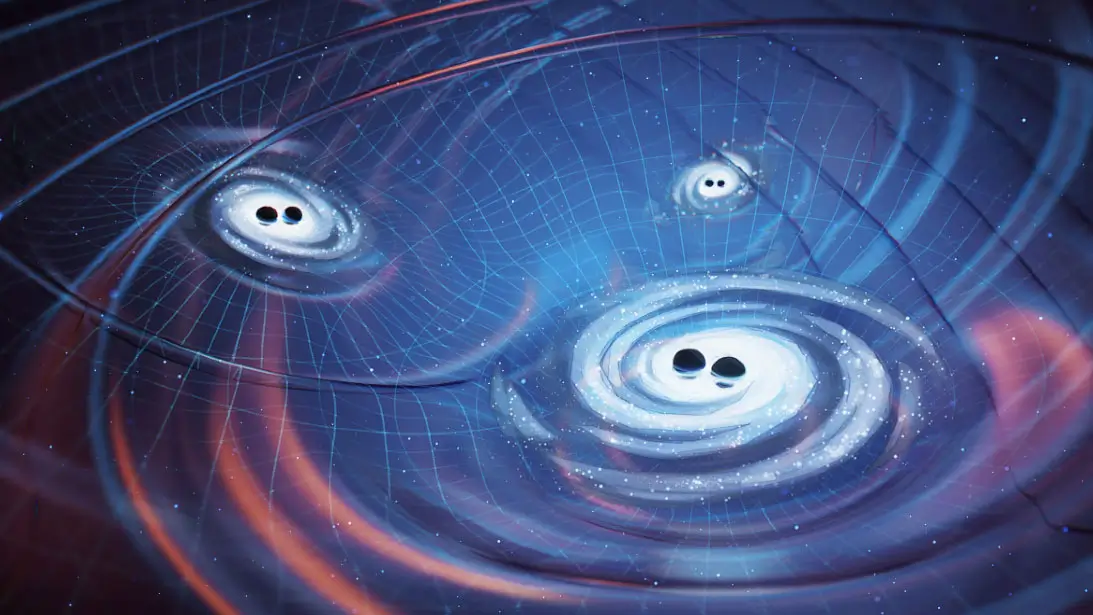
By synthesizing a cosmic symphony of gravitational waves, electromagnetic radiation, neutrinos, and cosmic rays, we can construct cohesive theoretical models of the universe’s most extreme phenomena found in stellar explosions, compact binary mergers, and accreting systems. We facilitate collaborations across theoretical, computational, and observational astrophysics to take full advantage of this new era of multi-messenger astrophysics.
Image: Olena Shmahalo for NANOGrav
Artificial Intelligence and Machine Learning
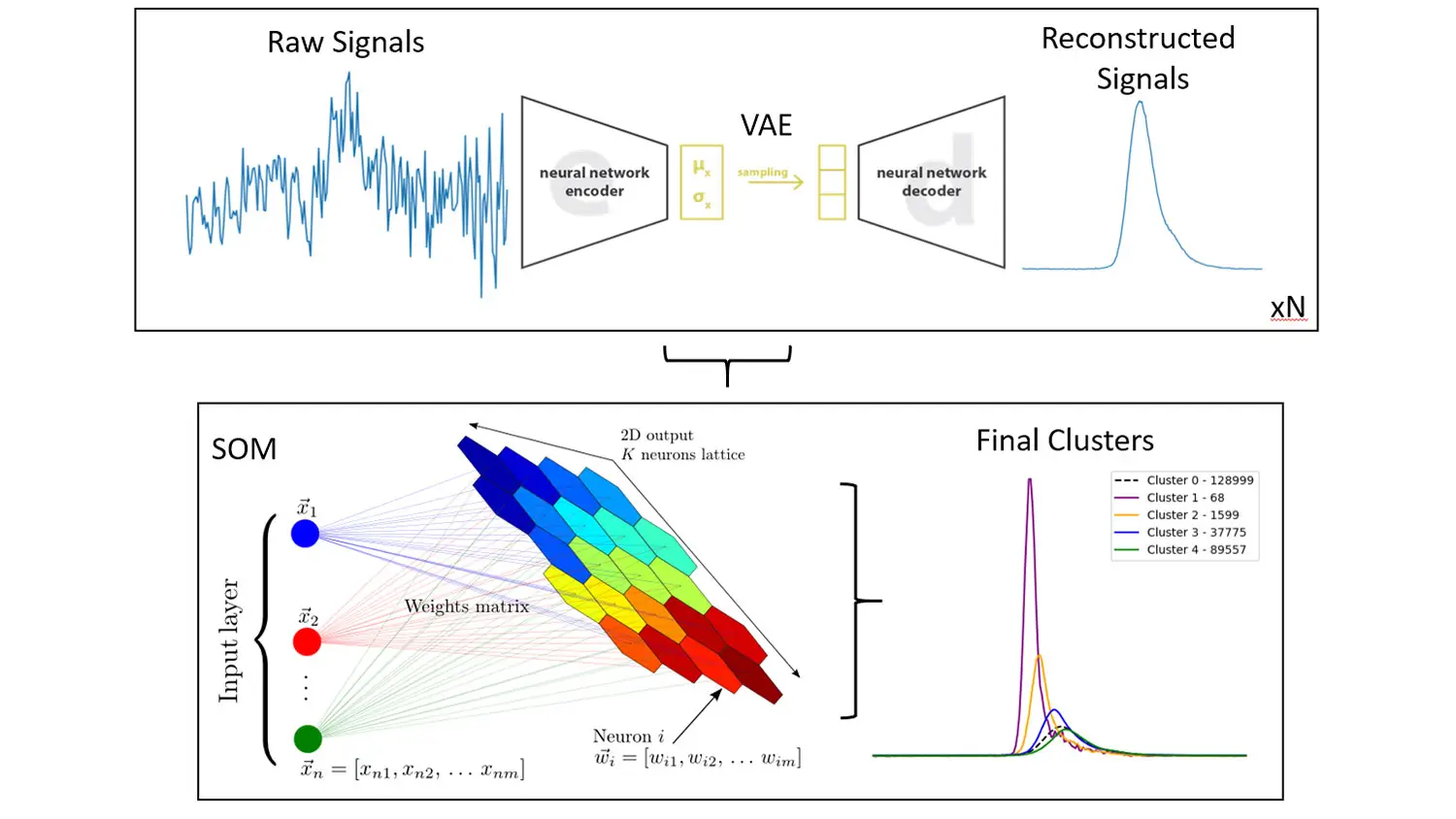
Artificial Intelligence is transforming the way computational astrophysics is performed. We develop and apply machine learning techniques to accelerate simulations, analyze large observational datasets, and extract weak astrophysical signals from noisy measurements. Our research spans gravitational-wave data analysis, pulsar discovery, surrogate modeling, reduced-order representations, and AI-enhanced numerical methods. We are also exploring the integration of AI into scientific software development, including code optimization, automated testing, and next-generation workflows for the Einstein Toolkit and AsterX. By combining first-principles physics with data-driven methods, we are building the next generation of computational tools for multimessenger astrophysics.
Numerical Relativity
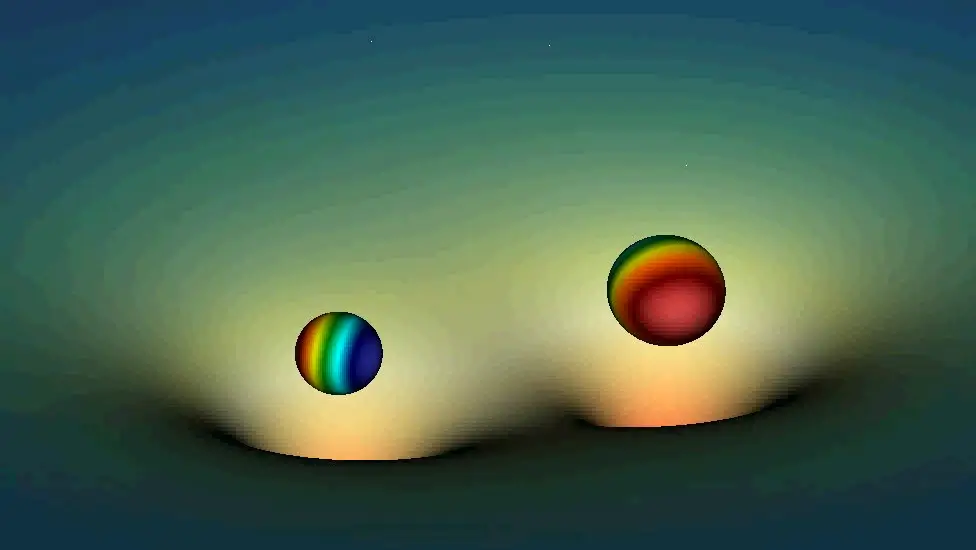
We develop state-of-the-art computational methods to solve Einstein’s field equations and model the dynamics of spacetime in the strong-gravity regime. As leading contributors to the Einstein Toolkit and developers of the AsterX GRMHD code, we create open-source software that enables researchers worldwide to study relativistic astrophysical systems. Our simulations span binary black holes, neutron stars, black hole–neutron star mergers, and extreme mass-ratio inspirals, producing the high-precision spacetime dynamics and gravitational-wave signals needed to interpret observations from current and future detectors. This work combines advances in numerical algorithms, relativistic physics, and extreme-scale computing to expand the frontiers of gravitational-wave and multimessenger astrophysics.
Image: Nicole Rosato, Ph.D. Math Modeling
Stellar Evolution and Core-Collapse Supernovae
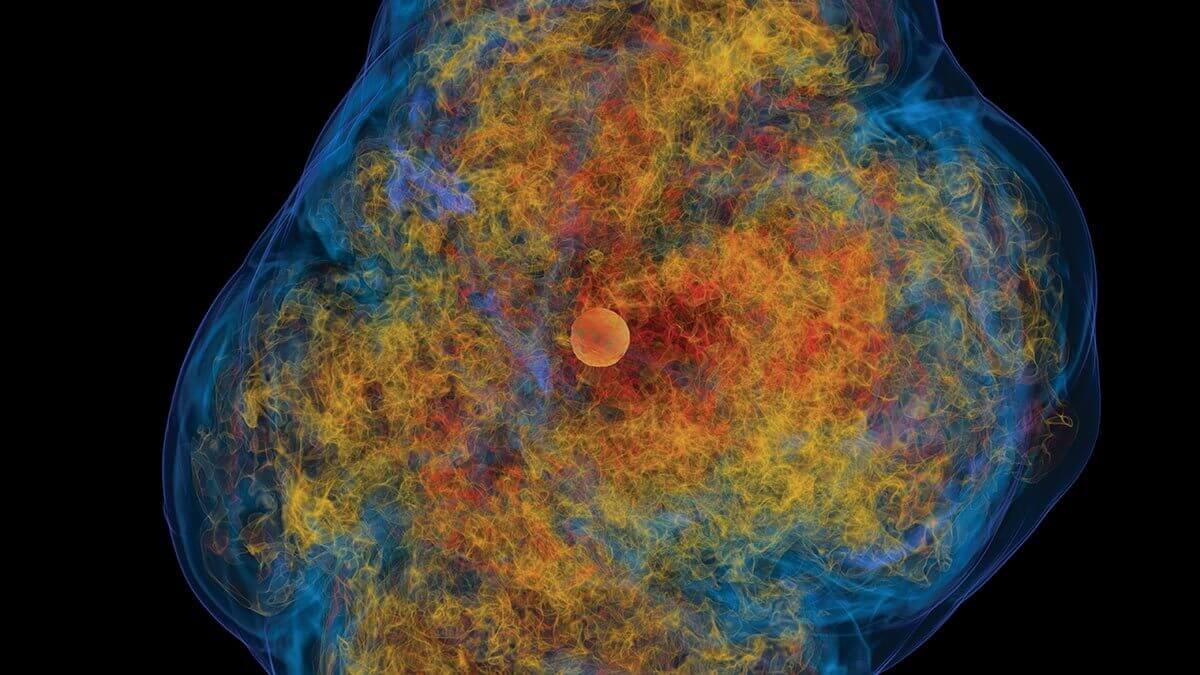
We investigate the life cycles of massive stars, from their evolution in isolated and binary systems to their catastrophic deaths as core-collapse supernovae. Using large-scale three-dimensional radiation-hydrodynamic simulations, we study the complex physical processes that drive stellar explosions and the formation of neutron stars and black holes. A central focus of our work is the accurate modeling of neutrino transport, whose interaction with matter governs the energy deposition needed to revive the stalled shock and power the explosion. These simulations provide critical insight into the mechanisms of supernova explosions, nucleosynthesis, and the birth of compact remnants.
Supermassive Black Holes, Accretion Disks, and Jets
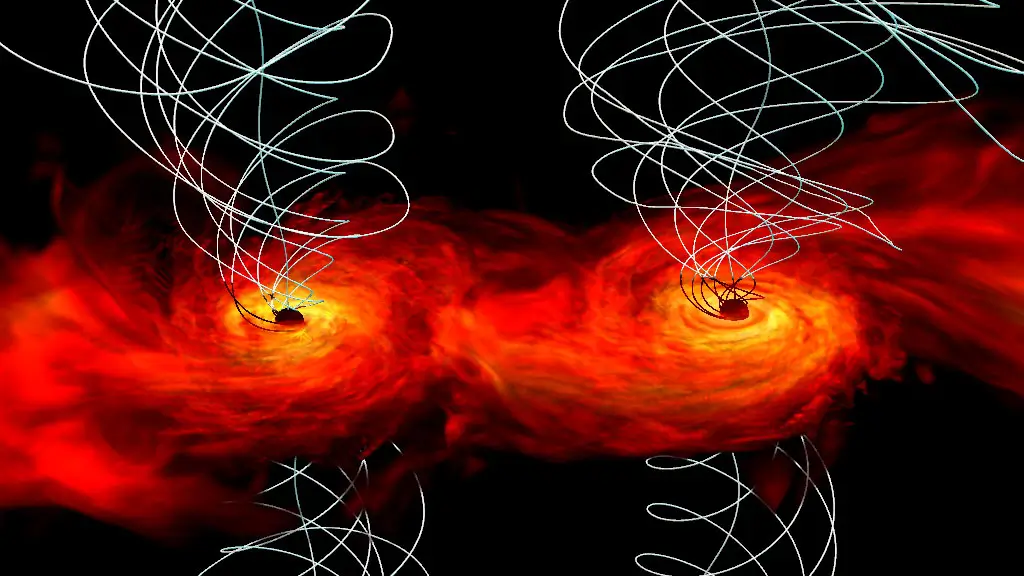
We investigate the extreme environments surrounding supermassive black hole binaries using state-of-the-art General Relativistic Magnetohydrodynamic (GRMHD) simulations. By modeling circumbinary accretion disks, relativistic jets, and radiation transport with advanced moment-based and Monte Carlo methods, we capture the complex interplay between gravity, magnetic fields, plasma, and radiation in the strong-field regime. These simulations enable us to predict the multimessenger signatures, electromagnetic emission and gravitational waves, of merging black holes, helping to interpret observations of active galactic nuclei and unravel the role of black hole mergers in galaxy evolution.
Image: Liciano Combi, Perimeter Institute