For Researchers

The center conducts advanced research integrating high-performance numerical simulations with innovative analytic modeling to develop the theoretical frameworks and tools required for next-generation gravitational wave observatories. Our impact is reflected in the extensive scholarly contributions, federally funded research initiatives, and open-source software projects led by our Principal Investigators.
Grants and Publications
Our research is supported by major federal agencies, including the National Science Foundation (NSF) and NASA, as well as private foundations.

Dr. Manuela Campanelli is the Distinguished Professor of astrophysics and John Vouros endowed professor at RIT. She is also the founding director of the Center for Computational Relativity and Gravitation. She is known for her renowned work on the astrophysics of black holes, neutron stars, and gravitational waves.
Publications:
ADS link for Manuela Campanelli | arXiv link for Manuela Campanelli | INSPIRE/HEP link for Manuela Campanelli | ORCID link for Manuela Campanelli | Google Scholar link for Manuela Campanelli
Grants:
NSF link for Manuela Campanelli | NASA link for Manuela Campanelli

Dr. Joshua Faber has been a member of the School of Mathematics and Statistics since joining RIT in December 2007, and was appointed to be the Head of the School in the summer of 2022.
He has been a member of the Center for Computational Relativity and Gravitation and a program faculty member for the Astrophysical Sciences and Technology Ph.D. program from their earliest days when he joined the faculty and now serves as a program faculty member of the Mathematical Modeling Ph.D. program as well.
Publications:
ADS link for Joshua Faber | arXiv link for Joshua Faber | INSPIRE/HEP link for Joshua Faber | ORCID link for Joshua Faber | Google Scholar link for Joshua Faber
Grants:
NSF link for Joshua Faber | NASA

Carlos Lousto is a Distinguished Professor in RIT's School of Mathematical Sciences and co-director of the Center for Computational Relativity and Gravitation. He has extensive research experience which ranges from black hole perturbation theory and numerical relativity to string theory and quantum gravity.
Publications:
ADS link for Carlos Lousto | arXiv link for Carlos Lousto | INSPIRE/HEP link for Carlos Lousto | ORCID link for Carlos Lousto | Google Scholar link for Carlos Lousto
Grants:
NSF link for Carlos Lousto | NASA

Jason Nordhaus has been an associate professor of physics at the National Institute for the Deaf at RIT since fall 2014. Nordhaus joined the CCRG as a NSF Astronomy and Astrophysics Postdoctoral Fellow (AAPF) in 2011 and is currently one of the core faculty of the center.
Publications:
ADS link for Jason Nordhaus | arXiv link for Jason Nordhaus | INSPIRE/HEP | ORCID link for Jason Nordhaus | Google Scholar link for Jason Nordhaus
Grants:
NSF link for Jason Nordhaus | NASA

Richard O’Shaughnessy is an assistant professor in the School of Mathematical Sciences and a program faculty in Astrophysical Sciences and Technology in the School of Physics and Astronomy. He joined the RIT faculty in 2014. A member of the LIGO Scientific Collaboration, O’Shaughenssy’s research focuses on how to discover and interpret gravitational waves produced by merging compact binaries like black holes and neutron stars, as individual events; as a population; and in broader astrophysical context.
Publications:
ADS link for Richard O'Shaughnessy | arXiv link for Richard O'Shaughnessy | INSPIRE/HEP link for Richard O'Shaughnessy | ORCID link for Richard O'Shaughnessy | Google Scholar link for Richard O'Shaughnessy
Grants:
NSF link for Richard O'Shaughnessy | NASA link for Richard O'Shaughnessy

Publications:
ADS link for John Whelan | arXiv link for John Whelan | INSPIRE/HEP link for John Whelan | ORCID link for John Whelan | Google Scholar link for John Whelan
Grants:

Yosef Zlochower specializes in numerical relativity and computational astrophysics. He is one of the developers of the “moving punctures” approach, a foundational breakthrough that enabled the evolution of multiple black holes in full numerical relativity. Dr. Zlochower’s primary research focus is the numerical evolution of compact-binary spacetimes.
Publications:
ADS link for Yosef Zlochower | arXiv link for Yosef Zlochower | INSPIRE/HEP link for Yosef Zlochower | ORCID link for Yosef Zlochower | Google Scholar link for Yosef Zlochower
Grants:
NSF link for Yosef Zlochower | NASA link for Yosef Zlochower
Key Software Projects
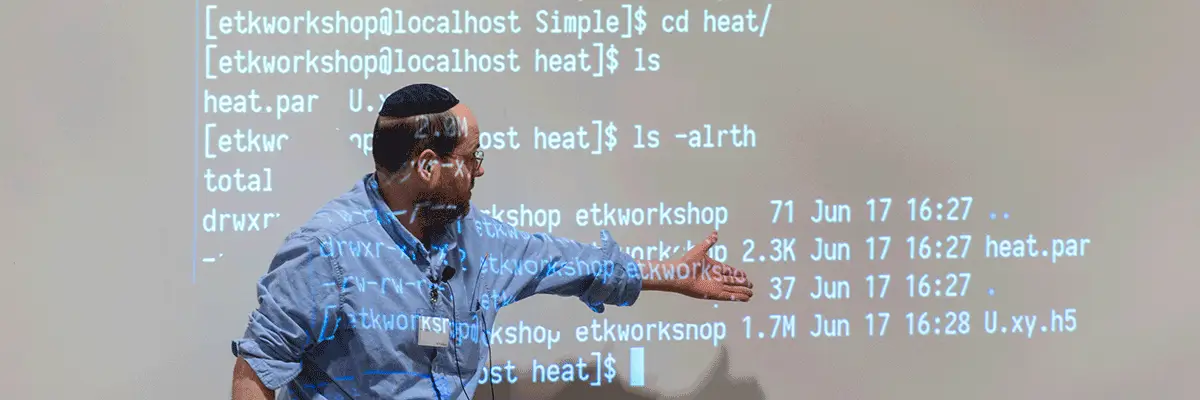
The center develops and maintains several critical software frameworks used by the international relativistic astrophysics community:
AsterX: A high-performance, GPU-accelerated framework for General Relativistic Magnetohydrodynamics (GRMHD) simulations developed by CCRG researchers and students.
The Einstein Toolkit: A community-driven, open-source software framework for relativistic astrophysics and gravitational physics.
GWKokab: An open source, Jax-based, gravitational waves sources population inference toolkit for parametric models
Inverse Curl: A public code developed at RIT that implements an inverse curl algorithm to obtain the magnetic field vector potential from a specified magnetic field in a fully relativistic context.
McFACTS: McFacts is the first public, open source, population synthesis code modeling the full AGN Channel for LVK detectable BBH merger.
RIFT: Rapid parameter inference on gravitational wave sources via Iterative FiTting, An Open-Source Software for Parameter Estimation of Compact Binaries and widely used within LVK.
Data and Repositories
We provide public access to data catalogs and central code repositories to foster collaboration and transparency in research:
RIT Waveform Catalog: A public repository of gravitational waveforms from numerical relativity simulations, widely used for gravitational wave data analysis and parameter estimation.
Einstein Toolkit GitHub: The central repository for the toolkit's various components, including AsterX (GPU-accelerated GRMHD), CarpetX (mesh refinement), and SpacetimeX.