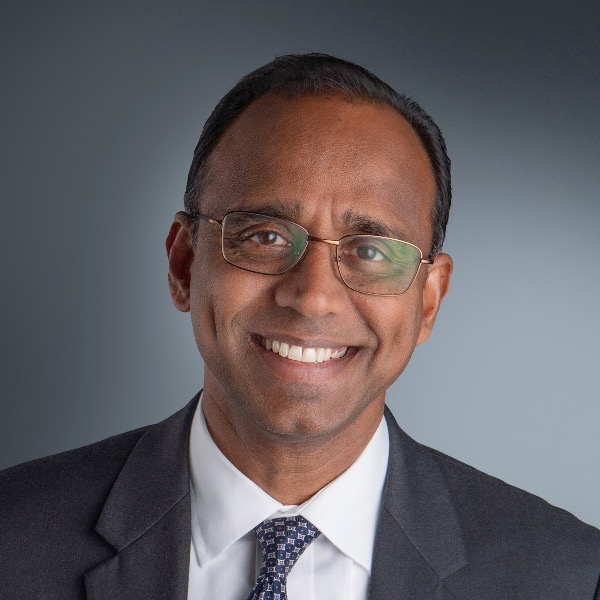
Prabu David
No AI was used in responding to these questions.
I serve as RIT's Provost and Sr. Vice President for Academic Affairs, which is a true honor. Over the last few years, I have focused my research on ethical and trustworthy AI and published papers on this topic. Currently, my co-authors and I are examining differences between AI and humans on social judgement tasks, such as social attraction, dating profile compatibility, and moral reasoning.
Fun fact: I am collaborating with our colleague, Michael Laver, on a class titled Being Human. This might seem so out of left field. But with the onslaught of AI, it is critically important to nurture and strengthen our humanity.
1. How do you use AI and Applied Critical Thinking in your professional practice, teaching or research and what are your favorite resources?
I use AI extensively. From ideating to searching, drafting, designing slides, creating figures, data analysis, and editing, you name it. AI is a game changer. But we must remember it is a Faustian bargain. It can atrophy our cognitive capacity, critical thinking ability, and delude us into believing we are smarter than we are. The sycophancy of these models is remarkable and we must be alert.
Without putting in the reps, we cannot build physical muscle. The same is true for our cognitive skills. Without doing the hard work, we cannot master anything. The fluency of LLMs seduces us into passive acceptance to think otherwise. The critical thinking that humans bring to the process is the willingness to look under the hood with domain expertise and skills to critically evaluate its claims.
2. Can you share or describe an example of an effective use of AI?
Over the weekend, I worked on a project examining the ability of LLMs to predict compatibility of online dating profiles. After finding that LLMs are more positive than humans in judging compatibility, I wanted to examine the effect of dealmakers and dealbreakers in partner choice. I worked with Claude to generate 16 pairs of synthetic profiles, each with an interesting tension. For example, one couple was a great match with spontaneity as the tension, which may not be a dealbreaker. For another couple, a gospel singer and a Sunday School teacher, the catch was travel and dreams. While he wanted to be travel around the world and share his music, she was homebound because of a special needs sibling. My collaborators and I are using such pairings to study social judgment and decision making differences between LLMs and human judges.
3. What do you tell others about using AI?
I firmly believe AI is not just another tool. It cannot be compared to a calculator, computer, or the internet. These are just tools, albeit smart tools. But AI is different. It can substitute the whole stack of thinking, from ideation to expression, and in many instances, it can outdo humans. We must resist the urge to get ensnared by AI (note to self here). Our task as humans is to resist the urge to offload or substitute human thinking with AI and to use AI only as a tool to augment our thinking. I spoke about this at our graduate student commencement and many faculty members responded positively to this message. I have a half-written paper on this topic, which I must finish.
4. How has using AI challenged you or your critical thinking?
I want to be a judicious user of AI, not a rabid fan. To reject AI is abdication of responsibility in my position. Part of my job is figure out acceptable use of AI at a technology school like RIT. Yet, I know many students and youth are skeptical about AI, as they should be. We must watch out for hallucinations, bias, data leakage, cyberthreats, sycophancy, job loss, and environmental impacts. But the genie is out of the bottle. All we can do now is train humans on AI literacy and implement governance principles to maintain ethical accountability without slowing down innovation. Most important, we must ensure that humans are always in the loop. This is a tall task, one that the whole planet is grappling with.
5. How do you think AI has or will impact your domain?
My field is communication. Expression is a valuable thing that is unique to each human. The uniqueness of human expression is homogenized by LLMs, which are excellent at spitting out the best average with impeccable fluency and aplomb. Language, art, music, and all forms of expression are inspired by creativity and novelty, and we cannot let AI squelch that. At this moment, it appears we are in danger of surrendering our uniqueness to the expediency of AI. However, I am confident that we will come to our senses soon enough and figure out how to best use AI to chart a harmonious human-centered future in which humans retain agency.