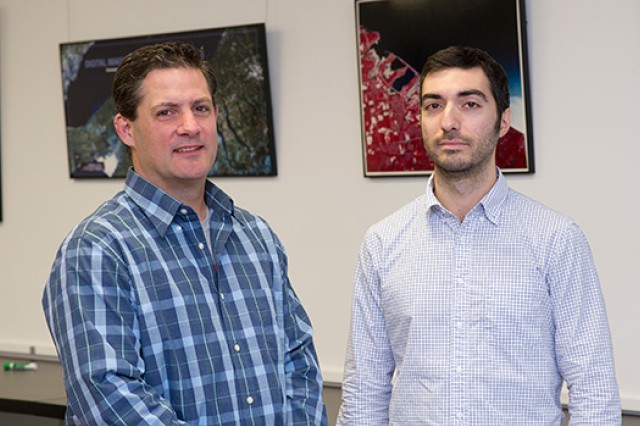
Aaron Gerace Headshot

Aaron Gerace

Research Faculty

Chester F. Carlson Center for Imaging Science
College of Science

585-475-4388
Office Location

Aaron Gerace

Research Faculty

Chester F. Carlson Center for Imaging Science
College of Science

585-475-4388

Areas of Expertise

Select Scholarship

Journal Paper
Gerace, Aaron. "Derivation and Validation of the Stray Light Correction Algorithm for the Thermal Infrared Sensor Onboard Landsat 8." Remote Sensing of the Environment 191. (2017): 246-257. Web.
Gerace, Aaron D., et al. "An Analysis of the Side Slither On-Orbit Calibration Technique Using the DIRSIG Model." Remote Sensing 6. 11 (2014): 10523--10545. Print.
Gerace, Aaron D., John R. Schott, and R Nevins. "Increased Potential to Monitor Water Quality in the Near-shore Environment with Landsat'’s Next-generation Satellite." Journal of Applied Remote Sensing 7. (2013): 073558-073558. Print.
Pahlevan, Nima, et al. "Integrating Landsat 7Imagery with Physics-based Models for Quantitative Mapping of coastal Waters near River Discharges." PE&RS 78. (2012): 1163-1174. Print.
Schott, John R., et al. "Simulation of Image Performance Characteristics of the Landsat Data Continuity Mission (LDCM) Thermal Infrared Sensor (TIRS)." Remote Sensing 4. (2012): 2477-2491. Print.
Published Conference Proceedings
Gerace, Aaron D. "Chasing the TIRS Ghosts: Calibrating the Landsat 8 Thermal Bands." Proceedings of the SPIE Optical Engineering+ Applications. San Diego, California: SPIE Optical, 2014. Print.
Giannandrea, AnneMarie, et al. "The SHARE 2012 Data Campaign." Proceedings of the Algorithms and Technologies for Multispectral, Hyperspectral, and Ultraspectral Imagery XIX. Baltimore, Maryland: n.p., 2013. Print.
Schott, John R., Aaron D. Gerace, and Matthew Montanaro. "Simulation of the Performance and Image Quality Characteristics of the Landsat OLI and TIRS Sensors Using DIRSIG." Proceedings of the SPIE Remote Sensing. Eninburgh, Scotland: n.p., 2012. Print.
Gerace, Aaron D. and John R. Schott. "Over-Water Atmospheric Correction for Landsat's New OLI Sensor." Proceedings of the Ocean Sensing and Monitoring IV. Baltimore, Maryland: n.p., 2012. Print.
Schott, John R., Aaron D. Gerace, and Scott D. Brown. "Incorporation of Advanced Sensor Models in DIRSIG." Proceedings of the 34th Reveiw of Atmospheric Transmission Models Meeting. Albuquerque, New Mexico: n.p., 2012. Print.
Gerace, Aaron D., et al. "Using DIRSIG to Identify Uniform Sites and Demonstrate the Utility of the Side-Slither Calibration Technique for Landsat's New Pushbroom Instruments." Proceedings of the Algorithms and Technologies for Multispectral, Hyperspectal, and Ultraspectral Imagery XVIII. Baltimore, Maryland: n.p., 2012. Print.
Pahlevan, Nima, et al. "Integrating Lansat 7 Imagery with Physics-based Models for Quantitative Mapping of Coastal Waters near a River Discharge." Proceedings of the Imaging and Geospatial Technology-Into the Future. Sacramento, California: n.p., 2012. Print.
Schott, John R., et al. "Modeling the Imaging Performance of the Landsat Data Continuity Mission Sensors." Proceedings of the SPIE Earth Observing Systems XVI. Ed. James J. Butler, Xiaoxiong Xiong, and Xingfa Gu. San Diego, CA: n.p., 2011. Print.
Pahlevan, N., Aaron D. Gerace, and John R. Schott. "Using Thermal Remote Sensing as a Tool for Calibrating a Hydrodynamic Model in Inland Waters." Proceedings of the SPIE Ocean Sensing and Monitoring III. Orlando, FL: n.p., 2011. Print.
Gerace, Aaron D., et al. "Data-driven Simulations of the Landsat Data Continuity Mission (LDCM) Platform." Proceedings of the Ultraspectral Imagery XVII. Orlando, FL: n.p., 2011. Print.
Schott, John R., et al. "Modeling the Imaging Performance of the Landsat Data Continuity Mission Sensors." Proceedings of the SPIE Earth Observing Systems XVI. Ed. James J. Butler, Xiaoxiong Xiong, and Xingfa Gu. San Diego, CA: n.p., 2011. Print.

Currently Teaching

IMGS-540
3 Credits
This course introduces the students to the governing equations for radiance reaching aerial or satellite based imaging systems. It then covers the temporal, geometric, spectral, and noise properties of these imaging systems with an emphasis on their use as quantitative scientific instruments. This is followed by a treatment of methods to invert the remotely sensed image data to measurements of the Earth’s surface (e.g. reflectance and temperature) through various means of inverting the governing radiometric equation. The emphasis is on practical implementation of multidimensional image analysis and examining the processes governing spatial, spectral and radiometric image fidelity.
IMGS-640
3 Credits
This course introduces the students to the governing equations for radiance reaching aerial or satellite based imaging systems. It then covers the temporal, geometric, spectral, and noise properties of these imaging systems with an emphasis on their use as quantitative scientific instruments. This is followed by a treatment of methods to invert the remotely sensed image data to measurements of the Earth’s surface (e.g. reflectance and temperature) through various means of inverting the governing radiometric equation. The emphasis is on practical implementation of multidimensional image analysis and examining the processes governing spatial, spectral and radiometric image fidelity.
IMGS-790
1 - 6 Credits
Masters-level research by the candidate on an appropriate topic as arranged between the candidate and the research advisor.
IMGS-890
1 - 6 Credits
Doctoral-level research by the candidate on an appropriate topic as arranged between the candidate and the research advisor.
IMGS-891
0 Credits
Continuation of Thesis

In the News