Analysis of NOx Blast Fumes using Machine Learning, GIS, and Drones
Principal Investigator(s)
Research Team Members
Bob Kremens
Nina Raqueno
Xuesong Liu (Ph.D.)
Sponsor:
Austin Powder
Project Description
https://www.rit.edu/news/researchers-using-drones-detect-noxious-gas-re… Austin Powder manufactures, distributes, and applies industrial explosives for industries including quarrying, mining, construction, and other applications. Although it’s unusual, these massive explosions can release a foreboding yellowish-orange cloud that is often an indicator of nitrogen oxides—commonly abbreviated NOx. Austin Powder is seeking research into the ability to image these plumes so as to estimate concentration (using image processing, machine learning, sensors on drones) and estimate volume. We also seek to automatically identify NOx in the plume itself.
We have made field-deployable NOx ground sensors that mount to drones and are currently used by Austin Powder in the field. We have made many in-lab controlled spectral measurements of NO2 gas so as to identify absorption features that can be used in algorithms. We have participated in Austin Powder customer blast data collections, created visualizations of NOx concentration and synced video data from UAS’s into a spatial environment (GIS) for spatial and temporal analysis. We have deployed our custom NOx sensors at customer sites to measure NO2 in units of ppm. We have published papers on an image processing technique to plume segmentation using machine learning. Our machine learning algorithm, which automatically detects NOx from blast video imagery, is currently integrated into the Austin Powder blast analysis report pipeline. This algorithm will automatically identify the existence of NOx gas from an average of 17,000 blast videos per year. Newer research includes post blast rock fragmentation sizing (color coded) using a machine learning.
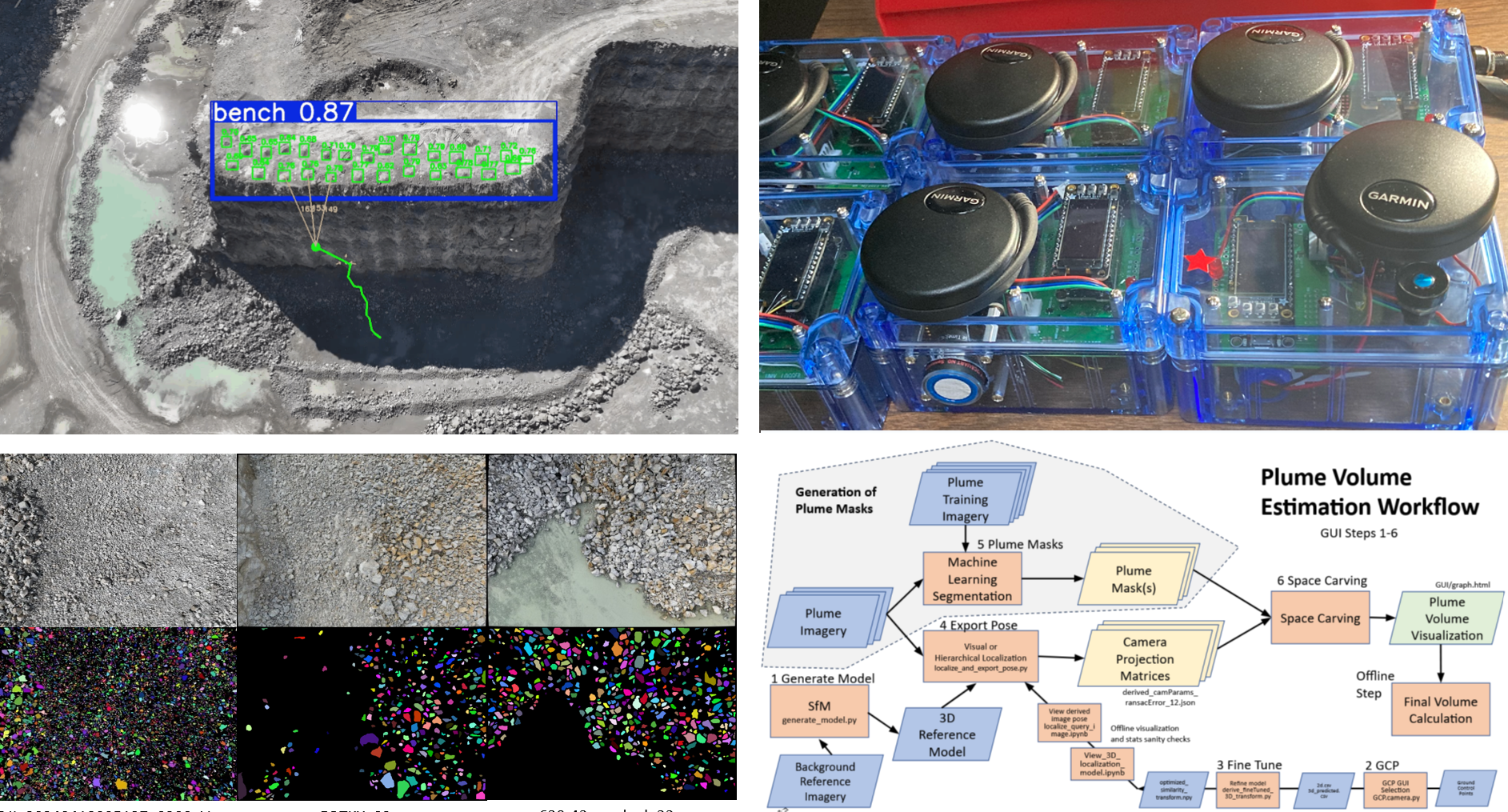
Figure 1: (top left) Shows a drilled hole bench in a quarry where we use machine learning to detect all the hole on the bench. The green line is a result of back-tracking the explosion plume tracing the origin of NOx gas to a particular set of holes. (top right) Shows the latest version of out NO2, GPS away, calibrated, drone-mounted sensor boxes. (bottom left) Shows a post blast rock fragmentation sizing (color coded) using a machine learning algorithm. (bottom right) Illustrates our most recent workflow for estimating blast plume volumes.
References
[1] Liu, X., and Ientilucci, E. Nox detection in video data based on ensemble machine learning. In ISEE 51st Conference on Explosives and Blasting (Cherokee, N. Carolina, Feburary 2025), ISEE, Ed., ISEE.
[2] Liu, X., and Ientilucci, E. Smoke segmentation leveraging multiscale convolutions and multiview attention mechanisms. In Association for the Advancement of Artificial Intelligence (Philadelphia, PA, Feburary 2025), AAAI, Ed., AAAI.
[3] Liu, X., and Ientilucci, E. Smokenet: Efficient smoke segmentation leveraging multiscale convolutions and multiview attention mechanisms. In Computer Vision and Pattern Recognition (Nashville, TN, December 2025), CVPR, Ed., CVPR.