RIT professor expands Great Lakes microplastics research to Georgian Bay
Traci Westcott/RIT
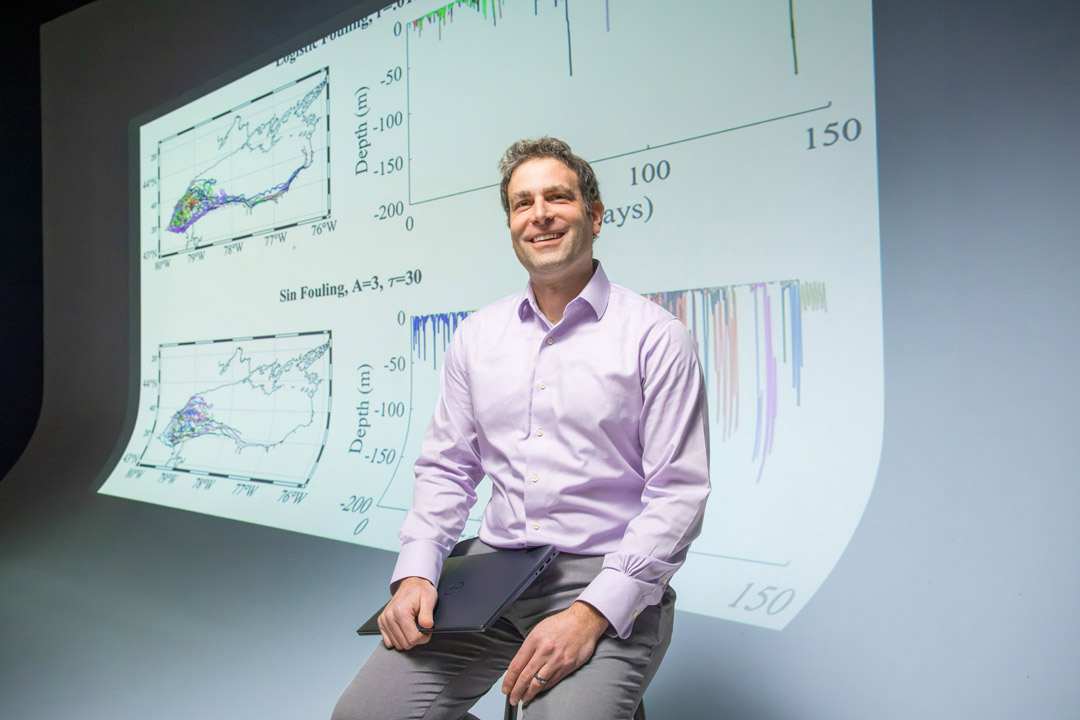
RIT Professor Matthew Hoffman uses mathematical models to examine the distribution and movement of plastics in the Great Lakes.
Rochester Institute of Technology Professor Matthew Hoffman is taking his mathematical models from Lake Ontario to Lake Huron to help map and assess microplastic pollution in Georgian Bay.
Georgian Bay Forever, a Canadian nonprofit aiming to conserve, protect, and restore the aquatic ecosystem of the area, announced five U.S.-based research projects funded by an anonymous foundation. Hoffman will be working with researchers from the University of Michigan on one of the projects.
The team will be mapping the threat of microplastics in the bay and evaluating the transport, fate, and ecological risks of the materials.
“The cool part about this project is that a lot of the methods that I’ll be using are basically what we’re doing as part of the Lake Ontario Center for Microplastics,” said Hoffman.
Microplastics are particles less than 5 millimeters in size that come from the breakdown of various sources of plastic pollution, most commonly food wrappers, bottles, bottle caps, bags, straws, and cigarette butts.
Hoffman’s microplastics research began more than a decade ago, and he spearheaded interdisciplinary research into the issue that culminated with multiple federally and state-funded projects for a now robust research team at RIT.
While in Ann Arbor, Michigan, to give a seminar at the Cooperative Institute for Great Lakes Research last December, he and project principal investigator Melissa Duhaime discovered they were independently considering applying for the funding opportunity and decided to combine projects and apply together.
The first stage of the project began this summer with Duhaime sampling water and sediment around Georgian Bay and examining the size, shape, and polymer composition of the particles. Then, Hoffman will incorporate this information into a particle transport model to try to scale to the entire bay to model microplastic concentrations and size distributions in order to inform risk assessments.
“I’m able to take a lot of the same skills and hopefully a lot of the same codes being used for Lake Ontario and apply it to a different domain,” added Hoffman. “It will be exciting to compare and to have this in two different regions.”
Hoffman’s previous work in microplastics pollution has expanded to other Great Lakes and he also has experience conducting research in Canada as part of the pELAstic Project at the IISD Experimental Lakes Area.