RIT students gain real-world experience solving health care challenges
Traci Westcott/RIT
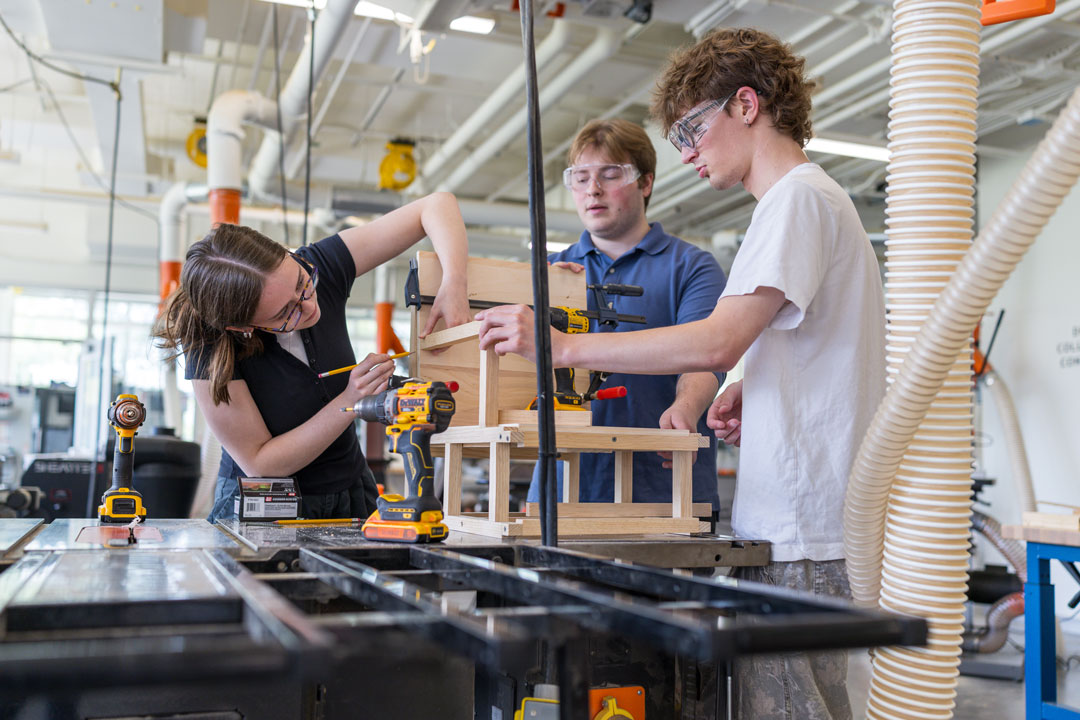
The experience of working in interdisciplinary teams and with real clients prepares students for the workplace. Here, RIT students Brooke Banninger, left, Andrew Nasser, center, and Spencer Harris, right, build a prototype pushcart for children at the Rochester Hearing and Speech Center.
Rochester Institute of Technology students designed accessible health care solutions for children and adults with disabilities and gained real-world experience working with not-for-profit clients.
Interdisciplinary teams of RIT students collaborated on eight projects during the Studio 930 program, a 10-week cooperative education/internship. Students majoring in computer engineering technology, computer science, individualized program, industrial design, mechanical engineering, and mechatronics engineering technology applied their RIT education to challenges facing people with chronic health conditions like dementia, autism, and cerebral palsy.
Experiential learning opportunities like Studio 930 prepare students for career success and are a staple at RIT, which is ranked fifth among co-op/internship programs by U.S. News & World Report.
Accessible design for dementia
Traci Westcott/RIT
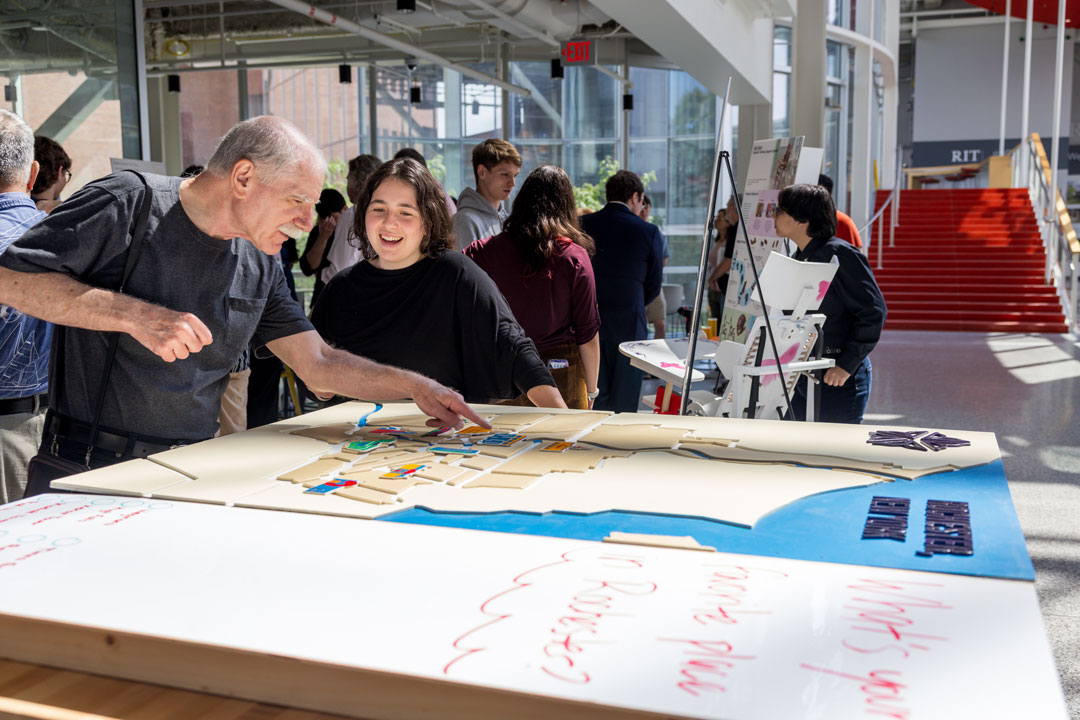
RIT student Gabrielle “Gigi” Bakos, right, shares a ‘memory map’ of Rochester, N.Y., to Dan Harel, left, adjunct professor and one of the Studio 930 founders. Bakos and her team designed the map for dementia patients living at the Jewish Home of Rochester.
One team built a sensory area installation to prompt memories and conversation among older adults living with middle-stage dementia at the Jewish Home of Rochester.
Gabrielle “Gigi” Bakos, a third-year student in the individualized program/sustainable architecture M.Arch programs, and her teammates visited the Strong National Museum of Play to get inspiration from its sensory installations created for children.
The students tailored concepts to an older population and made a wooden “memory map” of Greater Rochester with local detail. A virtual-reality orientation at the Jewish Home taught them about the effects of dementia and influenced their project down to the paint they selected. They picked contrasting colors for attachable landmark features because dementia mutes color perception.
“It’s important that we designed with dignity,” said Bakos, an Ithaca, N.Y. resident and incoming student senator for the School of Individualized Study.
Health technology innovation
Another set of projects in Studio 930 focuses on health care technology that streamlines workflow challenges at Rochester Regional Health, a strategic partner in the RIT RRH Alliance. RIT student teams designed concepts for a precision liquid dispenser for nurses caring for patients with dysphagia, who have trouble swallowing and require thickened liquids, and ergonomic child-proof bottle openers (mechanical and manual) for pharmacists, many of whom develop repetitive motion injuries on the job.
Different types of health care technology present a major growth area at RIT where students apply design thinking to improve life for people with disabilities. Studio 930 is a student-centered and collaborative opportunity housed within the School of Individualized Study and affiliated with RIT’s Access: Healthcare Technology.
Studio 930 creates an environment where diverse perspectives enrich the design process, said Dan Phillips, associate professor of electrical and microelectronic engineering. “When you get different people working together, it’s good for everyone.”
The internship asks students to come with an open mind because accessible and inclusive design requires empathy and awareness, said Lara Cardoso Goulart ’17 (industrial design MFA), program director and co-director of the industrial design BFA program.
“There are things that once you see, you can’t unsee,” she said. “It will make the students better people.”
The sensory project for the Jewish Home of Rochester was eye opening for Paige Panagos, a fourth-year industrial design major from Boxford, Mass. Their experience made them think about a career in access and medical technology. “I feel great that I made a tangible part of user testing,” they said. “Design is storytelling.”
RIT’s maker culture
RIT student Gabrielle “Gigi” Bakos, right, shares a ‘memory map’ of Rochester, N.Y., to Dan Harel, left, adjunct professor and one of the Studio 930 founders. Bakos and her team designed the map for dementia patients living at the Jewish Home of Rochester.
Studio 930 operates as a design consultancy and a workplace in RIT’s multi-level maker place, the SHED. Maker culture has deep roots at RIT with generations of students who tinker and play with technology and the arts and build careers around their passions. All RIT students have access to the SHED’s centralized wood and metal shops, textile and electronics area, and 3D printers, laser cutters, and other spaces.
Proximity to the makerspaces sped up the process work for the Studio 930 teams. Students could make quick prototypes and refine their ideas without leaving the building. Michael Buffalin IV, SHED makerspace director, and SHED mentor and co-op student Nathan Lavie, a second-year mechatronics engineering technology major, helped the teams navigate the makerspace and choose the right materials and processes.
“Studio 930 was meant for the SHED,” Goulart said. “It’s not just a classroom; it’s a multidisciplinary space.”
Assistive play design
Traci Westcott/RIT
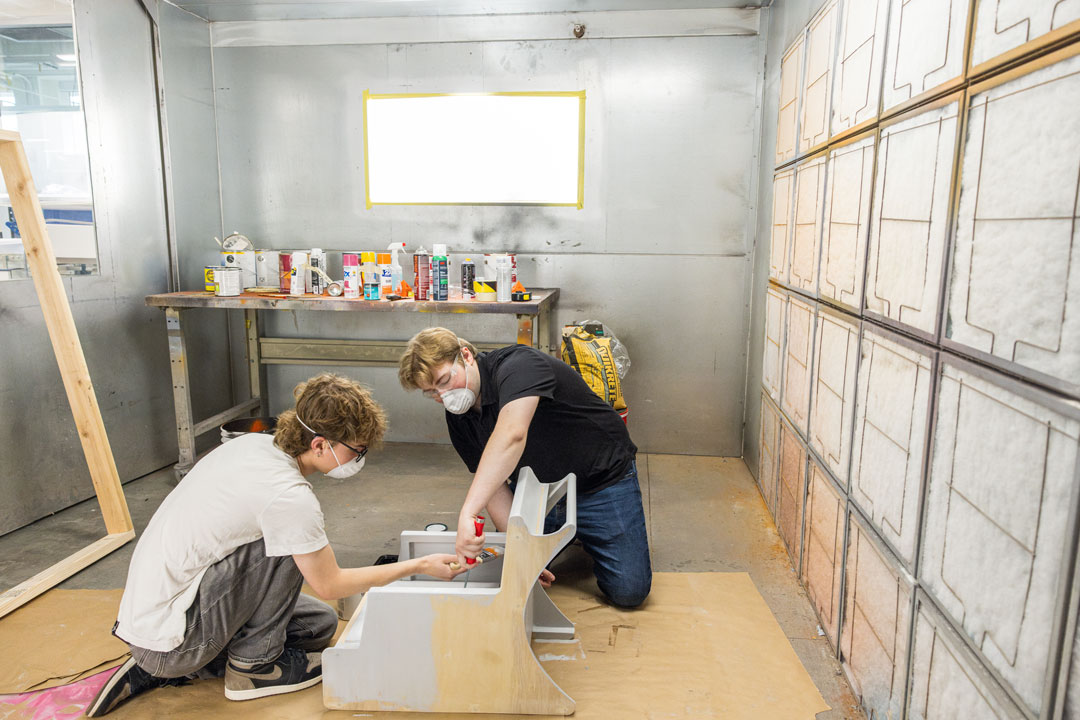
Studio 930 co-op students Spencer Harris, left, and Andrew Nasser paint their final prototype of their weighted pushcart in the Paint Booth in RIT's SHED.
The wood shop was a second home for the team that included fourth-year industrial design students Brooke Banninger, from Pottstown, Pa., and Spencer Harris from Milwaukee, Wisc., and Andrew Nasser, fourth-year mechatronics engineering technology major from Manhattan. The students designed a child’s pushcart with a top-loading compartment holding up to 40 pounds and a lid that doubles as a seat.
Their client, Sara Calus, director of educational and clinical services at the Rochester Hearing and Speech Center, envisioned a weighted cart for toddlers to push, pull, and steer without tipping or losing control. The motion and force needed to move the cart will “stimulate sensory regulation and foster motor planning to help the brain and muscles work together to complete a functional activity,” she said.
After children tested the nearly finished prototype at Rochester Hearing and Speech Center, Calus described the project a “smashing success.”
The team made a few final adjustments and painted the cart to look like a mail truck for added whimsy. They included a shelf between the handles to hold visual cue cards to help the child pushing the cart process information.
“The children crave input and movement, and this is perfect,” Calus said.
RIT Studio 930 accessible design challenges
- Sensory area installation for people with dementia, the Jewish Home of Rochester
- A precision food cutter to prevent choking, Lifetime Assistance Inc.
- Adjustable toilet support for children with cerebral palsy, Mary Cariola Center
- Interactive toys for children with cerebral palsy, CP Rochester
- Portable sensory cocoon and a push-weighted cart for toddlers, Rochester Hearing and Speech Center
- Ergonomic bottle opener for pharmacists and a precision dispensing lid for nurses, Rochester Regional Health