ROAR the Vote

At RIT, we recognize that our students are not only the future of our democracy but also vital contributors to its present. Our campus-wide efforts help students harness their significant influence - especially on the local level. In doing so we can help students see their power in action, in their communities, and around the change they care about most.

The ROAR the Vote initiative is led by the Center for Leadership and Civic Engagement and the Office of Government and Community Relations.

Voter Advocacy Network

The Voter Advocacy Network (VAN) gives students an opportunity to become more involved in voter engagement at RIT through ROAR the Vote. Members of the Voter Advocacy Network engage directly with students to inform them about voter registration and support students in making plans to vote in upcoming elections. They also support ROAR the Vote events, outreach to student organizations, and more.

Recruitment to join the Voter Advocacy Network takes place each semester. If you are interested in learning more or in joining the Voter Advocacy Network, please complete the Interest Form

Community Programs

Constitution Day

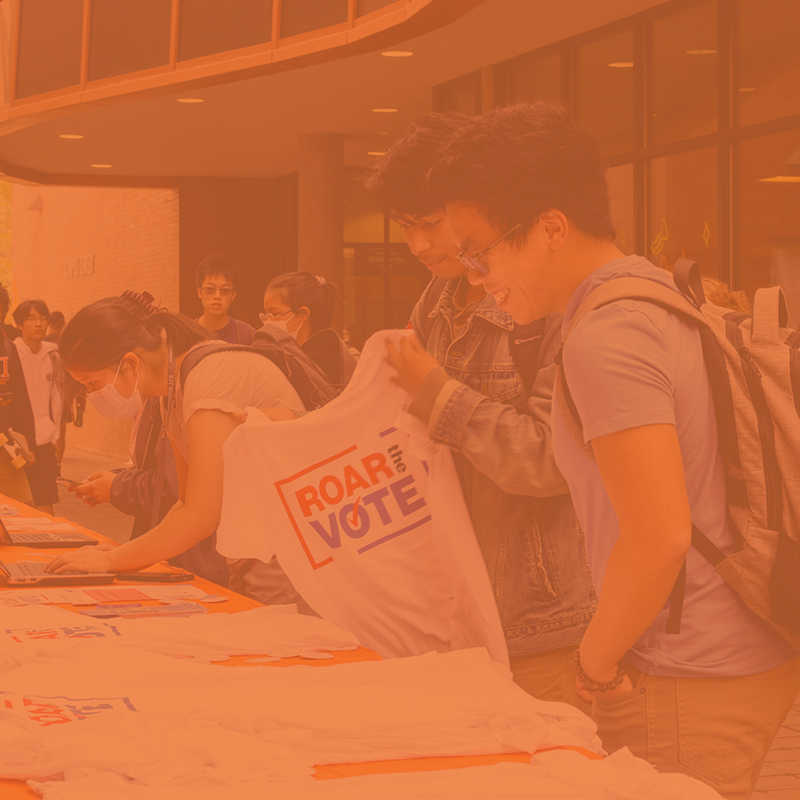
Constitution Day, observed annually on September 17, commemorates the signing of the United States Constitution on September 17, 1787. The day provides an opportunity to reflect on the Constitution’s enduring role as the foundation of the U.S. government and its continuing influence on civic life. Constitution Day encourages students to explore constitutional principles such as civic participation. ROAR the Vote hosts an annual Constitution Day event engaging with students on voter registration, making plans to vote, and reflecting on how they can continue to grow as active participants in their community. 

Congress to Campus

Congress to Campus provides RIT students with a unique civic education by engaging our community in honest dialogue with bipartisan teams of Former Members of Congress, Congressional staff, and American diplomats. These dialogues bring today’s issues to the forefront and display the benefits of healthy partisanship and civility within disagreement.

National Voter Registration Day 

National Voter Registration Day is a nationwide, nonpartisan civic engagement event dedicated to helping students register to vote and participate in the democratic process of elections. Held each September, National Voter Registration Day serves as an opportunity for students to learn about voter registration requirements, update voter registration information or request absentee ballots, and make plans to participate in local, state, and national elections.   

Register to Vote

ROAR the Vote supports students' involvement in electoral politics by helping to ensure that students understand the voting process — including voter registration and absentee ballots, as well as the importance of voting in local, state, and national elections.

Student Voter Statistics

90%

of students reported that RTV assisted them in navigating the voting process after attending a RTV event

71%

of students reported feeling more hopeful, excited, and engaged about processes around elections such as voting and dialogue, after attending a RTV event

34%

of students reported an understanding of their individual role in processes surrounding elections, after attending a RTV event

National Study of Learning Voting and Engagement

The National Study of Learning, Voting, and Engagement (NSLVE) offers colleges and universities an opportunity to learn their student registration and voting rates and, for interested campuses, a closer examination of their campus climate for political learning and engagement and correlations between specific student learning experiences and voting.

The election cycle can bring up a variety of emotional reactions – e.g. fear, sadness, anger, disappointment, grief, powerlessness. If you are experiencing heightened emotions throughout this election season, know that you are not alone. We encourage you to proactively take steps to maintain resilience during this time. 

Helpful tips to promote resilience throughout this election cycle:

  1. Notice feelings: Acknowledge thoughts and feelings. Notice with nonjudgmental curiosity and give yourself permission to feel the way you do.
  2. Unplug: Set time limits on exposure to media content related to the election. Be mindful of the time of day you are taking in information. For example, browsing just before bed is not recommended.
  3. Stay in the here and now: Focus on the present. Avoid engaging with prediction of the future and/or catastrophizing. Notice feelings with nonjudgmental curiosity.
  4. Connect: Connect with friends, family, and community. Talk about your feelings if needed. Practice communicating your boundaries when needed as well. It is OK to end a conversation when needed.
  5. Engage in self-care: Prioritize time for yourself. Spend time outside, practice mindful breathing, go for a walk, engage creativity, read for fun, or play a board game or cards.
  6. Recharge: Maintain basic needs including eating regular healthy meals, regularly activity/movement, and getting enough sleep. 7-9 hours of sleep daily is recommended.
  7. Do something: Channel feelings into positive and meaningful activity. Vote. Find ways to engage with your community through volunteering and advocacy.
  8. Reach out for help when needed: Connect with a resource that can provide a safe space to process feelings if you are struggling to maintain resilience. Counseling and Psychological Services and Spirituality and Religious Life can be useful confidential resources to help you process your thoughts and feelings.
Counseling and Psychological Services will provide election-focused support through the ongoing Let’s Chat program, which offers weekly confidential drop-in consultations with professional counselors. Here, students can get help building resilience and maintaining well-being throughout the election cycle. Learn more about Let's Chat

Community Care Spaces can also be a great drop-in resource for students to explore personal and community impacts of the election. By connecting and exploring with other students who have had shared experiences and hold shared identities, students can expect to gain a sense of belonging and support to bolster resilience through the election season. 

Additionally, a drop-in election support space co-hosted by Counseling and Psychological Services and the College of Science will be available on Thursday, Nov. 7. Learn more

Chaplains will offer guidance and support during drop-in hours the weeks before and after the election.

RIT students care deeply about one another. The students involved in the Peer-to-Peer Support group have volunteered to receive training to support other students who are experiencing anxiety or just general concern about the election. In the days after the election, peer advisors will host dialogue groups for students who want to process with other students.

Program Dates: 

  • Wednesday, Nov. 6
  • Thursday, Nov. 7 
  • Friday, Nov. 8

ALL IN Most Engaged Campus Seal

RIT is proud to be recognized as one of ALL IN Campus Democracy Challenge’s Most Engaged Campuses for College Student Voting. In addition to developing a 2024 democratic engagement action plan, RIT also participated in the ALL IN Campus Democracy Challenge, shared 2020 campus voting data with ALL IN, and is a signatory on ALL IN’s Higher Education Presidents’ Commitment to Full Student Voter Participation.

ALL IN Distinction Ribbons

Frequently Asked Questions

Yes! Your tuition status does not affect your eligibility to vote (nor will registering to vote locally qualify you for in-state tuition). https://allinchallenge.org/wp-content/uploads/ALL-IN-Out-of-State-College-Student-Voting-Guide.pdf

No! You can’t be dropped for registering to vote. This is typically used as an intimidation tactic to suppress the vote. 

The fact that you registered to vote and that you voted, along with your address and party affiliation, are considered public information (although not necessarily easy to access). Your vote itself is anonymous, however.  

(You may want to know that certain other records are public information, such as driver’s license, driver records, court decisions, real estate transactions, etc. Most states are required by law to keep especially sensitive information, such as your social security number and your birthdate confidential.) https://www2.law.umaryland.edu/marshall/crsreports/crsdocuments/RL30318_02082012.pdf

As a student, you have a constitutional right to register and vote at your college address or your family's address - whichever place you consider to be home. That can be your family’s house, your apartment, or your dorm room.  “Misinformation - such as claims that registering to vote at school may jeopardize eligibility for financial aid or insurance - are sometimes used to discourage students from voting locally.” (https://fairelectionscenter.org/map/new-york/)  Note, however, that you select only one place in which to vote: you can’t vote from both your family’s home and at your college home. This is the law in all states; here are references to the New York law: Williams v. Salerno, 792 F.2d 323, 327 (2d Cir. 1986); see also N.Y. Elec. Law § 1-104(22).

Yes! It can be confusing but there are numerous online sites that make it convenient for you to register and vote according to the regulations in your state. RIT has also partnered with TurboVote to make registering to vote and requesting an absentee ballot easier for students.

“Where you register to vote will not affect federal financial aid such as Pell Grants and Perkins or Stafford loans or your dependency status regarding FAFSA (Free Application for Federal Student Aid) (https://fairelectionscenter.org/map/new-york/). Occasionally, state and private scholarships are reserved for those who live in a particular location; however, voter registration is rarely considered to be definitive of residence for financial aid purposes. If in doubt, ask. 

Yes! Federal law provides that in all 50 states, homeless people can register and vote. They can list a shelter or even a street corner as their residence. They do need to provide a mailing address (which can be different from the registration address), which can be a shelter, organization, or anyone willing to accept mail on their behalf. 

The U.S. Constitution grants voting privileges in the general election to the states and the District of Columbia only, not to U.S. territories. Residents of Puerto Rico and other territories (American Somoa, the U.S. Virgin Islands, Guam) can vote in presidential primaries but not the general election.

Source: Factcheck.org

In most states, you can check online with your state Board of Elections. There are also websites that assist you in confirming your registration, such as https://www.nass.org/can-i-vote

Check your state's regulations.

Many states, including New York, have provisions allowing victims of domestic violence to keep their voter registration information (and other normally public information) confidential. They may also vote by absentee ballot rather than going to the polls. Check your state’s Board of Elections for the most-up-to-date information. For details of New York’s provisions for victims of domestic violence, see N.Y. Election Law (5-508) (11-306).

"First, make sure you are at the right polling place and check our Election Center to see if your state offers same-day registration so you can register on-site and vote at the same time. If you are at the wrong polling place they will not have your name on the list of voters. If you are at the correct location and are not on the list, you can still cast a ballot. Ask the poll worker for a provisional ballot. After the polls close on Election Day, the state will check on the status of your voter registration and if there was a mistake made. The state must notify you as to whether your ballot was counted. If you have a problem voting and think your rights have been denied, call (866) OUR-VOTE. There will be lawyers there to help." https://www.rockthevote.org/how-to-vote/voting-faqs/

In most states, 17-year-olds may go ahead and register to vote if they will be 18 by General Election Day. Some states allow 17-year-olds to vote in Primaries, as long as they will be 18 by Election Day. https://fairvote.org/archives/reform_library-voter_pre_registration/