Predatory Publishers
Recognize, Respond, Report
Predatory publishers are opportunistic publishing venues that exploit researchers and professors based on their academic requirements to have their work published. Predatory publishing organizations take the author’s money and publish the work without peer review or professional editing, completely diminishing the integrity of the research. As predatory publishers continue to grow in the world of academic publishing it is important to understand the risk associated with these spam attacks.
Recognize
- Be cautious of relatively low article processing charges (APCs).
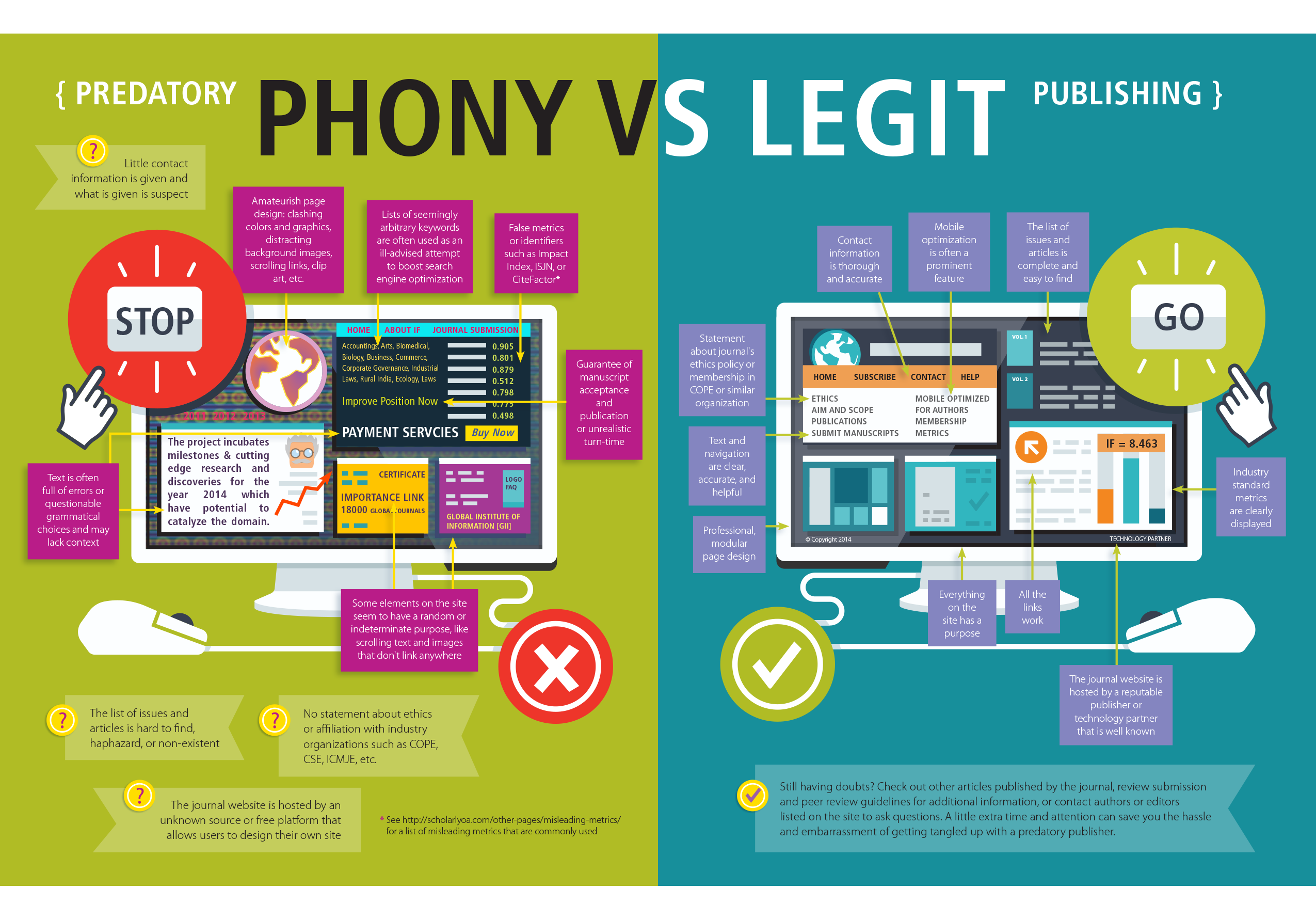
- Look out for fuzzy, distorted, or unauthorized images on the publisher’s website.
- Requests that an article be submitted via email is often a red flag.
- If a publisher lacks policies regarding retractions, corrections, and plagiarism this is a major red flag.
Respond
- Verify the legitimacy of an organization or conference referenced in an email by researching them online.
- Examine this list of suspected predatory publishers.
Report
- Report any suspected predatory publisher scam using the built-in reporting tools in Outlook or Gmail.
- If you clicked a link, opened an attachment, or entered credentials, contact the RIT Service Center immediately for assistance at 585-475-5000, or online at help.rit.edu to open an incident report.
- For detailed instructions on when to unsubscribe, report spam, or report phishing, and how to verify senders and links, see KB0045448: When and How to Unsubscribe, Report Spam, or Report Phishing and How to Spot Spoofing & Bad Links.
How a Predatory Publishing Scam Works
The scam works by the predatory publisher claiming to be a legitimate open-access operation and targeting the existing works of researchers and professors. They will make false claims regarding the practices of the organization and proceed to offer submission to the journal for some amount of money. The payment options will often be limited to a credit card or direct wire transfer to the sender of the email.
Check out this infographic (external) for ways to spot predatory publisher scams.