Staff Career Development

Our approach to staff career development is grounded in the belief that individuals are best positioned to shape their own professional journey. We encourage staff to actively navigate their careers by reflecting on their interests, strengths, and goals, and by leveraging a range of tools, resources, and learning opportunities provided by RIT.

Staff Career Development Philosophy

RIT is committed to fostering an environment where every staff member can grow professionally, expand their skills, and and make a meaningful impact. We do this by providing the resources, transparent pathways, and development tools necessary to align your career objectives with opportunities for growth within the university. 

We believe that career development is an investment in institutional effectiveness and success, empowering staff to grow professionally, align personal goals with organizational needs, and contribute meaningfully to RIT. It’s a strategic approach that values continuous learning, internal mobility, and shared responsibility between staff and managers.

Managers play a critical role as partners in this process - offering guidance, feedback, and support - while empowering staff to take ownership of their growth. Together, this shared approach fosters continuous development, meaningful career progression, and a culture of learning across the organization. 

We encourage you to acquire the forward-looking skills necessary to sustain your career growth and contribute to RIT’s future success.

Staff Career Development Guide
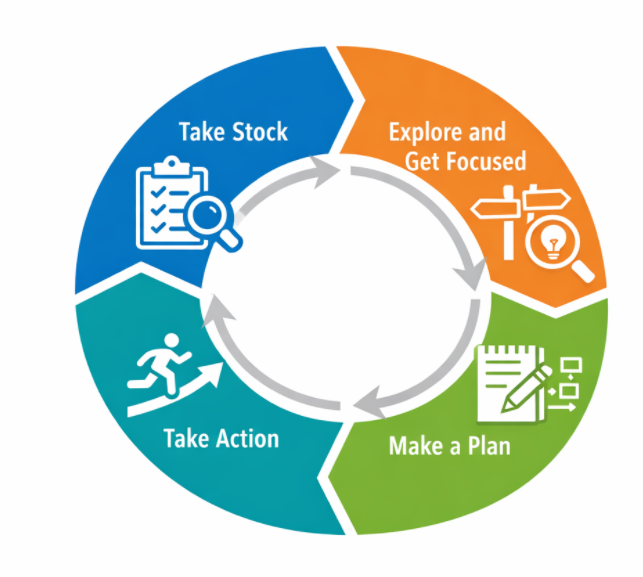
RIT Career Development Guide Graphic

Staff career development is a shared commitment at RIT, one that supports both individual growth and the university’s long-term success. The career development guide was created to help staff better understand the opportunities available to them, reflect on their strengths and interests, and take intentional steps toward professional growth. By providing a clear, consistent framework, the guide connects individual career aspirations with RIT’s values, job profile framework, and commitment to a positive staff experience.

This guide represents RIT’s investment in its people, recognizing that growth looks different for everyone and may include deepening expertise in a current role, preparing for future opportunities, or expanding skills to support evolving organizational needs. It is designed to be practical and flexible. Staff can use it independently to reflect, set goals, and identify development actions, or in partnership with their manager to support meaningful career conversations.

Managers can also use the guide as a resource for coaching, aligning development plans with job profiles, and encouraging continuous learning. Whether used in part or whole, all at once or revisited over time, the guide is intended to support ongoing growth throughout a staff member’s career at RIT.

Choose the version that best fits your needs: 

Download the full guide to work through each step, complete reflection activities, and build a clear, actionable development plan. 

Access the short guide to quickly choose a direction and take immediate steps to move your development forward. 

Or see the Quick Start Guide below!

Quick Start Guide

Self-awareness is the foundation of “taking stock” and is necessary for making informed career decisions. It involves understanding yourself:

  • What you’re naturally good at (strengths)
  • What you enjoy or are curious about (interests)
  • What’s important to you (values)
  • How others see you (perceptions)

The insight you glean from tapping into these four areas can keep you on a path for long-term career success that is authored by YOU.

Tools like self-assessments and reflection exercises can help clarify your strengths, interests, and values while getting feedback from others can give you important (and often necessary) insight into things that are working and potential areas you may want to shore up.

Understanding who you are and what you want from a career are the seeds from which your plan can begin to develop. You spend a lot of time at work, taking stock of what you want and need while coupling it with how you add value to the university can make your career productive, challenging and satisfying. 

Record your insights on the Take Stock Worksheet and move to Step 2, Explore and Get Focused.

Once you’ve Taken Stock, use your insights to re-confirm your current career direction or guide you as you explore other careers at RIT.

Explore the Environment

Understanding the organizational context which you are currently operating or will operate in over the next few years, is essential to effective career planning. Consider taking an informal scan of the environment, taking in what you hear and observing and distilling it into relevant, useful information.

Explore Career Pathways

Once you understand the macro landscape, begin to explore the type of work and paths that support your goals. Review Career Pathway Options to see examples of various types of movement including lateral, upward and vertical.

The RIT Staff Job Profile Catalog  makes it easier to see not only your current role, and other roles across the university that you may be interested in, but also how roles are related to one another. The Staff Job Profile Catalog Job Aid provides instructions for conducting searches.

Use the Human Resources Organization Chart to further understand how a division or college is formally organized and how positions relate to one another from a reporting perspective.

Informational interviews are an excellent way to gather additional details that may not be provided on a job profile.

Get Focused – Development Objectives

Development objectives are specific goals that guide your plan and help you achieve your career aspirations. They can be short term (3-12 months) or long term (1-3 years). They can be written to focus on developing a particular skill, gaining a certification, mastering a competency, building experience or identifying a next position. 

Examples of Development Objectives
  • Prepare for a comparable role within my current job family group
  • Move to the next level in my job profile
  • Learn project management skills
  • Pursue a management role in my department

Be prepared to update your development objectives and even shift, if needed. As a person with natural gifts and acquired learning, you could be good at a number of careers. Pick a direction and move with it. Set a time to reflect and course correct, when (not if) you learn something that better informs you of your direction. While nothing is forever, and you may be tempted to let the tides or winds take you in whatever direction they blow, creating development objectives is key to getting started and intentionally moving in the direction of your full potential. 

Record your insights on the Explore & Get Focused Worksheet

What is a Career Development Plan (CDP)?

A Career Development Plan (CDP) is a living document that helps you clarify your development objectives – the knowledge, skills, experiences, and competencies you want to develop – and outline specific actions that support your growth. It also provides a structured way to track progress, reflect on learning, and adjust over time.

CDPs are designed to promote intentional learning, shared understanding between employees and supervisors, and steady, sustainable growth rather than short-term or onetime career decisions. A CDP does not need to focus on immediate promotion or job change. Instead, it can be used to intentionally build skills, experiences, and confidence that support:

  • Growing and deepening effectiveness in your current role
  • Preparing for future opportunities over time
  • Expanding skills, capabilities, or confidence
  • Exploring new interests or potential career directions

Identify and Define Career Development Items

In Workday, the specific strategies you will use to achieve your development objectives are referred to as Career Development Items (CDIs). CDIs describe the things you will do to develop the KSA’s and Competencies that support your career aspirations. Strong development items focus on learning, practicing, and experiencing.

Well-defined CDIs include meaningful learning opportunities, stretch experiences, and professional relationships. One helpful way to think about and design effective CDIs is through the lens of the 70-20-10 Model of Development. Don’t forget, your manager can be a key partner by making introductions, assigning stretch work, offering feedback, and helping you reflect.

Sequence, Prioritize, and Build Your Career Plan

It’s important to note that not everything needs to happen at once. Career development plans that are too ambitious often stall. Your plan should take into consideration what development objectives and career development items should happen first; how long will each take to complete, what fits best with your current workload, and what can build momentum quickly. Ultimately, your career development plan should feel challenging but doable.

Once you’ve identified your development objectives, KSA’s & competencies and career development items, you’re ready to draft your plan. Use the Career Development Worksheet to sequence and prioritize your CDIs in a way that feels realistic and achievable.

Record your prioritized items on the Career Development Item Worksheet

Track Your Development Items in Workday

Workday is a central place to document your Career Development Plan (CDP) and Career Development Items (CDIs). Capturing your plan in Workday helps translate your intentions into visible, commitments and supports ongoing conversation, reflection, and followthrough over time.

Step-by-step instructions for documenting career development plans and items can be found in Career Development Plans and Items job aid.  

Use “My Check-Ins” to Document Development Conversations

Workday’s My Check-Ins feature supports ongoing dialogue with your manager (or other trusted advisor) about your development. It provides a space to share progress, reflect on learning, discuss challenges, and make adjustments to your plan. Used consistently, My Check Ins help ensure development remains an active part of your work, not something that gets discussed only once or twice a year.

Step-by-step instructions for documenting career development plans and items can be found in the Workday Check-Ins job aid.

Get to Work on Your Career Development Items

Your Career Development Items (CDIs) are the specific actions you take to support your development objectives. As you begin executing your CDIs: 

  • Start with the items you prioritized as most impactful and realistic 
  • Build development into your existing workload where possible 
  • Focus on learning through doing, not just completion 

Stay Accountable to Yourself

Accountability is what sustains momentum over time. Without it, even well‑designed plans can stall, especially when competing priorities surface. Accountability is not about pressure; it’s about follow‑through and visibility. 

Your Manager is Your Career Development Plan Partner

While you own and drive your career development, your manager is an important partner in Step 4. 

Use your regular check‑ins or 1:1 meetings to share what you’re working on and what you’re learning. Ask for specific feedback tied to your development objectives and discuss upcoming opportunities that could support your CDIs.

Track Progress and Capture Learning

Tracking progress is not just about documenting what you completed. It’s about understanding what you learned and how you’re applying it to your work today. Capturing what you’ve learned along the way helps you recognize growth that might otherwise go unnoticed.

Reflect, Learn, Adjust

Career development is an incremental, iterative process. New information, feedback, or opportunities may emerge as you execute your plan. It’s important to capture these insights. Adjusting your plan is a sign of learning. Flexibility allows your CDP to remain useful and realistic as your career evolves. 

Career development is not a destination but an ongoing practice, and a commitment to yourself and your professional growth. As your career and goals evolve, you may create and carry out multiple Career Development Plans each approached with the same care and commitment.

By continually reflecting, refocusing, planning, and taking action as circumstances change, you ensure your development remains aligned with who you are, what matters to you, and where you want to grow next.

Frequently Asked Questions

The Staff Career Development Guide is a step-by-step framework that helps you reflect on who you are, explore options, create a plan, and take action to grow in your career at RIT over time.

The steps are designed to build on each other, but you can revisit them anytime. Career development is not linear. You may reflect, plan, and adjust as your goals change.

No. Career development can include:

  • Growing in your current role
  • Building new skills
  • Exploring interests
  • Preparing for future opportunities

A Career Development Plan (CDP) is a flexible plan that outlines your development objectives and the specific actions you will take to grow.

Career Development Items (CDIs) are the specific actions you take, like projects, learning experiences, or conversations, to build your competencies, skills and knowledge.

The 70-20-10 model is a widely used framework for adult learning and career development. It reflects an important reality - that most professional growth doesn't happen in classrooms or workshops. It happens on the job, supported by others. the model breaks learning into three complementary sources and illustrates the optimal breakdown of effort and attention to each type of learning:

  • 70% through experience
    • Doing the work, taking on new challenges, stretch assignments, and problem solving in real situations
    • Examples: Lead or co-lead a team project; volunteer to onboard a new team member; take ownership of something that affects multiple stakeholders; pilot a new process or initiative
  • 20% through relationships
    • Feedback, coaching, mentoring, observing others, and learning from peers and supervisors
    • Examples: Ask for feedback regularly; identify a mentor who has relevant experience and perspective; conduct informational interviews with skilled ldeaders; join a professional network relevant to your field
  • 10% through formal learning
    • Courses, training programs, reading, workshops, and other structured learning
    • Examples: Take a course through RIT, LinkedIn Learning, or another resource available to RIT employees; read relevant articles or books; attend a workshop or webinar hosted by a relevant professional association

Focus on a few key priorities. Your plan should feel challenging but doable, not overwhelming.

Use Workday to document your career development objectives, items, and activities so you can track progress and reflect over time. Tools like My Check-Ins and Career Development Items and Plans will help you stay on track.

That’s normal. Your plan should evolve as you learn more about yourself and your work.

Go back to your motivations and focus on one or two priority actions to get momentum again.

Success means continuing to learn, grow, and stay aligned with what matters most to you over time.

See the full list of Frequently Asked Questions for staff here.

See the full list of Frequently Asked Questions for managers here.