Dimah Dera and students to develop trustworthy AI through NSF CAREER Award
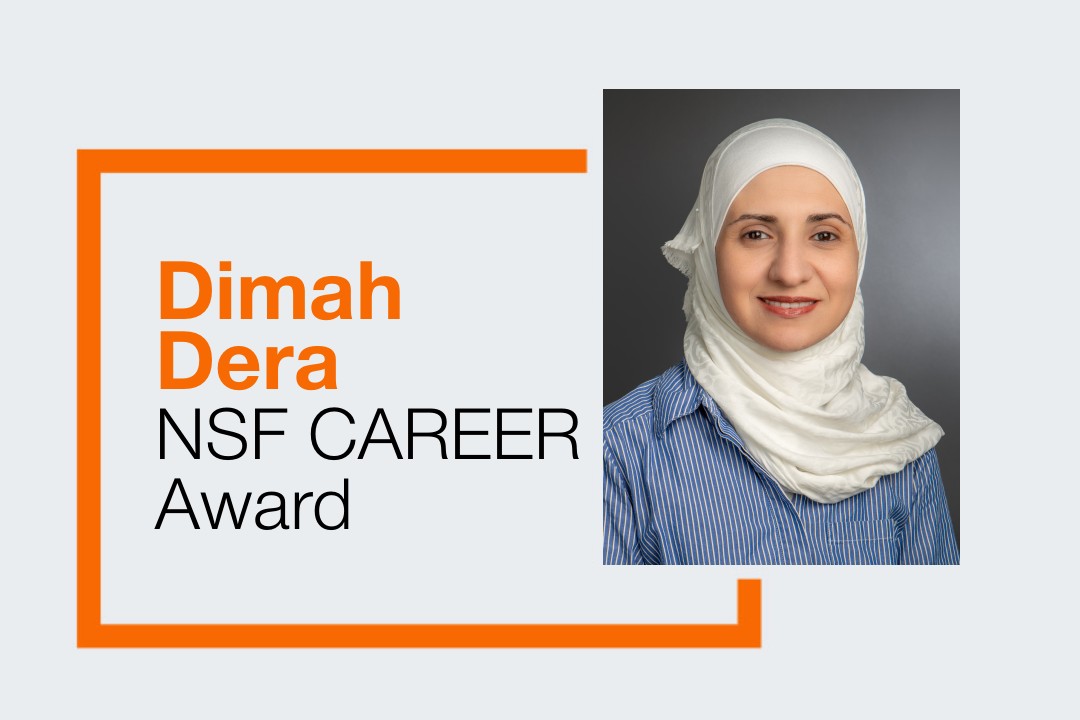
AI is transforming nearly every industry, and RIT’s Frederick and Anna B. Wiedman II Professor Dimah Dera is working to develop adaptable and trustworthy models that support different intelligent sensing technologies. She recently earned a National Science Foundation (NSF) CAREER Award to support her research and education efforts.
The five-year award is one of the NSF’s most prestigious honors for early-career faculty, supporting those who effectively integrate research and teaching. Fewer than a quarter of CAREER Award proposals are funded each year.
Through the award, Dera will develop AI models that can continuously learn from new information, adapt to changing environments, and account for uncertainty. Many current AI models are static, meaning they must be retrained when new data or changing conditions arise, a process that can be time-consuming and inefficient. Dera’s research aims to create models that can respond to distribution shifts and evolving data while retaining knowledge from prior learning.
“Every time we’re developing an algorithm we need to take into account the trustworthiness, the adaptability, and the uncertainty awareness before finalizing our model and putting it into deployment,” said Dera.
The project will also create research opportunities for students at multiple education levels from high school to Ph.D.’s. Dera will work with RIT’s K-12 University Center to engage five to six high school students each year in developing and studying AI models for environmental monitoring. Undergraduate students will be able to incorporate the work into senior design projects, while graduate students will be supported by the award to conduct advanced research. Dera also plans to integrate the project into both her undergraduate- and graduate-level courses.
The research will be informed by real-world applications through industry collaborations in healthcare, surveillance, and remote sensing.
“The nice thing about this award and this integrated research and education plan is that it spans all education levels so students are aware of all the challenges we face in this new era of AI,” said Dera.
Dera’s interest in trustworthy AI began during her academic training. As an undergraduate biomedical engineering student, she knew she wanted to pursue a career in academia and scientific research. During her master’s degree in electrical and computer engineering, she focused on brain tumor segmentation using mathematical modeling algorithms. That experience led her to explore machine learning and the ways statistics, mathematical modeling, and AI could be combined to solve complex problems.
“These algorithms are going to be used for patients so there’s no room for error,” said Dera. “During my Ph.D., I was investigating trustworthiness and how I could develop models that can quantify uncertainty.”
Now as a faculty member in the Chester F. Carlson Center for Imaging Science, Dera will use the CAREER Award to advance trustworthy AI research while preparing the next generation of scientists and engineers.
“I learned how I can develop research that can be integrated well within the education side of my career,” added Dera. “This is part of our job as faculty. We’re not only researchers and we’re not only teachers. We are both, and we need to learn how to integrate both tasks.”