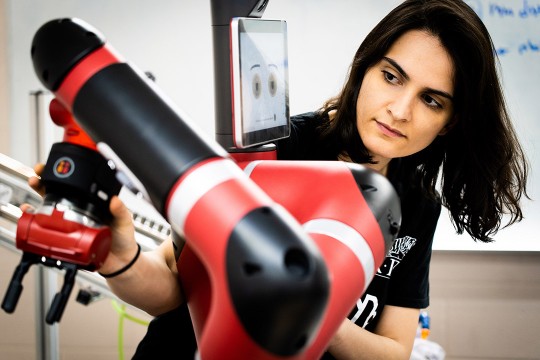
Undergrads from colleges across the U.S. come to RIT for summer research
RIT hosts four NSF Research Experience for Undergraduates (REU) sites for budding researchers
Liam Myerow/RIT
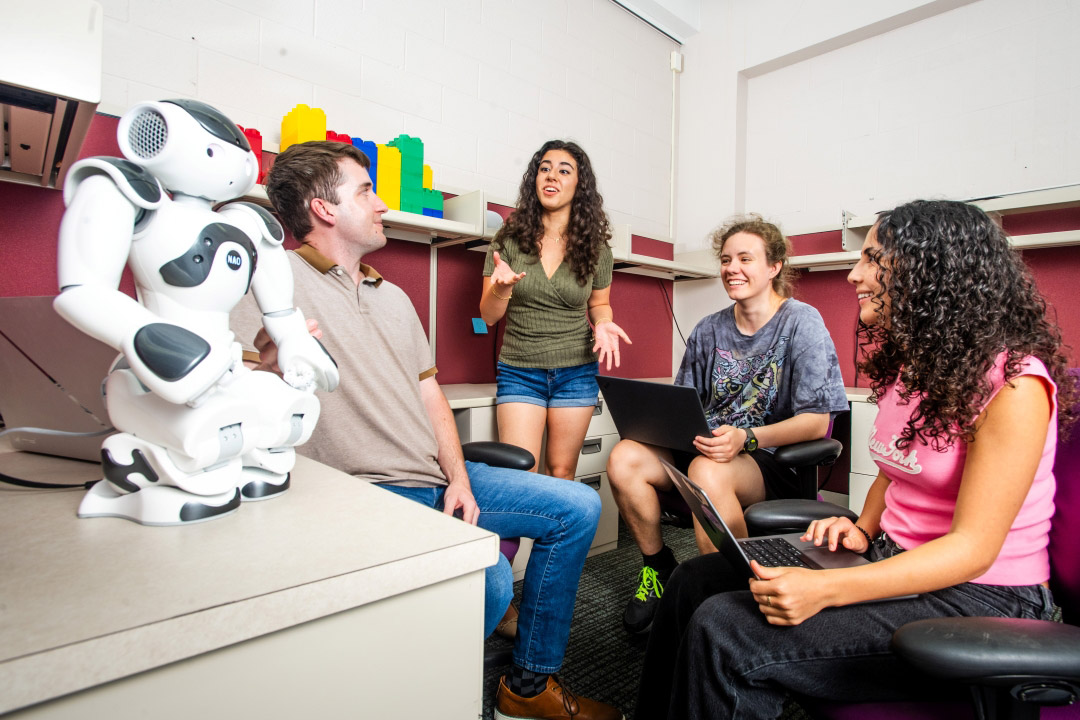
Research Experience for Undergraduates (REU) sites are bringing the country’s top college students to RIT for summer research. Nickolas Slayter, left, an electrical engineering major at San Diego Miramar College; RIT graduate research assistant Sophia Caruana, a cognitive science Ph.D. student; Emily Taylor, a computer science student at Florida State University; and Hazal Sahin, a neuroscience student at University of Pittsburgh, are studying how AI and robots can be used to assist deaf and hard-of-hearing individuals in the classroom.
Emily Taylor, a computer science student at Florida State University, was looking for an opportunity to combine their interest in AI research with their passion for learning American Sign Language.
Taylor landed in the perfect spot this summer doing a Research Experience for Undergraduate (REU) program at Rochester Institute of Technology. Now, Taylor is running a study on how generative AI and robots could be leveraged to assist deaf and hard-of-hearing individuals in the classroom.
RIT is hosting four REU sites this summer, led by faculty in RIT’s Golisano College of Computing and Information Sciences and College of Science. The 2026 REU sites include:
- Computational Sensing for Human-centered AI
- Trustworthy AI
- Multimessenger Astrophysics
- Extremal Graph Theory and Dynamical Systems
This summer, REU programs have brought 37 participants to Rochester, including students from other universities across the country and RIT undergraduate students. The RIT programs include a stipend, travel, and housing.
The university has a longstanding history hosting REU sites, which are funded by grants from the National Science Foundation (NSF). REUs are designed for undergraduate students to experience and develop a passion for research and receive guidance for pursuing graduate careers. The NSF program aims to strengthen the nation’s STEM workforce by preparing the next generation of innovators to tackle complex scientific and societal challenges.
“Through research, students learn how to ask meaningful questions, navigate uncertainty, learn from unexpected results, and solve open-ended problems where there may not be a single correct answer,” said Reynold Bailey, principal investigator for the REU site in Computational Sensing for Human-centered AI and professor in the Department of Computer Science. “REUs also provide opportunities that many students may not have at their home institutions, exposing them to cutting-edge research, advanced facilities, and close mentorship from faculty and graduate students.”
Students experience the process of discovery firsthand
During the REUs, participants are working in teams on a range of research projects.
Taylor is working on a team with Hazal Sahin, a neuroscience student at University of Pittsburgh, and Nickolas Slayter, an electrical engineering major at San Diego Miramar College. Their project tests how a robot companion can be used to increase a deaf or hard-of-hearing individual’s situational awareness and social inclusion in the classroom.
“There’s no doubt about it—robots are going to be in our lives,” said Sahin. “It’s important to do research that looks at how they can be applied in beneficial ways for everyone.”
The team is conducting a human subject experiment—something none of them has ever done before. In a classroom setting, study participants will interact with a Nao autonomous, programmable humanoid robot. The Nao robot can perceive and process visual, auditory, and other modalities.
The team is programming the robot to use interactive cues, including lights, pointing, and tactile stomp vibrations. The experiment that the team designs will test several variables and distractions in the classroom, including an emergency alarm, a name call, off-topic chatter, and on-topic chatter. The team said it hopes to discover which modalities study participants like the most and if they trust the robot. Future work could look at how the framework operates in office and manufacturing environments.
“We’ve been talking with many deaf and hard-of-hearing people and there have been times where technology was invented without them in mind,” said Slayter. “As technology like AI progresses, companies want to move forward as fast as possible. But it’s important to make sure that no populations are left behind.”
Graduate students visiting from Gallaudet University, Joe Merino and Paige DeVries, are also contributing to the team’s activities. Faculty mentors on the project include Jamison Heard, Cecilia Alm, and Bailey.
Throughout the summer, REU students also take part in professional development activities designed to support their growth as researchers. Some other enrichment activities include a seminar on grant writing, Q&As with professors in their areas, a mentoring café, industry field trips, and social team-building events, including a visit to Niagara Falls.
Sophia Caruana, a cognitive science Ph.D. student at RIT and member of RIT’s Computational Linguistics and Speech Processing (CLaSP) Lab, is serving as a graduate research assistant who works with students at the Computational Sensing for Human-centered AI REU site.
Caruana was once in the undergraduates’ shoes. She did a summer REU at University of Rochester as an undergraduate. This summer, she is refining her own mentorship and leadership philosophy in hopes of one day becoming a professor.
“I hope the students take away something personal from this experience and learn how being a researcher reflects on who they are,” said Caruana. “These experiences in research are great for developing character and learning how to work hard and how to have patience.”
At the end of the summer, many of the REU students will present their work at RIT’s annual Undergraduate Research Symposium. In previous cohorts, many REU students continued refining their projects for publication and conference presentations.
Attend the Undergraduate Research Symposium
What: The 35th annual Undergraduate Research Symposium showcases research and creative projects undertaken by undergraduate students in all RIT colleges.
Who: Free and open to the public
When: July 30, 2026