2025 Frameless XR Showcase
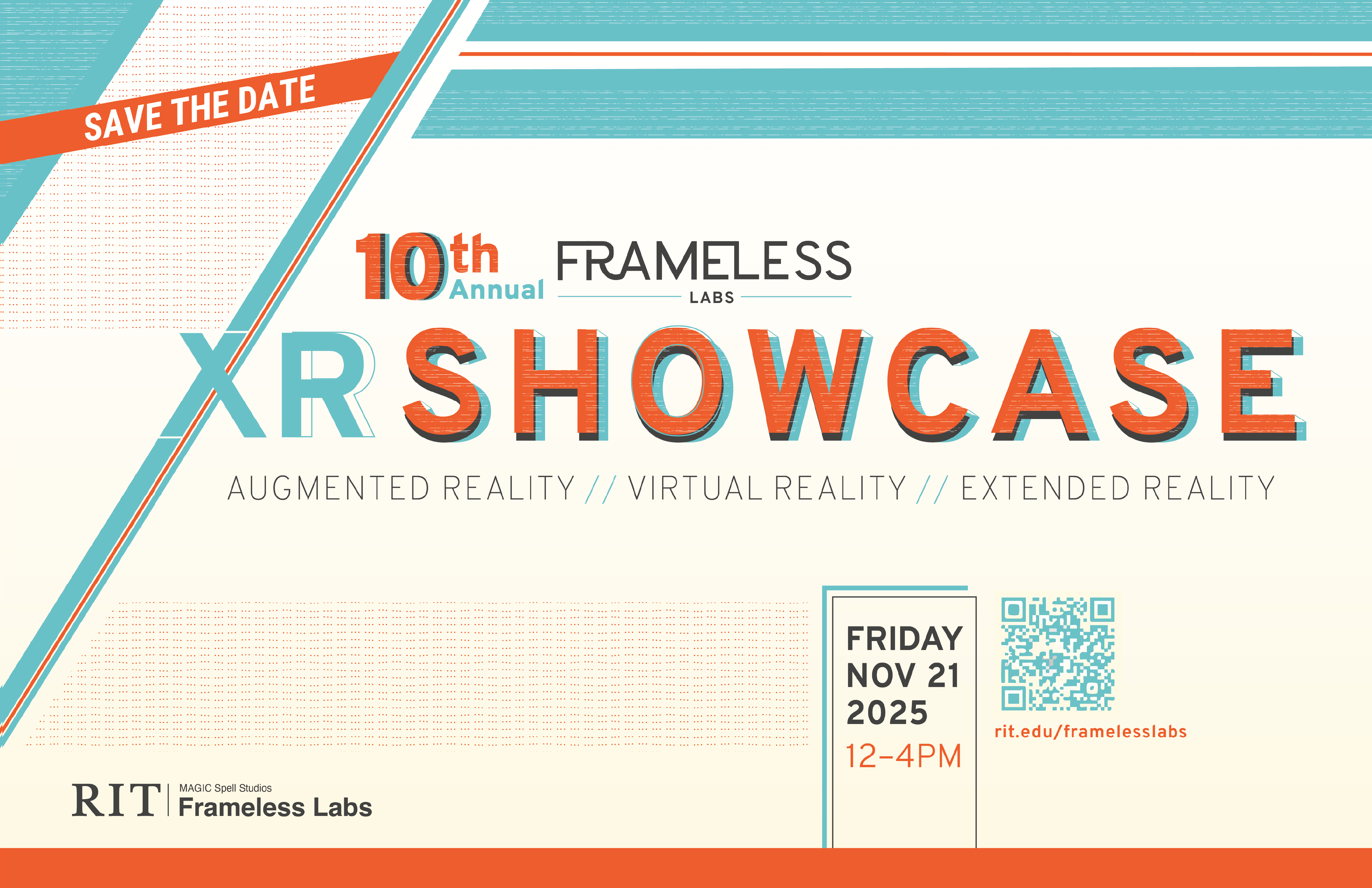
10th Annual Frameless XR Showcase
November 21, 2025
The Frameless Labs XR Showcase is an afternoon of virtual, augmented, and mixed reality demos, installations, and performances.
Location
MAGIC Spell Studios, Rochester Institute of Technology
Questions?
Please contact framelesslabs@rit.edu if you have any questions.
Note: There is no cost associated with either submitting a proposal or participating in the symposium.
Schedule
Interpreters can be requested at myaccess.rit.edu.
Videos of all Demos and Installations will be available on the Frameless Labs 2025 XR Showcase youtube playlist as they are submitted.
Demos / Works in progress / Installations : noon - 4 p.m.
Location: MAGIC Sound Stage (MSS-2020 / MSS-2060)
- Brian Kirby, Associate Director of Undergraduate Affairs, Meinig Family Professor of Engineering, Cornell University
- Ryan Tapping, Lecturer, Physics, Cornell University
- James Spinazzola, Barbara & Richard T. Silver ‘50, MD ‘53 Associate Professor, Director of Winds, Cornell University
- Suryash Malviya ’26, Physics and Astronomy & Computer Science, Ithaca College
- Ksenia Ionova (kbi4@cornell.edu) , Senior Instructional Designer, Center for Teaching Innovation, Cornell University
- Becky Lane, Associate Director of Learning Technologies, Center for Teaching Innovation, Cornell University
Creative Technology Lab at the Center for Teaching Innovation, Cornell University, will share three applications created in collaboration with Cornell faculty and students to foster learning goals in STEM and Humanities. First, we will share a new application called KirbyXR that lets mechanical engineering students disassemble, examine, and measure a 1916 Curtiss OXX-6 engine. The second and the third applications will be updated versions of the 3D Physics Simulation and VR Conducting Trainer we showed last year. The 3D Physics Simulation models are used to improve student understanding of the 3D-based concepts in a 500+ large-enrollment course. The VR Conducting Trainer app helps students learn topics including the beat plane, traditional beat patterns, various conducting styles, and more generally, the development of a comprehensive vocabulary of gestures for conducting.
Learn more about 3D and AR/VR for Learning in STEM and Humanities >
Location: MAGIC 1st floor atrium
- Dhaval Mahajan (dm3324@rit.edu), MS HCI, School of Information, RIT
- Sidney Grabosky, MS HCI, School of Information, RIT
- Roshan Peiris, Assistant Professor, School of Information, RIT
This exhibit presents an AI-powered Augmented Reality Chat Assistant designed to train and support autistic and neurodivergent individuals in customer-service roles. Using a wearable display, the system provides real-time conversational guidance, visual cues, and step-by-step prompts that help employees navigate customer interactions with greater confidence and independence.
Learn more about AI-Powered AR Assistant: Empowering Inclusive Customer Service >
Location: MAGIC Sound Stage (MSS-2020 / MSS-2060)
- Michael Murdoch (mmpocs@rit.edu) - Munsell Color Science Laboratory, RIT
The AR application for XReal includes a model brain representative of neuroscience education content. The application allows remote control of rendering parameters including transparency, emission, and glow, which will be used for testing of visual performance in a variety of indoor lighting conditions.
Learn more about Appearance Manipulation for AR in Education >
Location: MAGIC Sound Stage (MSS-2020 / MSS-2060)
- Fenway Powers (fpowers@library.rochester.edu) - Mary Ann Mavrinac Studio X, University of Rochester Libraries
- Yvie Zhang- Mary Ann Mavrinac Studio X, University of Rochester Libraries
Aurum is a virtual reality alchemy laboratory based off of real medieval alchemy manuscripts. To learn how to do things like turn copper to gold, try out Aurum in VR!
Location: MAGIC 1st floor atrium
- Gabriel Diaz (gabriel.diaz@rit.edu) - Chester F. Carlson Center for Imaging Science, Rochester Institute of Technology
Visitors will experience an interactive ball-catching task set in a dynamic “random-dot-stereogram” environment designed to isolate the ability to perceive depth and scene structure from stereo vision. This is a demonstration of a research tool in development for the assessment of stereo vision thresholds, the rehabilitation of stereo vision. This tool can also be used to improve the field’s understanding of the role of stereovision in visually guided action.
Location: MAGIC Sound Stage (MSS-2020 / MSS-2060)
- Tian Jiang (tjiang22@buffalo.edu) , University at Buffalo, Department of Media Studies (author)
- David Pape, University at Buffalo, Department of Media Studies (on site exhibitor)
Bio-News is an AR bio-media installation composed of sixteen Petri dishes that visualize real news stories from The New York Times and The Buffalo News through biological and digital processes. Each dish cultivates censored words, decaying images and symbolic traces that come alive in augmented reality, revealing how language, media and microorganisms intertwine to expose hidden layers of power and silence in contemporary society.
Location: MAGIC Sound Stage (MSS-2020 / MSS-2060)
- Anthony Betrus (betrusak@potsdam.edu) -- SUNY Potsdam
Step inside a collection of immersive virtual exhibits created by graduate students in ID 625: Emerging Learning Technologies. Explore how VR brings learning to life through topics like Trailblazers in Women’s STEM, Math Escape Rooms, Space Exploration, Gorilla Habitats, World Languages, and Global Uprisings. Each exhibit captures culture, creativity, and innovation through the lens of education and emerging technology.
Learn more about Capturing Culture with VR Exhibits in CoSpaces >
Location: MAGIC Sound Stage (MSS-2020 / MSS-2060)
- Elousie Oyzon (eroics@rit.edu) - School of Interactive Games and Media, GCCIS, RIT
- Ralston Galbraith - School of Interactive Games and Media, GCCIS, RIT
- Napolean Nyatt - School of Interactive Games and Media, GCCIS, RIT
ChangelingVR is a virtual reality first-person interactive mystery. Enter the thoughts of each one you touch: A different memory, a different world, a different story.
Location: MAGIC Sound Stage (MSS-2020 / MSS-2060)
- Dana Hunt-Locklear ( danahunt@buffalo.edu ) - Media Studies, University at Buffalo
‘creationstory’ is a mini walking simulator where players learn the story of a people who preexisted in the land they currently inhabit. With secret text hidden in the landscape, players must traverse and explore for the sake of uncovering a hidden message.
Location: MAGIC Sound Stage (MSS-2020 / MSS-2060)
- Michael Jarvis ( michael.jarvis@rochester.edu ) - Studio X, University of Rochester
Archaeological excavations are often distant, complex, and fleeting - hard to visit and covered up after fieldwork concludes. Digital Docent (currently a prototype platform) enables archaeologists and the public alike to view sites at various stages of excavation as if they were there in VR, the better to learn how archaeologists "read" dirt, formulate chronological sequencing, and interpret changes over time.
Learn more about Digital Docent: Interpreting Archaeological Excavations in VR >
Location: MAGIC 1st floor atrium
- Dr. Hanif Rahbari, Golisano College of Computing and Information Sciences, Rochester Institute of Technology
- Geoff Twardokus, Kate Gleason College of Engineering, Rochester Institute of Technology
- Deze Lyu (dl6822@g.rit.edu), Golisano College of Computing and Information Sciences, Rochester Institute of Technology
We demonstrate an immersive digital twin experience built in Unity that creates virtual replicas of real-world 3D scenes and shows vehicle movements on top of them to support connected-vehicle research. In this work-in-progress system, you specify a location and area of interest, and it constructs a realistic environment from open geospatial sources. It can then ingest live vehicle data to place and animate cars in real time, so you can observe traffic and V2X-style behaviors on actual geography or from a driver's perspective.
Learn more about Experiencing Connected Vehicles Through Digital Twin >
Location: MAGIC Sound Stage (MSS-2020 / MSS-2060)
- Ziming Li (zl1398@rit.edu) - School of Information, GCCIS, RIT
- Dr. Roshan Peiris - School of Information, GCCIS, RIT
This demo integrates virtual reality with generative AI avatars powered by large language models to simulate immersive role-play training scenarios for job-related communication practice. Participants engage in realistic conversations with AI-driven customers, manage orders, and interact with virtual objects to build communication and multitasking skills.
Learn more about Generative AI-based VR Interactive Customer Service Training >
Location: MAGIC Sound Stage (MSS-2020 / MSS-2060)
- Spencer Ahn ( sahn14@u.rochester.edu) - Studio X, University of Rochester
We will be exhibiting a 360 degree virtual tour of the Wilmot Cancer Center's Genomics Shared Resource Lab.
Location: MAGIC 1st floor atrium
- Chenghao Li (chenghaol@ylemstudio.com) - Ylem Studios
- Noya Cai - Ylem Studios
We will be exhibiting a VR puzzle game set aboard a city-scale space elevator, featuring chain-reaction challenges and interactive physical systems in a stylish retro-future world.
Location: MAGIC 1st floor atrium
- Huadong Zhang (hz2208@rit.edu) - School of Interactive Games and Media, Golisano College of Computing and Information Sciences, Rochester Institute of Technology
- Chao Peng - School of Interactive Games and Media, Golisano College of Computing and Information Sciences, Rochester Institute of Technology
We will exhibit “Lunar Roving Adventure”, a virtual reality game that brings the historic Apollo lunar exploration missions to life. Visitors will experience deploying the lunar rover, exploring the Moon’s surface, and piloting the rover in an immersive VR environment that combines authentic science facts with engaging storytelling.
Learn more about Lunar Roving Adventure: Stepping into Historic Apollo Missions in Virtual Reality >
Location: MAGIC Sound Stage (MSS-2020 / MSS-2060)
- Xinmiao Zhang (xz7004@g.rit.edu) — Munsell Color Science Laboratory, Color Science Program, College of Science, Rochester Institute of Technology
- Christopher Thorstenson — Munsell Color Science Laboratory, Color Science Program, College of Science, Rochester Institute of Technology
This demo invites you to explore how lighting changes affect what we see in augmented reality. Under three different lighting conditions, faces of different skin tones, a gray cube, and a banana are shown together—only one of them is lit differently each time. Can you spot which one looks “off”? Your perception helps us understand how lighting consistency affects realism in AR.
Learn more about Mixed-Light Faces: How We See Lighting in Augmented Reality >
Location: MAGIC Sound Stage (MSS-2020 / MSS-2060)
- Annalee Dorozynski (amd4149@rit.edu) -- School of Interactive Games and Media, GCCIS, RIT
Take a Virtual Reality tour through the new RIT Music Performance Theatre! See the stage from different seats throughout the theatre to experience all different angles of view, and find where you'll want to sit for the PAC's first show next year!
Location: MAGIC Sound Stage (MSS-2020 / MSS-2060)
- Emily Lin ( elin19@u.rochester.edu ) - Studio X, University of Rochester
This immersive virtual reality experience reimagines the Sirens scene from Homer’s Odyssey, inviting users to step into Odysseus’s perspective as he and his crew navigate the waters. Developed with a human-centered design approach, the project combines research, user personas, and UX strategy to shape its pacing, accessibility, and emotional impact. Featuring original 3D assets, custom sound design, and layered voice performances, the experience brings the myth to life through engaging visual and auditory storytelling.
Location: MAGIC Sound Stage (MSS-2020 / MSS-2060)
- Famous Clark ( famouscl@buffalo.edu ) - University at Buffalo
Project CMYK is a video game project creating an fictionally experimental blend between the continuity of virtual and physical worlds and the intersubjective construction virtual embodiment. Project CMYK intermingles between a virtual reality experience and the traditional storied exploration of a role playing game, attempting to playfully and fantastically write the physical existence of the headset dawning player into the virtual-fantastical narrative of the game world. The project utilizes gameic narrative and virtual characters to grapple with a growing concept of pervasive virtual worlds and existences that persist along the continuity of humanity, exploring and mimicking the hedonistic fan-culture phenomena surrounding intersubjective virtual continuity that fantasy and science-fiction employ.
Location: MAGIC Sound Stage (MSS-2020 / MSS-2060)
- Dave Pape (depape@buffalo.edu) - University at Buffalo, Department of Media Study
- Famous Clark - University at Buffalo, Department of Media Study
- Dana Hunt-Locklear - University at Buffalo, Department of Media Study
- Maria Roussou - National and Kapodistrian University of Athens
- Angel Aponte - University at Buffalo, Department of Media Study
A reconstruction-in-progress of "Mitologies", an early VR artwork created for the CAVE in 1997. Visitors explore a space loosely based on the Cretan myth of the Minotaur, the revelation of St. John, Dante's "Inferno", Durer's woodcuts after the revelation, and Borges' Library of Babel. The connections between these sources are central to the unfolding of a "labyrinthine medieval narrative".
Location: MAGIC Sound Stage (MSS-2020 / MSS-2060)
- Caleb Kohn-Blank (ckohnbla@u.rochester.edu) -- Studio X, University of Rochester
- Fenway Powers - Studio X, University of Rochester
- Aadi Rajbhandary - Studio X, University of Rochester
- Sherkeem Duprey - Studio X, University of Rochester
- Jelena Hristov - Studio X, University of Rochester
- Ouriya Boshi Levine - Studio X, University of Rochester
- Caroline Li - Studio X, University of Rochester
- Daniel Lin - Studio X, University of Rochester
In Studio X: Xscape the Cave (working title), you play as a miner trapped in a cave-in and must solve a series of puzzles to escape before you become trapped for good. This game is being developed by the student workers of the Mary Ann Mavrinac Studio X, with puzzle design by the Barbra J Burger IZone student workers.
Location: MAGIC Sound Stage (MSS-2020 / MSS-2060)
- Yvie Zhang (yzh420@ur.rochester.edu) - Studio X, University of Rochester Libraries
- Meg Moody - Studio X University of Rochester Libraries
Studio Xplorer is an educational VR project created by staff and students at the Mary Ann Mavrinac Studio X, an XR program and space at the University of Rochester Libraries. Studio Xplorer started as part of an undergraduate fellowship project and features a digital twin of Studio X’s physical space. The application introduces users to XR, Studio X, and how to use the headset through a playful escape room experience.
Location: MAGIC Sound Stage (MSS-2020 / MSS-2060)
- Yifan Jiang ( yjiang54@u.rochester.edu ) - University of Rochester
Are you tired of breaking immersion in the virtual world just to adjust the HMD's volume? Worry no more! TactiVol turns the familiar AirPods case into a tangible remote for XR—one you can spin like a sound knob, adjust like a textured volume bar, or shape the air around to tune sound. By leveraging the headphone case's physical affordances to virtual audio levels, TactiVol transforms a mundane accessory into a seamless bridge between the real and virtual.
Location: Wegmans Theatre
- Andrew Bowman, Dept of Computer Science, RIT
- Audrey Fuller, Dept of Computer Science, RIT
- Ben Hammond, Dept of Computer Science, RIT
- Aparnaa Senthilnathan, Dept of Computer Science, RIT
- Joe Geigel (Joe.Geigel@rit.edu), Dept of Computer Science, RIT
We will be showing off interactive water effect projected on the big screen. Create waves, make splashes, guide a school of fish; all achieved via real time motion capture. Interactions in real time.
Learn more about Under The Sea -- Interactive Water Effects >
Location: MAGIC Sound Stage (MSS-2020 / MSS-2060)
- Sevara Umarova -- University of Rochester, Department of Neuroscience, Department of Biomedical Engineering; University of Rochester Medical Center, Movement and Plasticity Lab
- Navya Koganti - University of Rochester, Department of Biology; University of Rochester Medical Center, Movement and Plasticity Lab
- Ayheem Khleif - University of Rochester, Department of Electrical and Computer Engineering; University of Rochester Medical Center, Movement and Plasticity Lab
- Yvie Zhang - University of Rochester, Studio X
- Paige Hepple (Paige_Hepple@URMC.Rochester.edu) - University of Rochester Medical Center, Department of Neurology, Stroke Division, Movement and Plasticity Lab
- Duje Tadin, PhD - Department of Brain and Cognitive Sciences, University of Rochester
- Ania Busza, MD, PhD - University of Rochester Medical Center, Department of Neurology, Stroke Division/Movement and Plasticity Lab
Vertigo and dizziness are common presenting symptoms in the Emergency Department (ED), accounting for approximately 4% of ED presentations at the University of Rochester Medical Center (URMC). Differentiating vertigo caused by acute stroke from peripheral causes is clinically critical yet challenging. We are developing an automated system to rapidly distinguish central from peripheral causes of acute vertigo using a battery of tests performed with VR headsets by approximating several clinical assessments (e.g. oculomotor function, vestibular responses, and fine motor coordination), using a series of standardized VR tasks.
Learn more about Virtual Reality-based Tool for Identifying Central Versus Peripheral Vertigo >
Location: MAGIC Sound Stage (MSS-2020 / MSS-2060)
- Magic Spell Studios in collaboration with Plug Power
MAGIC Spell Studios along with Plug Power would be presenting the application of XR technologies in modern day industrial training to help alleviate pain points of old training methodologies. In essence a simulator for workers to train on before entering the hazardous factory floor space.
Code of Conduct
The Frameless Symposium organizers value the diversity of views, expertise, opinions, backgrounds, and experiences reflected within our community and are committed to providing a welcoming, productive, and safe environment for all participants of our events. This Code of Conduct is important for promoting diversity and creating an inclusive, supportive, and collaborative environment for all.
All event participants – including, but not limited to attendees, speakers, organizers, volunteers, exhibitors, personnel, members of the media, vendors, and service providers--are expected to abide by this Code of Conduct.
Past Programs
Frameless Labs brings together diverse communities engaged in research, innovation, and artistic creations surrounding XR (VR/AR/MR) mediums and is affiliated with the RIT MAGIC Center.