RIT students build empathy through design
RIT design consultancy focuses on access and health technology products
Traci Westcott
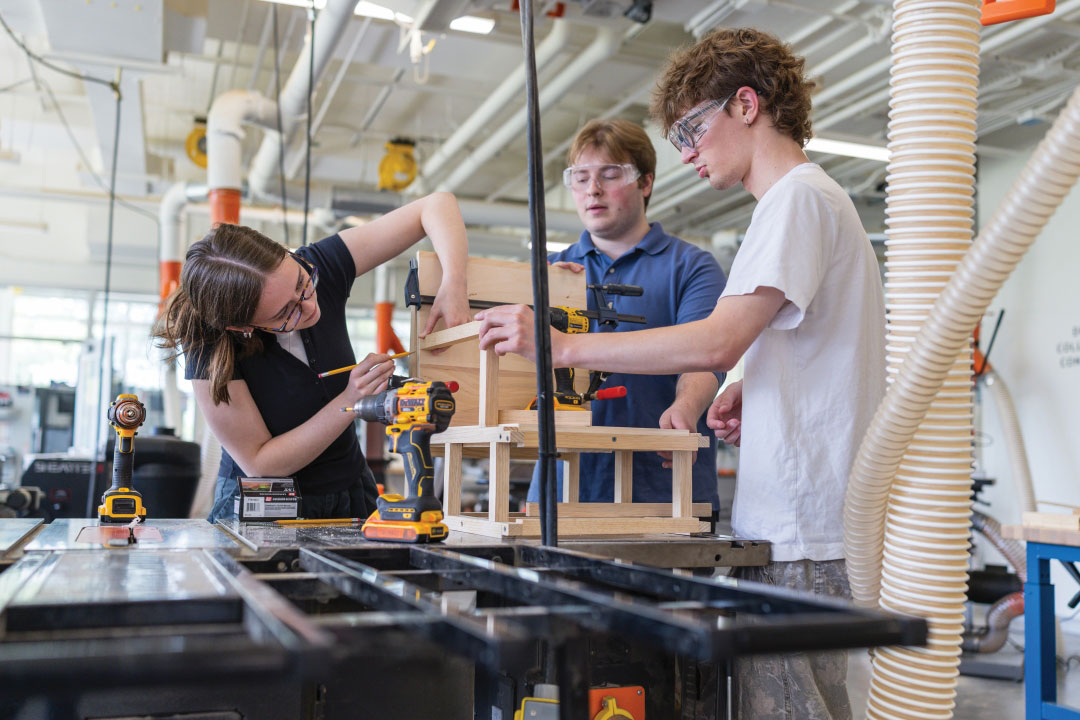
Students Brooke Banninger, left, Andrew Nasser, center, and Spencer Harris, right, worked in RIT’s multilevel makerspace to build a prototype pushcart for children at the Rochester Hearing and Speech Center.
For 10 weeks, the wood shop was a second home for Brooke Banninger, a fourth-year industrial design major. She spent the summer designing a therapeutic toy in disguise.
Her multidisciplinary student team was challenged to create a fully functional prototype of a weighted pushcart for children at the Rochester Hearing and Speech Center. The motion and force needed to move the cart will improve children’s motor development by stimulating sensory regulation that helps the brain and muscles work together.
![]: Toddlers test a pushcart that aims to improve motor development](https://cdn.rit.edu/images/inline-images/WEB_5326_cmyk.jpg)
Traci Westcott
Toddlers test a pushcart that aims to improve motor development.
“Being able to see your design in its intended final form is something that can take months or years in the industry, and having something ready for our client in just 10 weeks is remarkable,” said Banninger, who is from Pottstown, Pa. “I now have an understanding of what it is like to work on a product during a full workday for weeks.”
The pushcart project was part of Studio 930, an RIT design consultancy focused on producing access and health technology products. Studio 930 is one of many experiential learning opportunities that students can take part in at the university’s multilevel makerspace, the SHED.
Maker culture has deep roots at RIT, with generations of students who tinker and play with technology and the arts and build careers around their passions. All RIT students have access to the SHED’s centralized wood and metal shops, textile and electronics area, 3D printers, laser cutters, and other equipment and spaces.
What’s in a name?
Studio 930 was named after the temperature (in Celsius) at which steel turns the shade of RIT orange.
“Studio 930 was meant for the SHED,” said Lara Cardoso Goulart ’16 MFA (industrial design), the program director for Studio 930 and co-director of the industrial design program. “It’s not just a classroom; it’s a multidisciplinary space.”
This year’s Studio 930 group gained co-op and internship experience working on projects for Rochester-area organizations serving people with disabilities. The 16 undergraduates from majors across RIT did onsite visits to clients and produced concepts, design plans, and replicable prototypes. Each student was assigned to work on two different projects.
Andrew Nasser, a fourth-year mechatronics engineering major, worked on the pushcart and designed an ergonomic bottle opener for pharmacists.
![]: Industrial design majors Page Panagos, left, and Mohammadreza (“Reza”) Bavarsad sketch ideas for interactive sensory toys for children with cerebral palsy.](https://cdn.rit.edu/images/inline-images/WEB_4218_1_cmyk.jpg)
Traci Westcott
Industrial design majors Page Panagos, left, and Mohammadreza (“Reza”) Bavarsad sketch ideas for interactive sensory toys for children with cerebral palsy.
His team’s solution aimed to reduce repetitive motion injuries caused by opening hundreds of childproof bottles a day.
“Switching gears and focusing on a different project is something I was familiar with,” said Nasser, who is from Manhattan. “It builds organizational skills that allow you to keep track of your progress, manage time efficiently, and pick up where you left off.”
Madisen Pavoris, a fourth-year industrial design student, worked on a project that simplified a workflow.
Her team sought to design a precision food-cutting solution for staff at Lifetime Assistance, a group home for people with intellectual disabilities.
![]: Spencer Harris, left, and Madisen Pavoris make a system for cutting food into precisely sized pieces for group home residents prone to choking.](https://cdn.rit.edu/images/inline-images/WEB_6156_cmyk.jpg)
Traci Westcott
Spencer Harris, left, and Madisen Pavoris make a system for cutting food into precisely sized pieces for group home residents prone to choking.
Many of the residents there have trouble chewing and swallowing food, and mealtimes can be dangerous for them. To prevent choking, the state stipulates each piece of food measure from 1/4-inch to 1-inch cubes, with the precise dimensions illustrated on a cutting mat.
Pork chops were on the menu the day the RIT design team visited the kitchen staff. The students observed the time and dexterity required to cut the meat to the right size and tried it for themselves.
“The food moved around on the mat, and we could only cut one piece at a time,” said Pavoris, who is from the Chicago area. “It took over one hour to cut pork chops.”
Traci Westcott
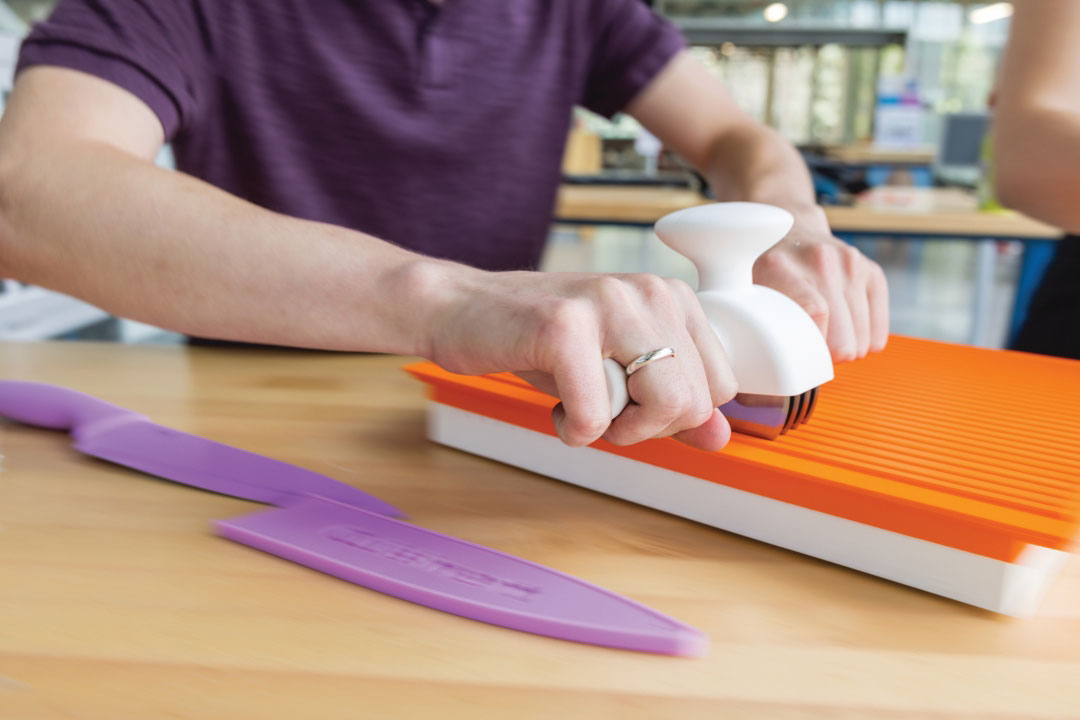
The food-cutting prototype combines a grooved cutting board with a removable guide and a modified pizza cutter.
The team simplified the workflow and designed an efficient and ergonomic tool. Program organizers said the team advanced a project that had stumped students in prior years.
Their solution centered around a grooved cutting board with a guided cover for slicing food with a knife or a modified pizza cutter with different handle attachments. Professors said the food cutter design will continue as a capstone project for graduate students in the mechatronics and mechanical systems program.
“It’s the process of the real world,” Pavoris said. “This is where our job as designers stops, and the product goes to manufacturers, the engineers. I enjoyed the problem solving.”
Challenge accepted
Students were given a 10-week experiential learning challenge to produce practical solutions for real clients. Here’s some of what they made.
Problem: Dementia patients at the Jewish Home of Rochester need more sensory stimulation.
Solution: The Memory Map, a wooden map of Rochester neighborhoods with landmarks to stimulate conversation.
Problem: Re-engineer an adjustable toilet support system for children with cerebral palsy.
Solution: Designed a prototype and created technical drawings that could be built on site in a cost-efficient way.
Problem: Nurses need a precision liquid dispenser to prepare thickened beverages for patients with dysphagia, who have trouble swallowing.
Solution: For warm beverages: clear containers with inserts and slots that allow for accurate measurement without overflow. For cold drinks: a storage unit for the refrigerator with visual indicators