Successful space mission shows promise of RIT-led space energy solution
A perovskite solar cell recently performed with no degradation on a SpaceX flight
Carlos Ortiz/RIT
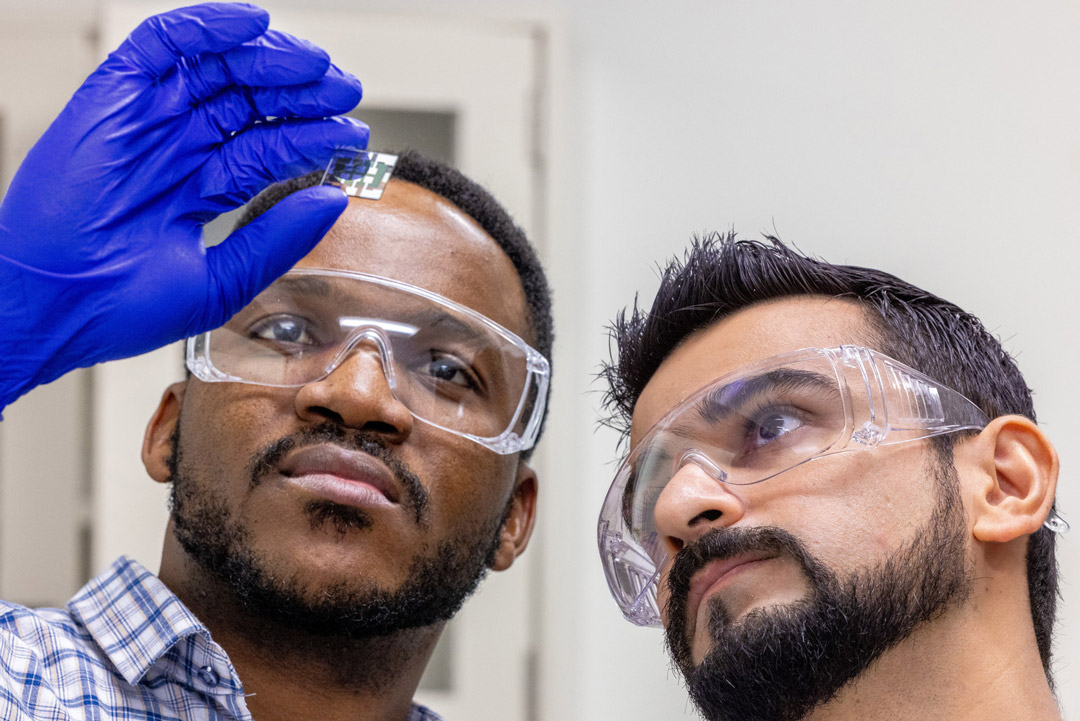
Assistant Professor Ahmad Kirmani, right, and Ph.D. student Tatchen Buh Kum inspect a perovskite solar cell.
The number of satellites launched into space reached an all-time high in 2025, and that number is expected to increase exponentially within the next decade. With the commercialization of space travel and the expansion of space economy, low-cost, scalable power is needed.
Perovskite solar cells may be the best solution, and RIT assistant professor Ahmad Kirmani’s research in the School of Chemistry and Materials Science led to one of the first successful launches of a perovskite solar cell in a low-Earth orbit mission where there was no observable degradation to the cell.
The solar cell was deployed on a CubeSat aboard a SpaceX Falcon 9 rocket for about 100 days at the approximate altitude of the International Space Station. Despite being bombarded by the harsh conditions of space, like radiation and solar storms, ultraviolet radiation, extreme temperatures, and vacuum, the cell performed during the entirety of the flight with no breakdown. The milestone was highlighted in a paper published in Cell Press.
“Research into perovskite solar cells for space power is new and gaining momentum,” said Kirmani. “Our results highlight the importance of vetting perovskites or any technology on earth. The hope is that it’s going to open up and usher in a new era, just like the conventional technologies did for past missions.”
Ahmad Kirmani/RIT
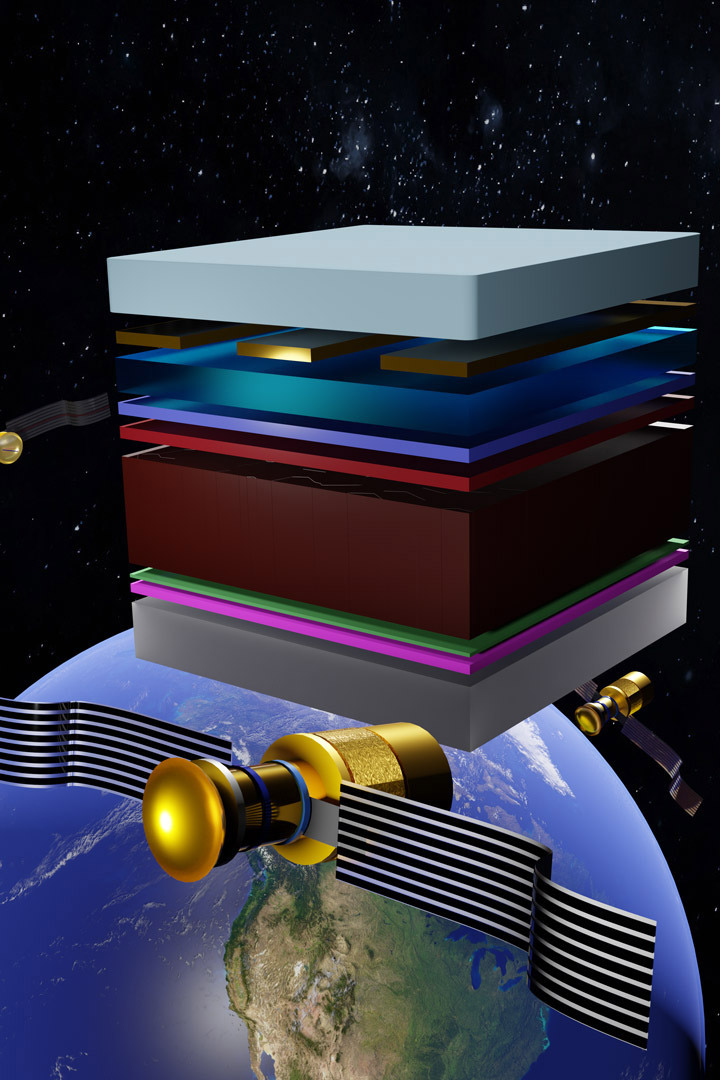
This illustration shows the layers of a perovskite solar cell that successfully flew on a SpaceX rocket with no observable degradation.
In Kirmani’s lab, researchers develop lightweight, thin film device architectures for on-ground testing with proton radiation, electron radiation, thermal cycling, and other stressors to mimic space conditions. Through these tests, they’ve learned the best ways to engineer the devices to sustain space missions. Testing the cells in a lab setting is much cheaper than continually having to launch the cells into space to get results.
With the global space economy projected to reach into the trillions of dollars in the next decade or two, scaling up these cheaper options for power is a priority for both public and private entities. Kirmani began this research as a member of The National Laboratory of the Rockies, which is funded by the U.S. Department of Energy. His work is a crucial part of a nearly $10 million grant from the U.S. Space Force.
That grant helps fund microsystems engineering Ph.D. student Tatchen Buh Kum, who is a co-author on the recent paper and has authored numerous other papers while at RIT. He and other students in the lab are helping push the research forward. The interdisciplinary team consists of students in physics, microsystems engineering, chemical engineering, and computer science.
“Our strength lies in the diversity of the students’ backgrounds,” said Kirmani. “Scientific diversity really helps drive our lab. Bringing different types of ideas from different domains has been very rewarding for the group as a whole.”
Kirmani and his students will continue their work on perovskite solar cells to prepare for the oncoming influx of satellites launching into space and their need for a cheap, reliable power source.
“I think this discovery tells us that perovskites might be a very viable option,” he said.
Perovskites Semiconductors are the Future of Space