Lilly Rennie (She/Her)
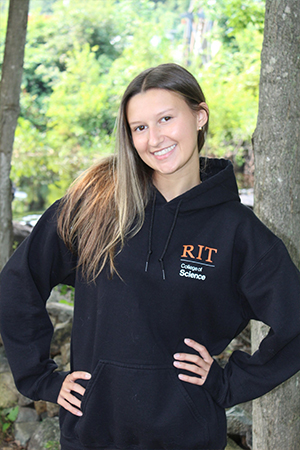
Where are you from?
Rindge, New Hampshire
What are you involved in at RIT?
I am the Secretary of the College of Science Student Activities Board (COSSAB), a member of VisViva Dance Company. As well as being a Notetaker, an RIT365 Co-Facilitator for the Year One Program, a Learning Assistant, and a Development Student Orientation Coordinator. I am also involved in research with the Mega Labs under Dr. Elle Barnes.
Why RIT and the College of Science?
I chose RIT because of all the opportunities it would open up for me. I am from such a small town so being able to come to a larger area with so much to offer was my main reason for coming to school here. Along with that I enjoyed the campus when I first came to visit and I liked how safe it felt here being further out of the city than I expected. On tours I visited different labs and instantly knew that I wanted to be involved and go here because I just found them so cool. Now looking back I know I made the right choice coming to RIT because I have been able to participate is so many different things and learn so much.
What is your advice for prospective college students?
I would say as my advice for prospective students, especially those coming from small towns like myself, is that even though the campus is so big and the whole thing can be intimidating, there is nothing to be nervous about at RIT. There is always someone in your corner there to support you and look after you, and that no matter what happens especially in the College of Science, you have so many resources to be the best version of yourself you can be in and outside of the classroom.
What research projects have you been involved in or are currently working on?
I am involved in research with Dr. Elle Barnes in the MEGA Labs at RIT. I have been working in the MEGA Labs since the spring of my freshman year! MEGA stands for Microbial Ecology & Genomics in Amphibians, and we focus on salamanders and their interactions with the environment. Our lab has particularly been interested in the chytrid fungus and how it invades the microbiome of amphibians, and this fungus has been the reason for extinction amoung many different species.
I will be working for credit Spring 2026, investigating eDNA of vernal pools. eDNA is environmental DNA, and I will be using samples taken from vernal pools to determine what organisms are at and surrounding the pools. I also will be looking to investigate primers of specific amphibians to determine which specific amphibian species are in the area, that way further researches can take samples of water to determine species in the vernal pools, rather than having to specifically capture the salamanders to determine their species.