RIT students and their professor turn laser research vision into reality
The team demonstrated a new way to make freeform optics with a femtosecond laser. The Laser Institute elected Associate Professor Jie Qiao a Fellow
Liam Myerow/RIT
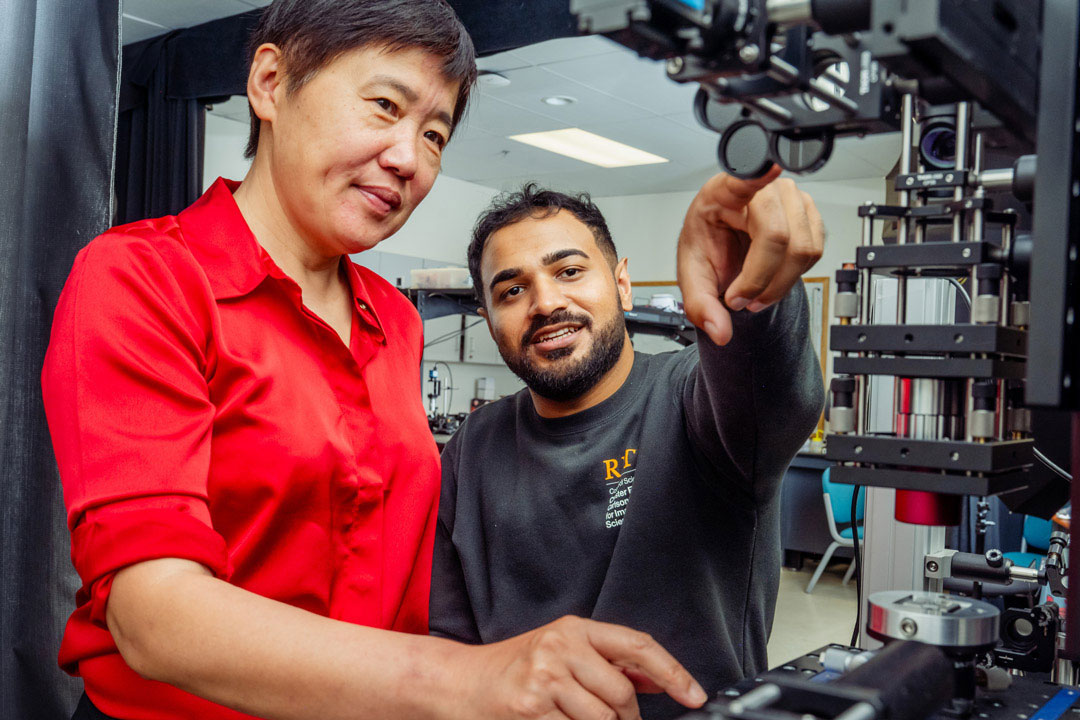
RIT Associate Professor of Imaging Science Jie Qiao, left, works alongside imaging science Ph.D. student Muhammad Akif Qadeer in her lab. With Qiao’s expertise and connections, students are helping advance laser technology.
Rochester Institute of Technology (RIT) graduate and undergraduate students helped Associate Professor Jie Qiao turn a research vision more than a decade in the making into a breakthrough that could change how advanced optical components are made.
Drawing on her research and development and innovation experience in ultrafast laser systems and precision optics, Qiao first conceived the idea of using ultrafast lasers to directly fabricate freeform optics.
Over the following decade, her research group studied how ultrashort laser pulses could precisely shape and smooth semiconductor and optical materials. That work laid the foundation for a noncontact process that shapes and finishes glass without a separate polishing step.
Freeform surfaces give optical designers more freedom to efficiently control how the light travels. They are used in augmented and virtual reality, space telescopes, vehicle headlights, and medical equipment, among other common applications.
Qiao’s Advanced Optical Fabrication, Instrumentation, and Metrology Laboratory in the Chester F. Carlson Center for Imaging Science has now demonstrated deterministic, simultaneous figuring and finishing freeform optical surfaces using a femtosecond laser. The achievement was published in Optics Express with imaging science Ph.D. student Muhammed Akif Qadeer as lead author and undergraduate physics student Noah Sanderson as the second author.
“What began as a research vision has progressed over the past decade through fundamental studies and modeling of how ultrafast laser pulses interact with materials, followed by process development and experimental demonstrations, with important contributions from generations of students and postdoctoral researchers,” said Qiao. “This new capability could fundamentally change how high-precision freeform optics are fabricated.”
Qiao’s patented femtosecond-laser fabrication technology has been licensed to industry and continues to draw interest from companies.
Qadeer received the 2025 Harvey M. Pollicove Memorial Scholarship from the Optica Foundation and earned the Best Student Oral Presentation Award at SPIE Photonics West. Sanderson is an undergraduate research fellow through RIT’s College of Science.
International leader in lasers and laser applications
The Chester F. Carlson Center for Imaging Science offered the first imaging science program in the U.S. and is currently the only formal imaging science program in the nation. Imaging science is an interdisciplinary field combining computer science, engineering, and physics to explore image creation, perception, and analysis.
The Laser Institute, an international professional society for laser applications and safety, named Qiao a fellow in the fall of 2026. Fellow is the institute’s highest membership grade.
“Jie’s work has changed what large ultrafast systems can do and has pioneered ultrafast-laser precision fabrication of freeform optics,” said Shaun Oleson, executive director of The Laser Institute. “Her scientific contributions, together with her leadership in the international laser community, exemplify what the fellow grade is meant to recognize.”
Qiao is also an Optica Fellow and a former U.S. Fulbright Scholar. She served as general chair at the Conference on Laser and Electro-Optics (CLEO) in 2024 and 2025 and will serve as general chair of the 2027 International Congress on Applications of Laser and Electro-Optics (ICALEO). She was an associate editor of Optics Express and the founder and chair of Women in Science, Technology, Engineering, and Entrepreneurship Connect, an organization aimed at advancing women’s leadership in science and engineering.
Through her industry collaborations and professional leadership, Qiao helps create opportunities for her students to present at conferences, collaborate on research, and find jobs in the field.
Rochester’s laser technology workforce
RIT, including Qiao’s lab, is part of the National Science Foundation STELLAR Engine, a $15 million-funded collaboration to bolster the Rochester/Finger Lakes region’s eminence in laser technology.
The STELLAR (Science, Technology and Engineering for Laser and Laser Applications Research) group focuses on laser technologies, education, company creation, manufacturing, and workforce development.
As a co-principal investigator on RIT’s STELLAR subaward, Qiao leads research in intelligent ultrafast-laser processing for precision optical fabrication and integrated photonics. She also directs the development of RIT’s STELLAR Laser and Optics Laboratory, which will support workforce development in the Rochester and Finger Lakes region.
Qiao’s research is an example of the region’s strength in laser innovations, and her students are receiving the skills and knowledge to enter the workforce and push industry forward.
Through this research, Qiao’s students gain hands-on experience in laser processing and optical fabrication, building skills they can bring to the region’s optics and photonics industry,
“One of the most rewarding aspects of my academic career is mentoring students as they take on meaningful research as undergraduates, and grow into accomplished graduate researchers, ultimately becoming independent scientists and engineers,” said Qiao.

