Ph.D. student recognized for work in optics
Muhammad Akif Qadeer receives scholarship from the Optica Foundation
Provided
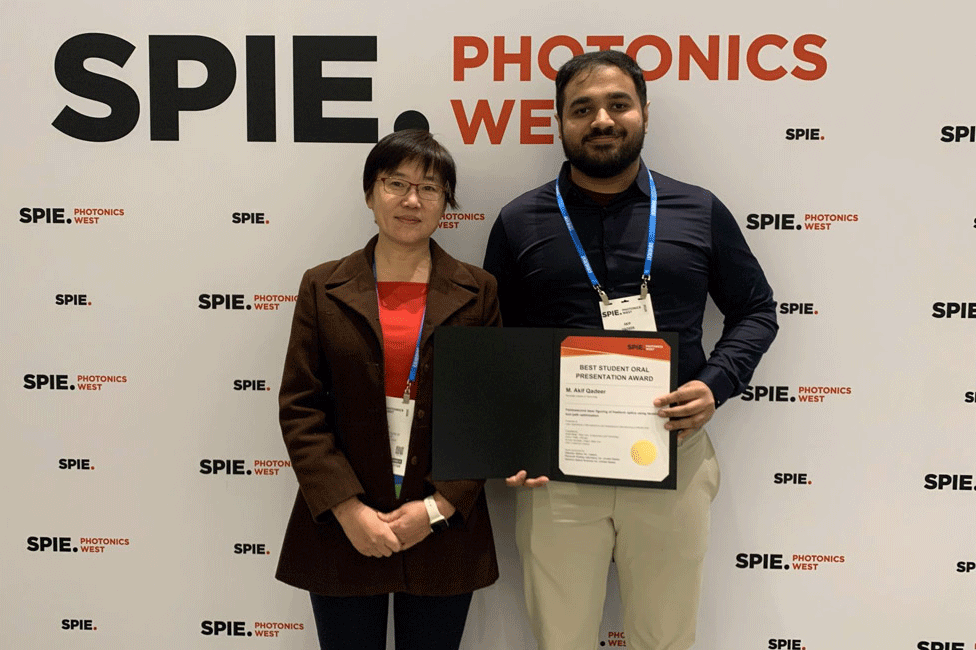
Muhammed Akif Qadeer, right, poses for a picture with Associate Professor Jie Qiao after winning an award for his research presentation at the 2026 SPIE Photonics West conference.
Muhammad Akif Qadeer, who considers himself to be a curious person who wants to know how things work, came to RIT as an undergraduate student in 2018 to study physics.
Qadeer had no plans to attend graduate school, but after working with Associate Professor Jie Qiao in the Advanced Optical Fabrication, Instrumentation and Metrology Laboratory for his capstone project, he changed his mind.
“When I got involved in this research, it really sparked my interest,” he said. “I really felt like I found somewhere I belong, where my skills are being used in a way to do something useful. After my capstone project, I thought just one year’s worth of research wasn’t enough. I wanted some way to continue my capstone research. I wanted to keep doing more.”
Qadeer is now continuing work in Qiao’s lab as an imaging science Ph.D. student and has been rewarded with the 2025 Harvey M. Pollicove Memorial Scholarship from the Optica Foundation. The $4,000 award is given to one student each year who shows potential in precision optics manufacturing and lens design.
Qiao’s lab in the Chester F. Carlson Center for Imaging Science gives students both theoretical and hands-on experience developing new optics and laser technologies. More than that, it provides a holistic environment for students to also learn from one another and to build robust skillsets that translate well into industry or academic research.
Under Qiao’s mentorship, Qadeer was able to work with one student on wavefront sensing with machine learning and with another student on ultrafast laser-based optical fabrication, both students being senior doctoral researchers in her group. This dual exposure to computational optics and advanced ultrafast laser fabrication distinguished Qadeer from other scholarship applicants.
“One of the unique aspects of working in Professor Qiao’s lab is that I’m able to gain real understanding of the whole process from beginning to end,” said Qadeer. “I have developed a very multifaceted background in being able to do optics fabrication, being able to characterize optics, being able to measure optics, and then also having the physics-based understanding of the underlying physics of laser material interaction. This integrated experience is rare and has given me a uniquely broad and rigorous foundation. Not a lot of people would really have that sort of unique background.”
Qiao’s connections in industry, government labs, and academia have helped her prepare her students for their careers. As a faculty member of the National Science Foundation’s Center for Freeform Optics, an industry/university cooperative research center, she provides her students with chances to regularly present their research to industry leaders.
Qadeer admits he wasn’t comfortable with public speaking, but with Qiao’s mentorship, he now presents at large conferences. He recently was recognized with the Best Student Oral Presentation Award at the SPIE (international society for optics and photonics) Photonics West conference.
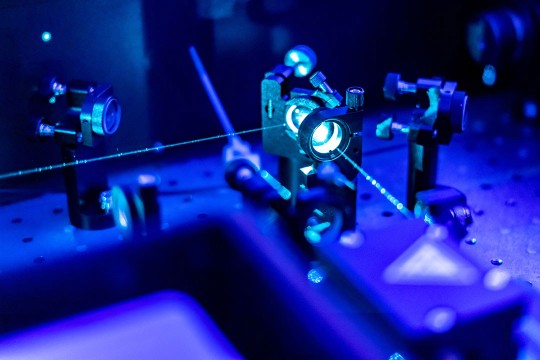
In Qiao’s lab, students are working with state-of-the-art equipment to make breakthroughs in ultrafast laser application technology that is highly coveted by outside industry.
“We are developing new technology that allows us to put gigantic optics or lasers the size of a tabletop onto a chip,” said Qiao. “Companies are reaching out because they love the technology and they want to commercialize it. There’s the potential for multi-hundred millions—to billions—of market value.”
It’s not just the technology that companies want, but also the students who can enter the industry to help move it forward. Qiao recognizes that her lab is successful because of the development of the science, the technology, and the students.
“We are really working in an innovative area that is cross-cutting lasers, optics, photonics, and imaging,” said Qiao. “There is a lot of foundational work that faculty members have to bring in order for students to be successful. It is a holistic process from educating and training the next-generation workforce.”
While Qadeer is focused on finishing his Ph.D. right now, he hopes to bring his skills into a career in the optics industry once he graduates. He is thankful for the opportunities in Qiao’s lab and the connections made through numerous organizations that have led to his success.
“I have a quote on my wall at my apartment that says, ‘What a privilege it is to be tired of the work you once dreamed about,’” said Qadeer. “Being a kid in Pakistan, I never really imagined that I would be able to leave. Being in this position at the moment is quite surreal for me. I’ve really been blessed with a lot of things.”