Research
Molecular Biology
Principal Investigators: Dina Newman and Kate Wright
The Molecular Biology Education Research (MBER) Group is a collaborative research lab co-led by Dr. Dina Newman and Dr. Kate Wright, faculty in the Gosnell School of Life Sciences at RIT. The team studies how students think about molecular biology concepts and develops tools for improving biology education.
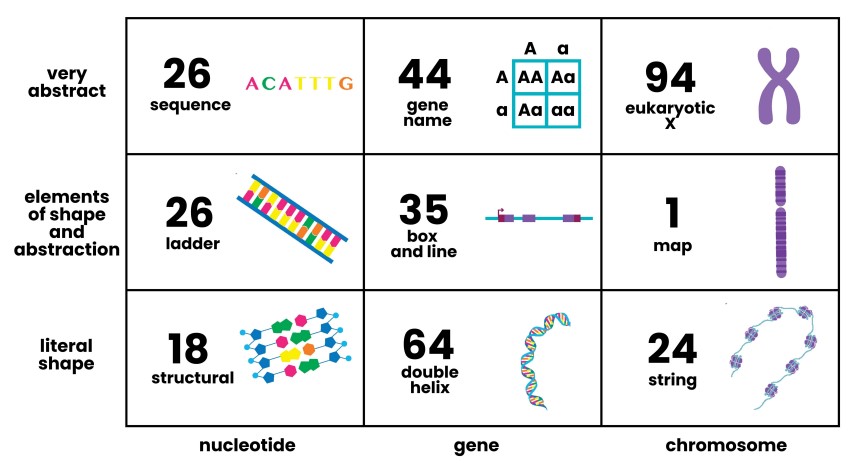
The DNA Lanscape Framework is used to characterize students' sketches. From Uminsky, Wright, and Newman (2025) Link to article
Chemistry
Principal Investigators: Christina Goudreau Collison, Paul A. Craig
Dr. Tina Goudreau Collison leads a collaborative effort focused on a reformed chemistry curriculum for teaching undergraduate laboratories using a scaffolding effect. Reformed Experimental Activities (REActivities) incorporates inclusivity, continuity, and engaged student learning in early chemistry experiences. Learn more about REActivities on the web or YouTube. An arm of this research includes the Sign Language Incorporation in Chemistry Education (SLICE) project which explores the impacts of recently developed organic chemistry signs on student learning and classroom culture.
Dr. Paul Craig directs the Biochemistry Authentic Scientific Inquiry Lab (BASIL), which is a Course-based Undergraduate Research Experience (CURE) being led by faculty on 9 campuses (Cal Poly SLO, Hope College, NOVA Southeastern, Richmond, RIT, SUNY Oswego, Ursinus, Washington State, Xavier/Cincinnati) with participation by as many as 250 faculty members nationwide. Students use computational methods to predict protein function and then go to the lab bench to test their hypotheses. We are currently focused on identifying barriers to adopting the BASIL CURE (and CUREs in general), using workshops, surveys and interviews.
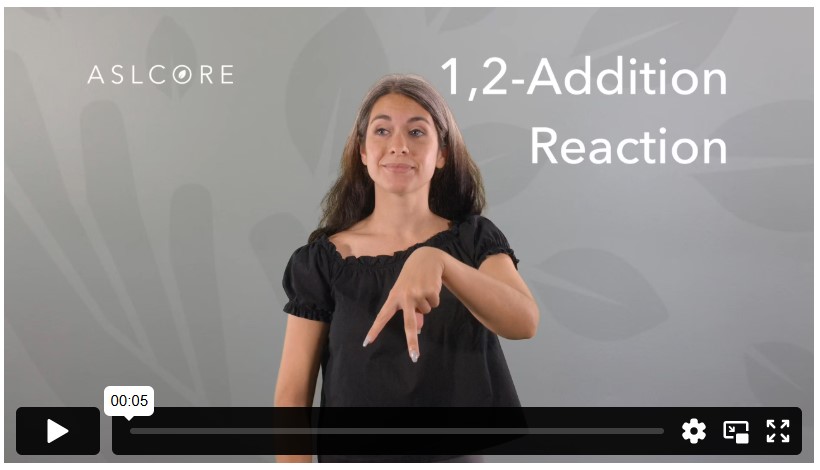
An organic chemistry sign developed by the ASLCore team for the concept of "1,2-Addition Reaction".
Engineering
Principal Investigators: Ashish Agrawal, Jeffrey Stransky, Jennifer Bailey
The Engineering Education Research Group is comprised of faculty in the College of Engineering Technology (Ashish Agrawal and Jeffrey Stransky) and the Kate Gleason College of Engineering (Jen Bailey). Ashish Agrawal is conducting research on integrating sustainability into engineering education and the role that math preparation and math courses play in engineering student success. Jeff Stransky is researching ethical decision making among engineering students and how to train them for realistic situations that may occur in their professional work. Jen Bailey focuses on student learning in biomedical engineering lab courses and design projects.
Math and Statistics
Principal Investigators: Tony Wong
The Mathematics and Statistics Education Research group at RIT is a community of researchers dedicated to building understanding of and improving education in the mathematical sciences. We interact broadly across other disciplines at RIT, reflecting the interdisciplinary importance of mathematical foundations for students from many different STEM fields. Our group employs quantitative and qualitative methods to answer questions and better understand a range of topics in mathematical, statistical, and computational education, including problem-solving in computational environments, student and faculty attitudes toward computation, and educational data analytics related to student outcomes, particularly for Learning Assistant programs.
Physics
Principal Investigators: Scott Franklin, Diana Sachmpazidi, Ben Zwickl, Casey Miller
The Physics Education Research (PER) group at RIT is a community of undergraduate and graduate students, postdocs, and faculty who are dedicated to understanding and improving all aspects of physics education. We are always seeking to grow in understanding, grow by welcoming new members, and grow in our impact on physics education locally and nationally. Our group employs quantitative and qualitative methods to answer questions and build theoretical models related to a range of topics, including: quantum information science education and workforce development, career interest formation, problem-solving in complex environments, use of large language models for qualitative data analysis, graduate admissions and inclusive graduate education, and providing professional development for emerging education researchers (PEER).
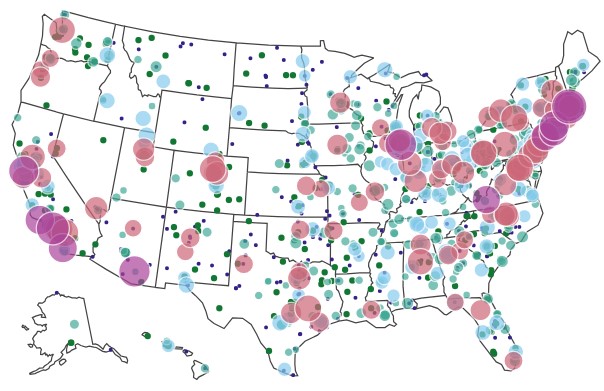
A map of the United States locating institutions with quantum-related courses. The size of a circle indicates the number of quantum-related courses at that institution. Access the dataset and interactive graphics.