
Zhongwang Dou
Assistant Professor, Biomedical Engineering
Department of Biomedical Engineering
Kate Gleason College of Engineering
585-475-7178
Office Location
Zhongwang Dou
Assistant Professor, Biomedical Engineering
Department of Biomedical Engineering
Kate Gleason College of Engineering
Currently Teaching
BIME-391
Biomaterials and Biomechanics Lab
2 Credits
Laboratory experiments are conducted to explore and reinforce fundamental principles and concepts introduced in Biomaterials and Biomechanics courses. The experimental procedures involve measuring results, analyzing and interpreting data, and drawing objective conclusions. Emphasis is also placed on proper documentation and effective presentation of findings and results. Biomechanics based lab procedures involve anatomical measurements as well as manipulation and analysis of structures and materials designed to model human anatomy. Biomaterials based lab procedures involve creation, manipulation, and physical as well as biological testing of materials.
BIME-520
Hemodynamics
3 Credits
This course will focus on the application of fluid mechanics principles to vascular blood flow and flow dynamics. It will cover concepts such as the vascular system and flow patterns in different segments (i.e., blood, heart, arteries and veins), parameters and measures of flow dynamics, including pressure, flow rate, and vascular resistance; fully developed laminar flow (Poiseuille’s Law), applications of electrical analogous and optimality for modeling vascular flow using Poiseuille’s Law; equations of fluid flow (Continuity, Bernoulli, Navier-Stokes). In addition, the course will also cover the principles of microcirculation briefly, as well as the principles of pulsatile flow and wave propagation in both rigid and elastic vessels. Lastly, we will briefly cover the concepts of large artery hemodynamics and its effect on the vascular disease and medical imaging and blood flow (i.e., Doppler flow imaging, phase-contrast MRI and arterial spin labeling) techniques.
BIME-620
Hemodynamics
3 Credits
This course will focus on the application of fluid mechanics principles to vascular blood flow and flow dynamics. It will cover concepts such as the vascular system and flow patterns in different segments (i.e., blood, heart, arteries and veins), parameters and measures of flow dynamics, including pressure, flow rate, and vascular resistance; fully developed laminar flow (Poiseuille’s Law), applications of electrical analogous and optimality for modeling vascular flow using Poiseuille’s Law; equations of fluid flow (Continuity, Bernoulli, Navier-Stokes). In addition, the course will also cover the principles of microcirculation briefly, as well as the principles of pulsatile flow and wave propagation in both rigid and elastic vessels. Lastly, we will briefly cover the concepts of large artery hemodynamics and its effect on the vascular disease and medical imaging and blood flow (i.e., Doppler flow imaging, phase-contrast MRI and arterial spin labeling) techniques.
In the News
-
February 23, 2026
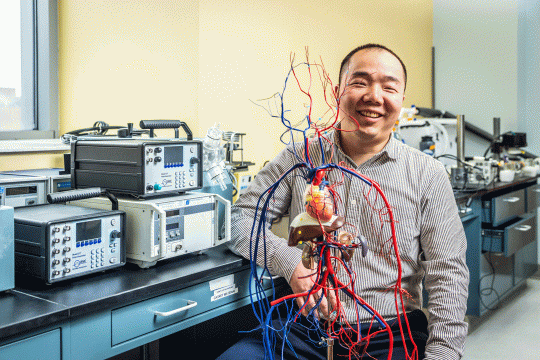
RIT researcher studies how exercise could reduce the risk of aneurysm rupture
RIT Professor Zhongwang Dou recently received a prestigious National Science Foundation Faculty Early Career Development (CAREER) award for a five-year project to detail how blood flow within an aneurysm is affected by movement, and how physical exercise might affect the risk of aneurysm rupture.