College of Engineering News
Department of Biomedical Engineering
-
November 11, 2026
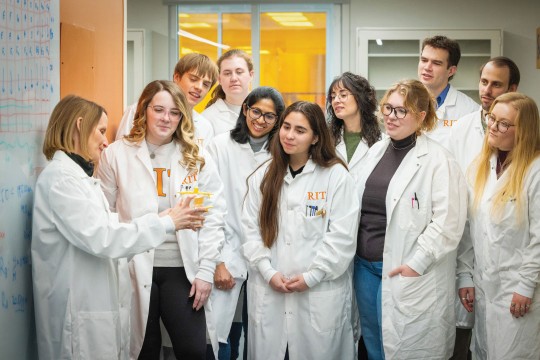
RIT research looks beyond surgery for back pain relief
Professor Karin Wuertz-Kozak is developing gene and cell therapies that may be the next step in tissue regeneration, a type of noninvasive treatment that could control the molecular mechanisms contributing to pain, mostly inflammation.
-
November 9, 2026
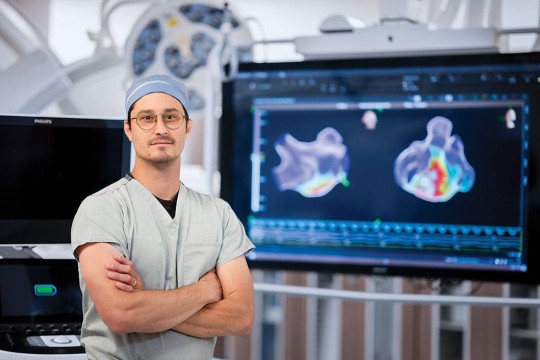
RIT alumni are shaping new careers: 3D heart mapper
As a service engineer for Abbott in Detroit, Michael Kormos provides electrical anatomical mapping to locate and navigate heart arrhythmias and tissue damage.
-
October 27, 2026

Viruses obey the laws of physics – studying how can help researchers understand why they infect people differently and lead to better treatments
The Conversation features an essay by Tori Russell, biomedical and chemical engineering Ph.D. candidate; Karin Wuertz-Kozak, Harvey J. Palmer Professor in the Department of Biomedical Engineering; and Maureen Ferran, professor of biology, exploring how physical forces and tissue stiffness influence viral infections and how this research could lead to better treatments.
-
April 29, 2026

Stem cell therapy for degenerative disc disease - RIT Research Minute
Harvey J. Palmer Professor Karin Wuertz-Kozak is researching how CRISPR gene editing and stem cells could transform the future of regenerative medicine therapy for degenerative disc disease, a major cause of chronic back pain.
-
April 14, 2026

Antibiotics can trigger bacteria to release bubbles of inflammation tinder, making it harder to treat infection
The Conversation features research from Panteha Torabian, biomedical and chemical engineering Ph.D. student, examining how certain antibiotics can trigger bacteria to release particles that may increase inflammation, with implications for treating severe infections.
-
April 7, 2026

RIT’s graduate programs ranked among the best by ‘U.S. News & World Report’
Seventeen graduate degree programs at Rochester Institute of Technology and the graduate schools in business and engineering are among the best in the nation, according to U.S. News & World Report’s annual rankings.
-
March 17, 2026
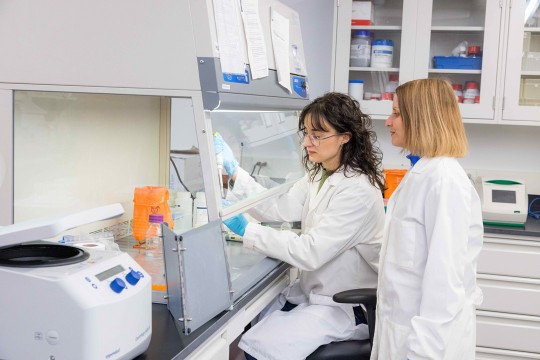
RIT research could slow fibrosis disease progression
Researchers in RIT's Tissue Regeneration and Mechanobiology Lab are investigating a new approach that could change how fibrosis is treated across organs in patients suffering from systemic sclerosis: targeting the protein TRPC6, a small ion channel—that can sense mechanical cues such as stiffness. -
May 22, 2025

RIT researchers develop self-healing photopolymers for 3D printing to enhance part longevity and sustainability
3D Printing Industry discusses the research of Christopher Lewis, associate professor in the Department of Manufacturing and Mechanical Engineering Technology; graduate student Vincent Mei; and biomedical and chemical engineering Ph.D. student Kory Schimmelpfenning, which focuses on self-healing photopolymers for 3D printing that should enhance part longevity and sustainability.
-
May 20, 2025

Biomedical engineer integrates AI techniques to improve diagnostic medicine
Researchers at RIT developed new artificial intelligence techniques to extract and visualize information from standard-of-care biomedical data, providing a means for clinicians to better diagnose diseases and determine interventions. -
May 14, 2025

New separation technique will improve lab-on-chip devices
Using a non-traditional, micro-organism separation method, researchers at RIT discovered a faster technique that can be used to distinguish cells that are resistant to antibiotics or cancer.
-
April 28, 2025

Tackling the macro problem of microplastics
RIT experts are at the forefront of research that aims to better understand the impact of microplastics on the environment. RIT’s interdisciplinary microplastics team has received nearly $10 million in funding since 2020.
-
February 24, 2025

Researchers explore how mechanical signals influence viral infections in lungs
The process combines virology and mechanobiology, two distinct areas of study that had not been explored at the same time but might prove to be a way to better understand disease progressions to intervene earlier and improve patient outcomes.