RIT research could slow fibrosis disease progression
Biomedical engineering researcher identifies a new therapeutic target for systemic sclerosis
Traci Westcott/RIT
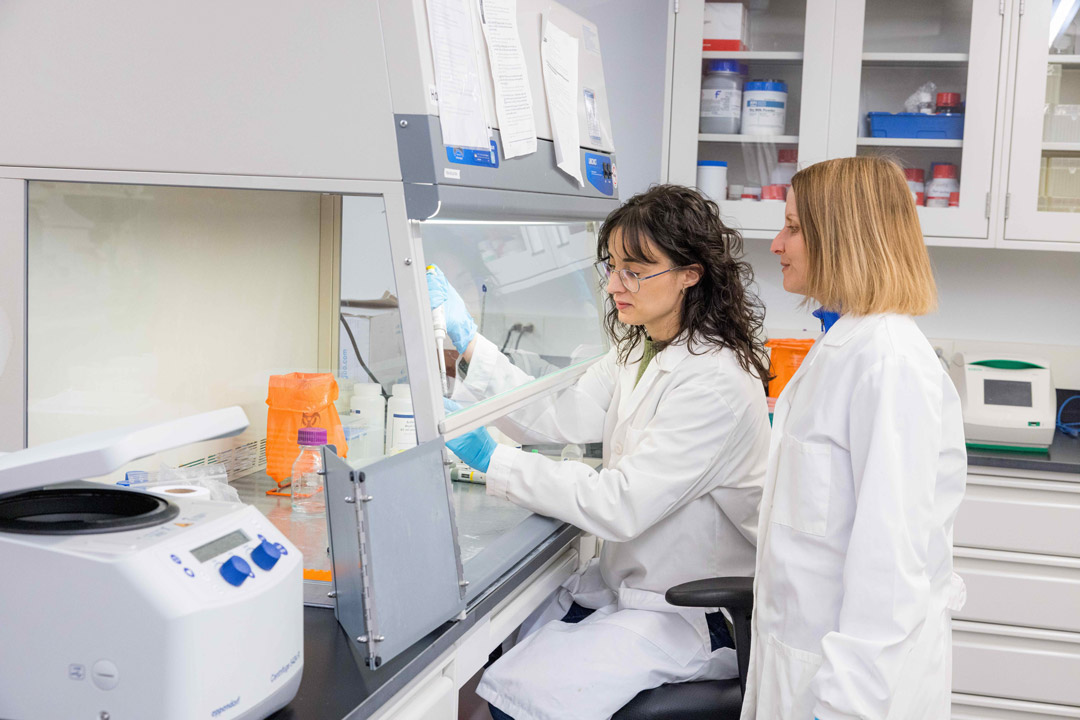
Doctoral candidate Patricia Alvaro Llopis works closely with Professor Karin Wuertz-Kozak in the Tissue Regeneration and Mechanobiology Lab assessing treatment solutions for fibrosis.
Researchers in Rochester Institute of Technology’s Tissue Regeneration and Mechanobiology (TRAM) Laboratory are investigating a new approach that could change how fibrosis is treated across organs in patients suffering from systemic sclerosis: targeting the protein TRPC6, a small ion channel—that can sense mechanical cues such as stiffness.
Patricia Alvaro Llopis, a biomedical engineering doctoral candidate in RIT’s Kate Gleason College of Engineering, is part of the TRAM Lab. She collaborates with Karin Wuertz-Kozak, the Harvey J. Palmer Professor and TRAM Laboratory director, one of the top researchers in the area of tissue regeneration and mechanobiology. Alvaro Llopis discussed some of the breakthrough work that will advance fibrosis treatment and interventions, specifically for systemic sclerosis.
What is fibrosis?
Fibrosis is a process in which the body produces excessive connective tissue, leading to the formation of scar-like material that accumulates within organs. In diseases such as systemic sclerosis (scleroderma), this buildup causes tissues to become stiff and thickened, gradually impairing their function. Despite its serious impact and its ability to affect multiple organs, there are currently no therapies that directly stop or reverse this process. Patients suffering from systemic sclerosis are currently limited to treatments that manage symptoms.
What are the characteristics of fibrosis and the role of TRPC6?
Fibrosis is characterized by the excessive accumulation of extracellular matrix proteins, particularly collagen, which causes tissues to become thickened and stiff. This process is driven by fibroblasts, connective tissue cells that produce and remodel the extracellular matrix. Under persistent biochemical and mechanical stimulation, fibroblasts can shift into an overactive, scar-producing state. TRPC6, a mechanosensitive calcium channel, contributes to this process by responding to mechanical cues such as tissue stiffening. Its activation increases calcium signaling in fibroblasts, promoting pathways that drive extracellular matrix production and fibrotic progression.
Describe some of the early research results.
Using preclinical models, we tested whether pharmacological inhibition of the ion channel TRPC6 could alter fibrotic disease progression. Our early findings show that blocking TRPC6 significantly reduces fibrosis remodeling in both skin and lung tissues. Markers of fibrosis, including collagen deposition and myofibroblast-associated proteins, were reduced approximately 50 percent. Observing similar antifibrotic effects in two distinct organs is particularly notable, as it suggests that TRPC6 inhibition may target a shared, disease-relevant mechanism, rather than addressing fibrosis in individual organs.
Why is this therapeutic strategy important?
There are currently no therapies that directly reverse fibrosis in systemic sclerosis. TRPC6 regulates calcium entry into fibroblasts, a signal that promotes extracellular matrix production and tissue stiffening. Our findings show that this pathway is active in both skin and lung tissue and that its activity can be pharmacologically modulated, suggesting that targeting TRPC6 may offer a way to address fibrotic processes in multiple organs simultaneously.
What are some of the next steps in this research area?
One of the next steps in this research area is the development of an in vitro 3D dermal model that will serve as a drug-testing platform. Because TRPC6 inhibition reduced fibrosis but did not fully restore tissue to a healthy state, the model will allow us to test different dosing strategies and identify the levels that most effectively bring fibrotic markers to healthy levels. Additionally, this system will also allow us to explore additional therapeutic targets and evaluate new antifibrotic therapies.


