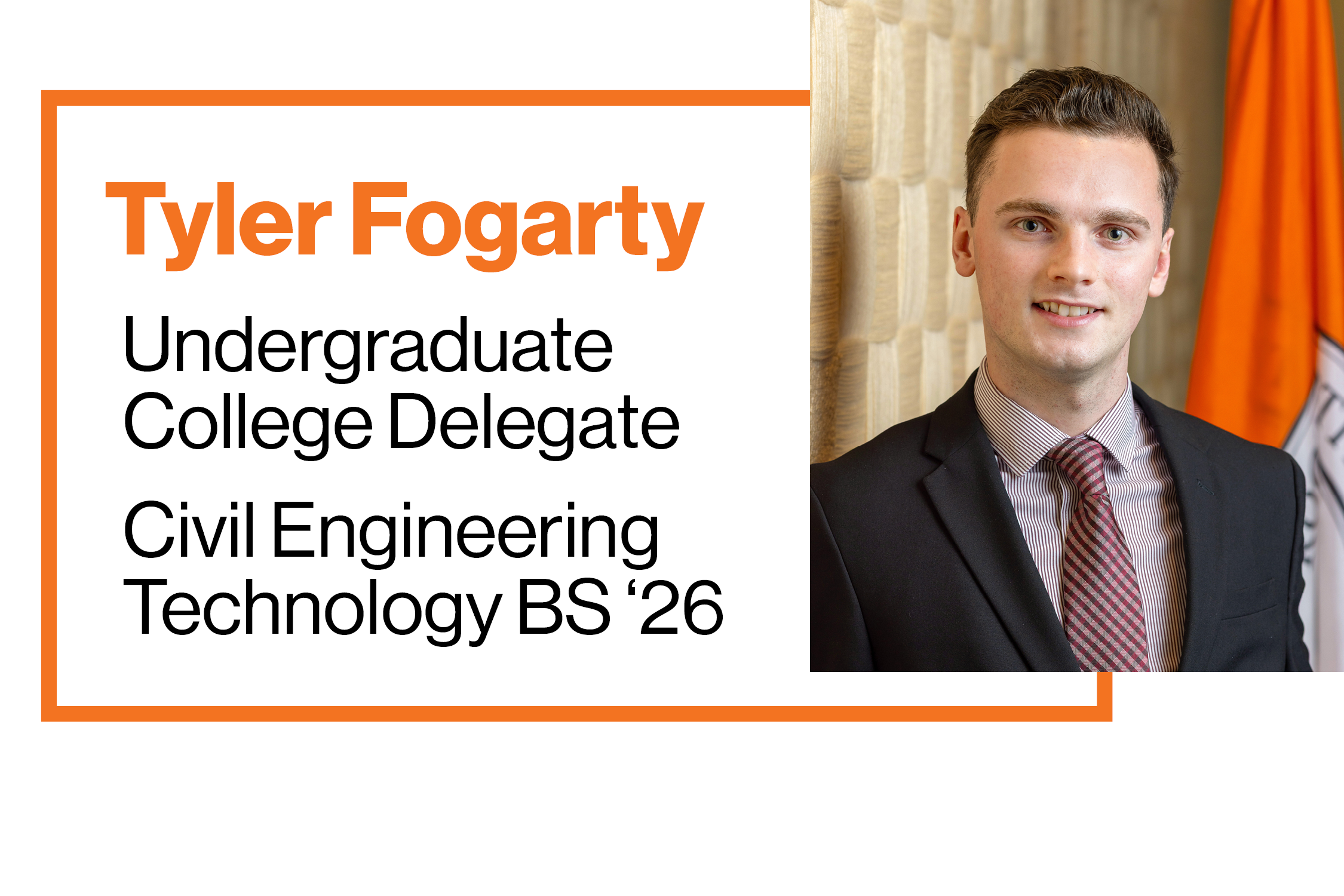
'26 Undergraduate College Delegate: Tyler Fogarty
After graduation, Tyler will continue advancing his career at Lu Engineers, where as a student, he worked two years of continuous, full-time co-op.
Where are you from?
West Seneca, NY (Buffalo, NY)
What degree are you receiving?
Bachelor of Science in Civil Engineering Technology, Minor in Communications
What are your plans after graduation?
Jr. Engineer & Construction Services at Lu Engineers (Rochester, NY)
During your time at RIT, what did you like best about your program?
What I valued most about my program at RIT was the strong sense of family it fostered. Over the past four and a half years, nearly every member of the faculty became not only an instructor, but also a mentor and, in many cases, a trusted supporter. The accessibility and dedication of the faculty created an environment where students were genuinely invested in and encouraged to grow.
The program’s emphasis on professional practice set it apart. Faculty members consistently bridged academic concepts with real-world application, preparing us for the expectations of the engineering industry. Through exposure to industry professionals, networking opportunities, and meaningful Co-Op experiences, I gained a clear understanding of how what we study in the classroom translates directly to professional practice.
This combination of mentorship, community, and hands-on experience made my time at RIT both personally and professionally transformative.
What's your fondest RIT memory:
I don’t think I could only pick 1! My fondest memory at RIT had to be when our AGC RIT team was at competition in Albany, we competed against some of the top schools in the nation for Heavy Civil Construction Management. We ended up winning first place and bringing home this proud moment to the school. It was not only a great achievement for our team, but also for the Civil Engineering Technology Department since it’s such a great honor to represent.
What awards and/or recognition did you receive as a student while at RIT?
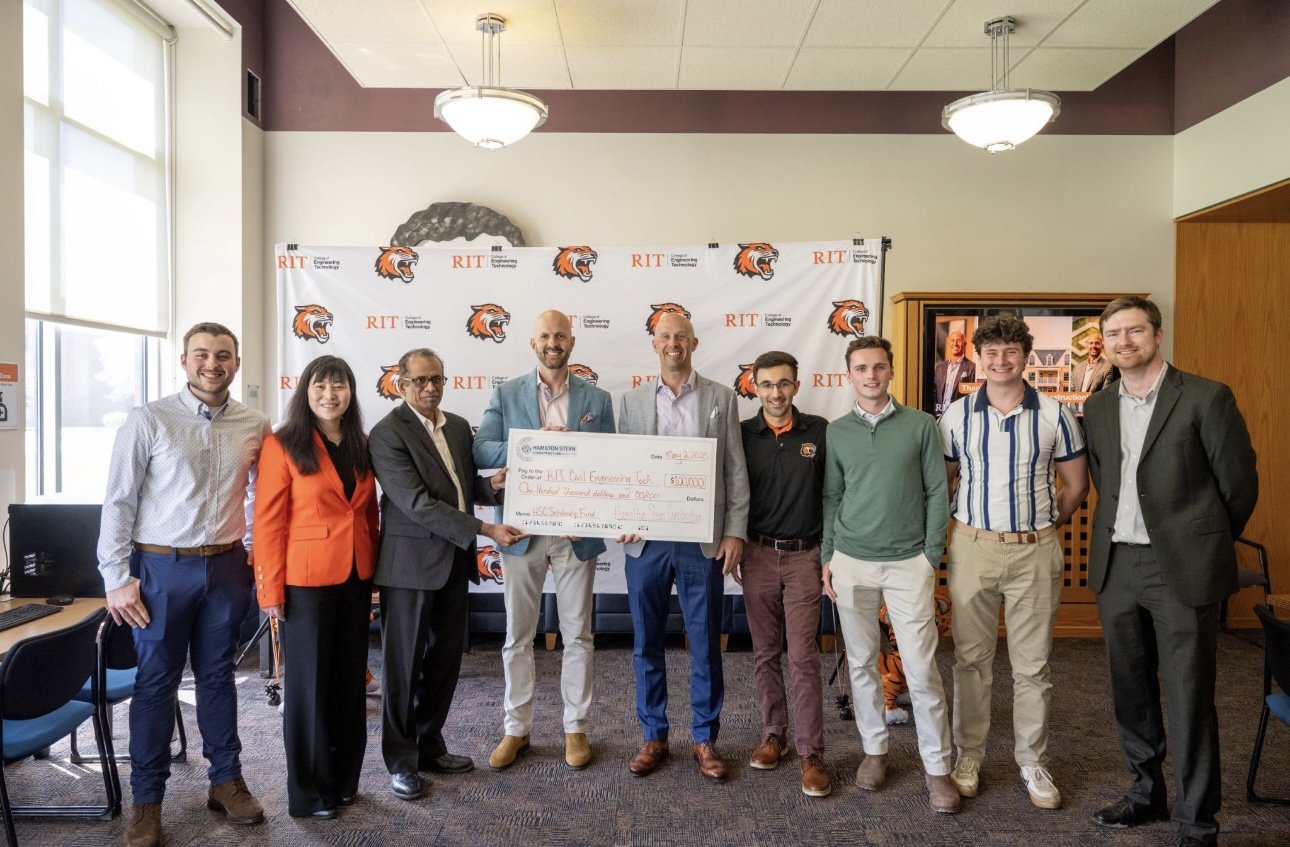
I was nominated at the Department delegate (Here we are!), Labella Scholarship, Hamilton Stern Scholarship, AGC Scholarship, ASCE Scholarship, ABCD Scholarship, DFI Institute Scholarship, Donald & Jeris Boyce End Scholarship, SD CoMETS, AGC Competition 1st place award, Deans list achievement awards.
What activities were you are involved in (clubs, sports, and organizations)?
Associated General Contractors (AGC), American Society of Civil Engineers (ASCE), Association for Bridge Construction & Design (ABCD), Architecture, Construction, & Engineering Mentor Program (ACE), Rochester Camber of Commerce Younger member, Deep Foundations Institute (DFI), Rochester Younger Professionals, and Toastmasters International.
As you reflect on your academic career, can you please briefly describe a time when…
...Thinking like you was celebrated (as opposed to following theory in a textbook - by peers, faculty, staff, or a rewarding result)?
During my capstone design course last semester, our team was tasked with developing a park improvement project that required both technical design and critical consideration of the surrounding community. While we applied the engineering principles and methodologies learned throughout our coursework, I took on the role of project manager and encouraged our team to think beyond a purely textbook-driven solution.
Rather than focusing solely on technical efficiency, I spearheaded a more creative and thoughtful approach that emphasized the people who would ultimately use the space. We considered community needs, accessibility, and how the park could foster connection and inclusivity. This human-centered mindset guided our design decisions and set our project apart from more conventional approaches.
As a result, our team emerged as one of the top groups in the class. Our work was celebrated by faculty and peers, and our final presentation was well received by an audience of over 60 attendees. While the reward was not monetary, the recognition validated the importance of critical thinking, leadership, and valuing people as much as technical outcomes. This experience reinforced my confidence in trusting my own approach and demonstrated how engineering solutions are most successful when grounded in both technical knowledge and human impact.
...The road to innovation was not as smooth as you expected (a cycle of failure and breaking to ultimately discover a solution)?
The road to innovation has never been smooth for me, and I do not view failure as the enemy. If anything, I see it as a necessary teacher. Failure creates the opportunity to learn, adapt, and ultimately improve. No one is perfect, and meaningful progress rarely comes without setbacks.
Earlier in my life, I was not focused on school and was headed down a path that could have limited my future. That period of early failure taught me one of the most valuable lessons I carry today: success is not handed to us; it is earned. What we put into the world is what we receive in return. Recognizing this forced me to change my mindset, develop discipline, and take ownership of my growth.
Looking back at who I was then compared to who I am now, the contrast is striking. Through repeated challenges, mistakes, and self-reflection, I learned how to break cycles of failure and turn them into forward momentum. Being honored with the opportunity to speak at my graduation ceremony is a meaningful reflection of that growth.
Failure is inevitable in innovation, but I am grateful for it. Each setback has shaped my character, strengthened my resilience, and reinforced my belief that true progress comes from learning, adapting, and continuing forward with purpose.
From your time in CET, what was unique in your experience from other engineering programs, schools or universities?
What made my experience in CET truly unique compared to other engineering programs was the Co-Op program; not simply because it placed students into industry, but because it immersed us in real professional responsibility. Rather than learning how to be an engineer solely in a classroom, I was placed in challenging, real-world situations that taught me how to be a professional.
Over the course of two years of co-op experience, I learned how to communicate effectively with contractors, clients, and design teams, manage expectations, handle setbacks, and make decisions under pressure. These experiences extended far beyond technical skills and shaped how I approach accountability, leadership, and problem-solving in a professional environment.
As a result, I feel confident entering the engineering industry with a level of preparedness that many students do not gain until years into their careers. This emphasis on professional development, not just technical instruction, is what sets CET apart and places its graduates’ steps ahead of peers from other competitive universities.
Let’s celebrate your journey – please tell us a little about how you got here!
Looking back - What kind of student were you in high school and what initially drew you to CET?
In high school, I was a determined and motivated student, balancing academics with being a multi-sport athlete while working toward building a strong future for myself and my family. At a young age, I experienced the loss of my mother to breast cancer, a moment that could have defined my life in many ways. Instead of allowing that loss to hold me back, I made a conscious decision to let it shape who I would become.
I wanted to grow into a man my mother would be proud of; someone resilient, driven, and grounded in strong values. That motivation ultimately led me to CET, a program known not only for academic rigor but for developing well-rounded professionals. Adversity has a way of creating perspective, and my journey has taught me that challenges often build strength, purpose, and empathy. Being able to share this story reflects the progress I’ve made and the person I continue striving to become.
How did your expectations translate to reality during your time here?
Coming to CET, my expectations were high. Attending such a respected institution meant a great deal to both me and my family. However, my experience here exceeded even those expectations. Beyond the academics, I found a strong sense of community, professionalism, and mutual respect among students, faculty, and staff.
While we all arrived with a common goal, the environment at CET allowed me to grow alongside others, learning from professors, collaborating with peers, and developing not only as an engineer, but as a person. CET taught me that reality can challenge you quickly, but it is ultimately shaped by how you respond, adapt, and commit to continuous growth.
Looking ahead - What’s the biggest lesson you’re taking with you after graduation?
The most important lesson I am taking with me after graduation is that hard work, perseverance, and determination can open doors once thought impossible. I’ve learned that success is not measured solely by monetary value, but by the relationships you build, the people you support, and the integrity you carry forward. Kindness, humility, and a willingness to help others are strengths, and they will continue to guide me as I move into the next chapter of my life and career.
More Featured Profiles and Work
Amanda Bao