RIT research looks beyond surgery for back pain relief
Team aims to reduce disc inflammation and pain using special cell technologies and CRISPR techniques
Carlos Ortiz/RIT
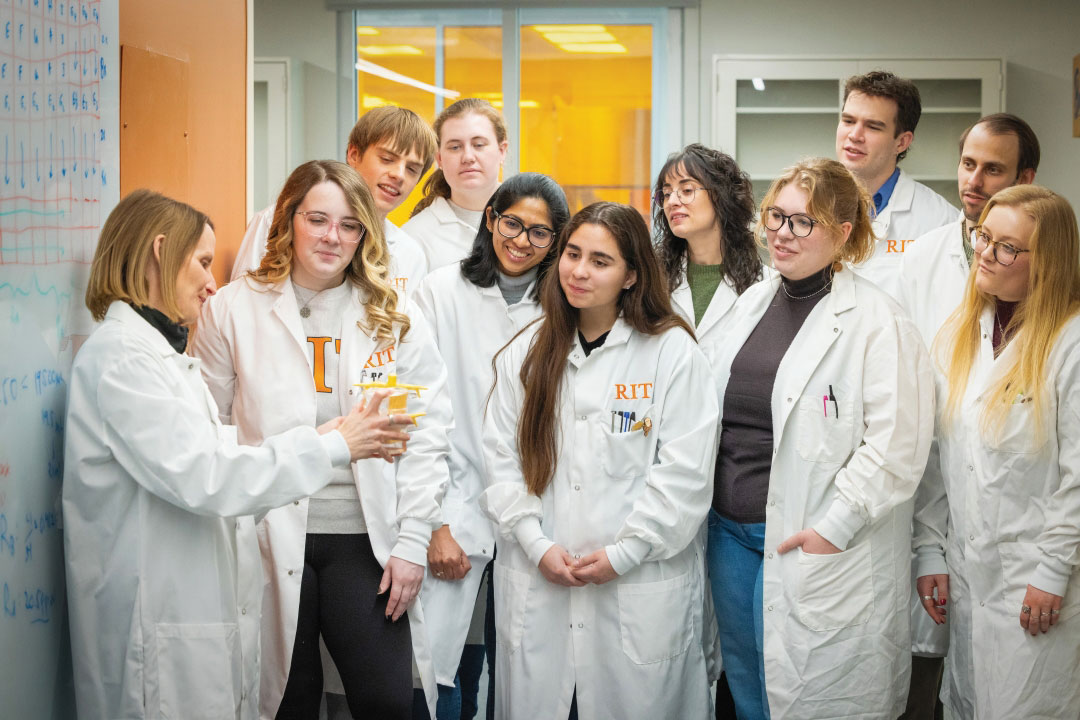
Harvey J. Palmer Endowed Professor Karin Wuertz-Kozak, left, works alongside undergraduate and graduate students through the research process, from designing experiments and analyzing data to interpreting findings.
For those with chronic back pain, surgery might seem inevitable. But biomedical engineering professor Karin Wuertz-Kozak sees other possibilities before that point is even reached.
Wuertz-Kozak is developing gene and cell therapies that may be the next step in tissue regeneration, a type of noninvasive treatment that could control the molecular mechanisms contributing to pain, mostly inflammation.
The breakdown of the intervertebral disc—the cushioning tissue between the bones of the spinal column—occurs for multiple reasons, from age and genetics to repetitive tasks and injuries. Her research team in the Tissue Regeneration and Mechanobiology Lab is focusing on extracellular vesicles (EVs), natural nanoparticles that can stimulate tissue repair, reduce inflammation, and modulate the behavior of existing cells.
Carlos Ortiz/RIT
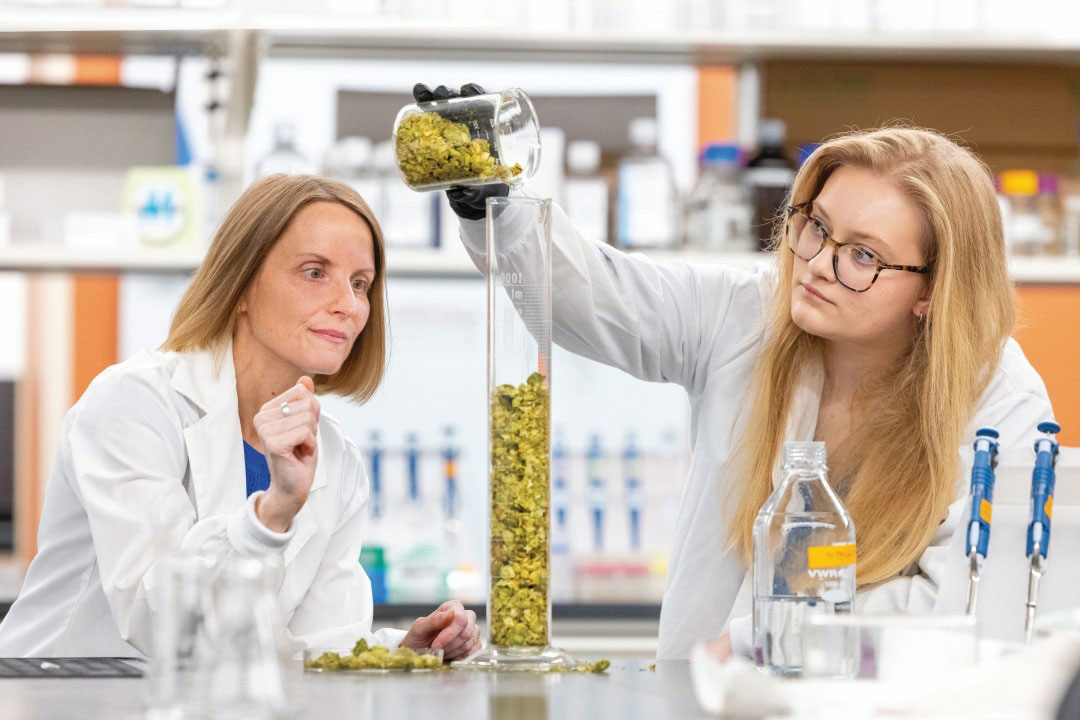
Gabriella Wagner, right, began working in Wuertz-Kozak’s lab as an undergraduate. She is now a doctoral student studying plant-derived extracellular vesicles from hops.
“Professor Wuertz-Kozak’s translational research shows significant promise in potentially revolutionizing clinical spine care,” said Dr. Varun Puvanesarajah, a top surgeon in orthopedic care and treatment for back, spine, and disc ailments at the University of Rochester Medical Center.
He worked closely with Wuertz-Kozak and her student-researchers to assess the clinical and translational relevance of the research.
“The work that she has pioneered could provide a critical non-operative modality that may help alleviate symptoms and avoid invasive procedures, which may have higher inherent risk,” said Puvanesarajah.
That could be a game changer for the millions of people who are impacted by degenerative disc disease.
Building a lab
Researchers in Wuertz-Kozak’s lab study cellular mechanisms involved in inflammation, degeneration, and fibrosis, with a primary focus on the intervertebral disc. Their goal is to advance disc repair through innovative, noninvasive therapies.
The team has had some success controlling tissue inflammation and promoting regeneration using EVs derived from CRISPR-modified stem cells in vitro. Stem cells show promise in regenerative medicine because once introduced into damaged tissue, they can develop into other cell types and release signals that influence neighboring cells.
A major challenge, however, is the intervertebral disc’s harsh environment and limited regenerative cell capacity. Unlike conventional gene-editing approaches that cut or alter DNA, CRISPR activation technology increases the activity of selected therapeutic genes.
The modified stem cells then release EVs with enhanced therapeutic cargo. In laboratory studies, these EVs showed stronger anti-inflammatory effects than EVs produced by unmodified stem cells, Wuertz-Kozak explained.
Carlos Ortiz/RIT
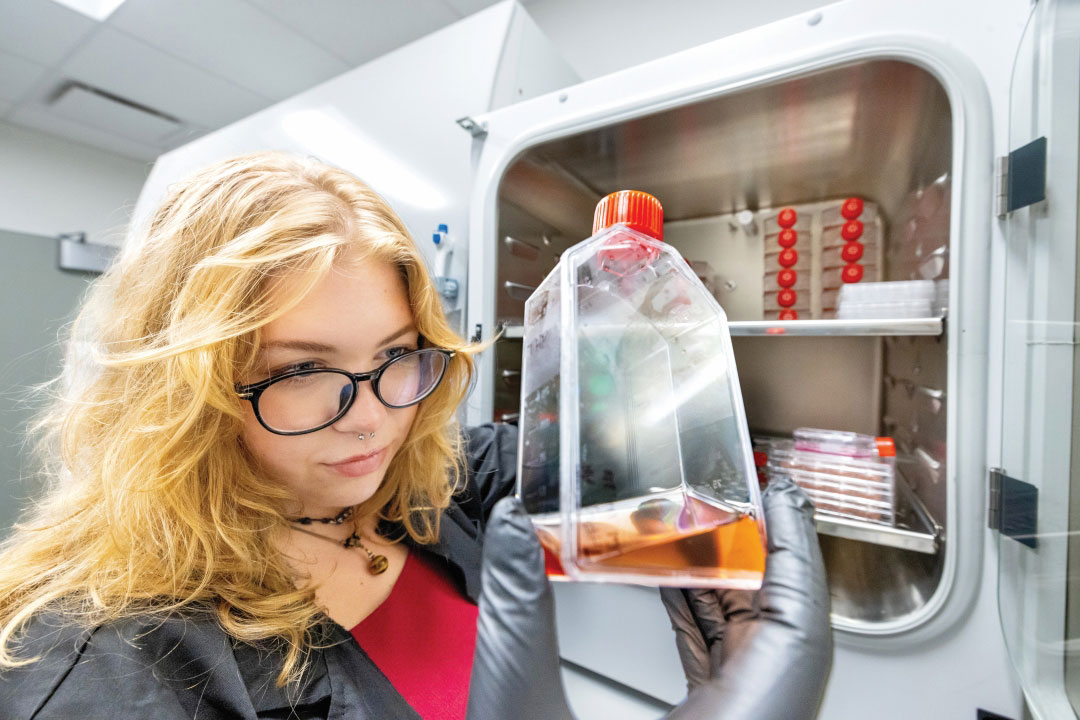
Tori Russell ’25 (biotechnology and molecular bioscience, applied modern language and culture-French option), a Ph.D. student in the lab, is RIT’s newest recipient of the prestigious National Science Foundation Graduate Research Fellowship award.
Her path to this research reflects a cross-disciplinary approach that defines her lab Team aims to reduce disc inflammation.
Wuertz-Kozak earned a degree in pharmaceutical sciences from the University of Regensburg in Germany before pursuing a Ph.D. at the University of Ulm’s Institute of Orthopaedic Research and Biomechanics. Her training brought together cell and molecular biology, biomechanics, and engineering—an interdisciplinary foundation that continues to shape her research.
After completing her Ph.D., Wuertz-Kozak held research and faculty positions in the United States and Europe, including at ETH Zurich. She joined RIT in 2019 and is currently the Harvey J. Palmer Endowed Professor of Biomedical Engineering. Her background in pharmacology, biology, and engineering allows her to approach tissue disease from multiple perspectives and connect fundamental mechanisms with questions that matter to clinicians and patients.
“Karin brought an internationally recognized research program in musculoskeletal tissue engineering, a collaborative approach to science, and a deep commitment to student mentorship,” said Thomas Gaborski, head of RIT’s Department of Biomedical Engineering. “Her scholarship, collaborative leadership, and dedication to students have strengthened both the department’s research enterprise and its educational experience.”
Learning through discovery
What distinguishes RIT’s biomedical engineering program is its emphasis on experiential learning. Students work alongside faculty and often with physicians from nearby medical centers, faculty from peer universities, and alumni at national technology companies.
These on- and off-campus experiences shape how students are trained in Wuertz-Kozak’s lab. The team currently includes one postdoctoral researcher, six Ph.D. students, and seven undergraduate researchers.
Students learn to conduct experiments, troubleshoot methods, analyze data, interpret unexpected results, and gradually take ownership of their own scientific questions.
One of those areas is whether plant-derived EVs could provide a complementary and potentially more scalable therapeutic source. Plants also release EVs containing proteins, lipids, RNA, and other bioactive molecules.
The lab is particularly interested in EVs derived from hops. Hops contain compounds with recognized anti-inflammatory and antioxidant properties, making them an intriguing candidate for EV research.
Gabriella Wagner ’25 (biomedical engineering), ’25 MS (biomedical engineering) began working in the lab in 2022 as an undergraduate, then continued as a doctoral student in RIT’s biomedical and chemical engineering Ph.D. program.

Carlos Ortiz/RIT
Wuertz-Kozak came to RIT in 2019 and currently serves as the Harvey J. Palmer Endowed Professor, one of 54 endowed professorships at RIT. Endowments create a source of funding in perpetuity to support and retain cutting-edge teaching and research faculty.
Wuertz-Kozak, who grew up near hops fields in Germany, introduced Wagner to the concept of hops as natural supplements for healing.
For her dissertation, Wagner is studying whether plant-derived EVs are an alternative to stem cell-derived EVs. It is a project she helped shape as her role in the lab has grown.
“Dr. Wuertz-Kozak instilled in me the importance of independence, curiosity, and always pushing scientific questions further. She encourages me to improve, think critically, and reach higher,” Wagner said. “That mindset has shaped not only how I approach research, but also how I approach challenges in every part of my life.”
Mikkael Lamoca ’24 (biomedical engineering) also grew as a researcher working closely with Wuertz-Kozak in her lab during his undergraduate studies, and the experience became one of the influences in his growing interest as a research scientist. He was a 2024 Fulbright Scholar and spent 10 months at the National University of Singapore.
When he completed his Fulbright, he was hired as part of the clinical research team at Stanford University. He primarily coordinates and manages clinical trials and research studies related to sports medicine, bone stress injuries, and shockwave therapy. His current work bridges his research initiatives at RIT with his aspirations to become a physician.
“Before I worked for Dr. Wuertz-Kozak, I did not even know what research was. I had no idea there was a whole field of research,” said Lamoca. “Before her, it was mainly, I want to get my M.D. I’ve always had the passion for patient care, taking care of others. But that intellectual curiosity for science was definitely something I developed at RIT.”