Researchers discover luminous signature to identify supermassive black hole mergers
Researchers from the Center for Computational Relativity and Gravitation publish two papers on new simulations
Scott Hamilton/RIT
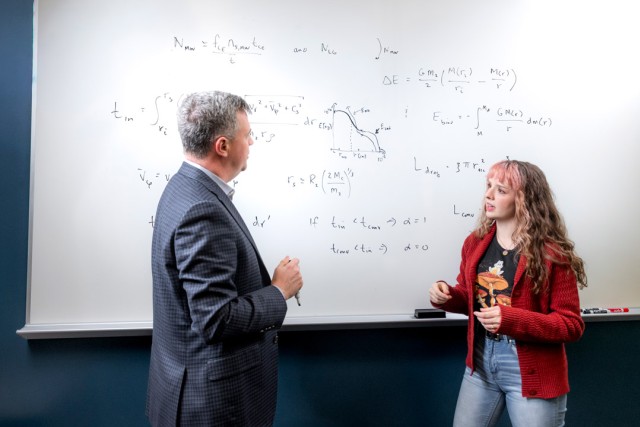
Distinguished Professor Manuela Campanelli works with graduate students in the Center of Computational Gravitation and Relativity. Students are essential to the center’s work and provide collaborative experience.
While scientists know supermassive black holes collide, these events have remained invisible to telescopes. RIT researchers have now identified a specific spike in light that occurs at the moment of merger, providing the roadmap needed to finally observe these cosmic giants in action.
Led by Lorenzo Ennoggi ‘25 Ph.D. (astrophysical sciences and technology) and Manuela Campanelli, Distinguished Professor of Astrophysics, members of RIT’s Center for Computational Relativity and Gravitation (CCRG) have published two papers in American Physical Society journals.
In the first paper, the team looked at two spinning black holes accreting gas and generating powerful electromagnetic signals. Through complex simulations, it was confirmed that there is a steady decrease in the system’s luminosity, but then at the time of merger, there is an abrupt spike.
“People were not able to do this simulation with the full physics that Lorenzo has been able to include, so they were not getting this rise in luminosity at the merger,” Campanelli explained. “What Lorenzo has discovered is that there is a bump at the merger, and the bump is correlated between both the jet and the light from the disk. That bump is important because it will allow mergers to be identified for the first time.”
Campanelli further explained that while it is known that galaxies collide and their central black holes collide, they have not been observed. Getting the right signal for these events, as Ennoggi calculated, is needed to be able to identify the mergers and then observe them.
“I had to repeat the simulations quite a few times,” said Ennoggi. “When I finally had something that worked and we managed to find something of relevance from the physics point-of-view, I was very happy.”
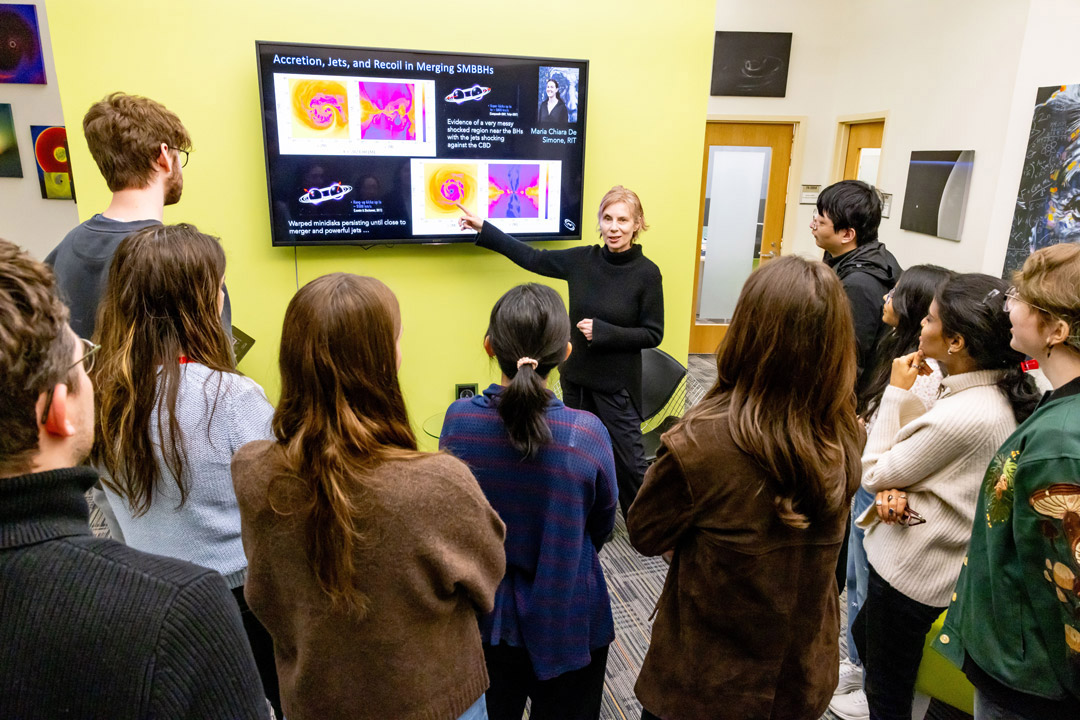
Current astrophysical sciences and technology Ph.D. student and co-author Maria Chiara de Simone further explained, “We are in the process of getting ready to help in observations because the gravitational wave emission and the electromagnetic emission together help with localization so we can get more information about galaxy evolution in a broader aspect.” De Simone's Ph.D. work is supported through funding from the John Vouros endowment.
Other co-authors of the paper include Yosef Zlochower, professor in RIT’s School of Physics and Astronomy; Scott Noble, NASA Goddard Space Flight Center; Julian Krolik, Johns Hopkins University; Federico Cattorini, University of Milano-Bicocca; Jay Kalinani, RIT postdoctoral researcher; Vassilios Mewes, Oak Ridge National Laboratory; Michail Chabanov, RIT postdoctoral researcher; and Liwei Ji, RIT postdoctoral associate.
In the second paper, researchers conducted simulations that may provide a new way to identify supermassive black hole mergers through photon emissions.
Black hole mergers are identified primarily by gravitational waves, but these events also radiate photons from thermal gas and photons from relativistic electrons energized by relativistic jets. The simulations conducted showed that during a merger of two black holes with the same mass and spin, photon radiation decreases as the black holes are drawn together, but increases sharply during mergers. Such a distinct signature could help identify such mergers.
The authors of this paper are Ennoggi, Campanelli, Krolik, Noble, Zlochower, and de Simone.
The publications capped nearly four years of Ennoggi’s Ph.D. research. He moved back to Italy after graduating from RIT and now works in high-performance computing applied to oil and gas. De Simone is continuing his work in her Ph.D. journey.
“I’m continuing Lorenzo’s work and extending the parameter space of our simulations,” said de Simone. “The idea is to produce simulations that help us with observations. We can work together with the observation side of the astrophysics world and get more exciting results. It’s nice to collaborate with other universities and professors.”
The collaborative nature of the research center, the ability to work with researchers around the world, and the passing of knowledge from one student to another is what makes ground-breaking research at the CCRG happen.
“When the center was created, I wanted to have this environment where you would have scientists and researchers and students together so there would be a lot of interaction,” said Campanelli, director and co-founder of the center. “The NASA-funded project for these simulations in particular involved numerous institutions and gave students exposure to work with other scientists. We are reaping the benefits and seeing that it’s working.”