Experimental Cosmology and Astrophysics

Focusing on experimental astrophysics and cosmology, Professor Zemcov’s Research Group is involved in several projects in a variety of roles, ranging from technology development to the scientific interpretation of data from mature instruments.
Research
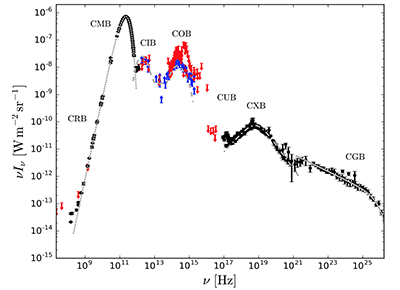
The Extragalactic Background Light (EBL) is the combined brightness from all sources of light over the history of the Universe after the light from our solar system and Milky Way galaxy is excluded. The physical processes responsible for the production of these photons vary, and can tell us about the physical conditions at different times in the universe’s history. At optical and near infrared (IR) wavelengths, the EBL is due to the light from all the stars in the Universe, so teaches us about the history of baryons and nucleosynthesis across cosmic time, while in the far IR (FIR) the light arises from cold dust during star formation. The plot below shows the EBL’s relative brightness over the entire observable electromagnetic spectrum. Various peaks are visible, each corresponding to different physical processes in the universe.
Courtesy Hill, Matsui & Scott
The part of the spectrum with the most energy density - the largest peak on the plot - is around 1 mm; this is the cosmic microwave background radiation (CMB), which is the earliest light we can see in the universe. At shorter wavelengths than the CMB, labeled 'Infrared' in this plot, the light predominantly comes from dusty galaxies in the distant Universe that are vigorously forming stars at a fantastic rate. At shorter wavelengths still, labeled 'Optical' in the plot, the light is due to the light collectively emitted by all of the stars in the Cosmos. FIRAS on COBE measured the FIR EBL spectrum to amazing accuracy; various projects I work on are aiming to do the same in the Optical and Infrared, particularly at wavelengths that are currently not so well understood.
Our research group is a world-leader in the field of spectrophotometric measurements of the EBL at a wide range of wavelengths. Building on the heritage of the CIBER-1 and CIBER-2 sounding rocket payloads, NASA’s SPHEREx mission is poised to deliver orders of magnitude improvements in our understanding of the EBL throughout the near-infrared spectral range.
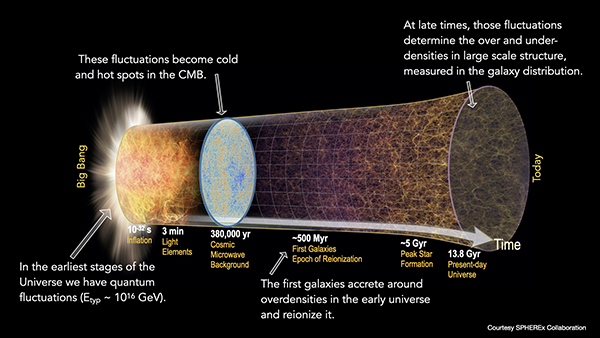
The epoch of reionization was the era during which the first population of stars in the Universe, seeded by the same over-densities visible in the CMB, ionized the neutral hydrogen then ubiquitous in the Universe. The epoch of reionization is at the forefront of current cosmological research. The details of the process, such as when it began, how long it took, and what class of sources produced it, are not well understood. The image below shows our current understanding of the process of structure formation over cosmic history, and displays the epoch of reionization that began roughly 500 million years after the big bang and was complete about 500 million years later.
Courtesy SPHEREx Collaboration
A promising way to study the epoch of reionization is via the fluctuations it causes in the infra-red background. Several of the projects I am currently involved with are searching for these fluctuations, which will allow a much better understanding of the generation of the first galaxies in the Universe and the processes which led to them.
The Cosmic Infrared Background Experiment (CIBER) is a sounding rocket borne experiment which is optimized to search for the signatures of reionization in the near infrared background. With four flights from early 2009 to mid 2013, the CIBER payload was extremely successful. The continuation of this project is known as CIBER-2, which has launched three times between mid-2021 and 2024.
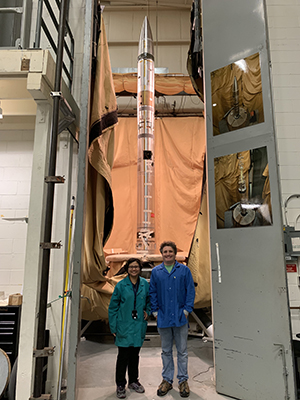
The photograph below shows team members C. Nguyen and M. Zemcov in front of the CIBER-2 instrument integrated into the Black Brant IX rocket payload during pre-flight tests at Wallops Flight Facility, Virginia.
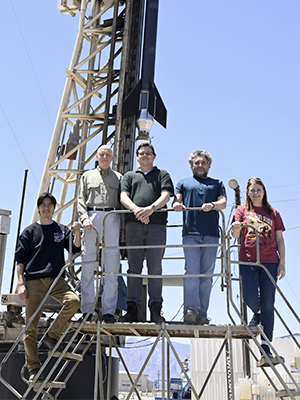
The photograph below shows current and former team members K. Noda, D. Patru, D. Mercado, M. Zemcov and C. Fazar in front of the CIBER-2 instrument integrated into the Black Brant IX rocket payload prior to its third launch on May 5, 2024.
CIBER-2 is specifically designed to help disentangle the reionization signal from emission from all of the galaxies closer to us. One of the primary CIBER results has been unexpectedly bright large-angle fluctuations at wavelengths of 1.1 and 1.6 microns, which may be identified with stars flung outside of galaxies or other new populations that result from large-scale structure formation. The CIBER-2 data set provides higher spectral resolving power of the near-IR background than had previously been achieved and data analysis of recent flight data is currently underway.
Building on CIBER, SPHEREx, the Spectro-Photometer for the History of the universe, Epoch of Reionization, and ices Explorer, is a NASA Mid-scale Explorer mission (MIDEX) that launched on March 11, 2025. SPHEREx is in the process of performing an all-sky spectral survey over the entire NIR wavelength range. SPHEREx is designed to map the large-scale structure of galaxies in the universe to help study the process of inflation, measure the light produced by stars and galaxies over time by using multiple wavelength bands to study galaxy clusters, and investigate how water and biogenic ices influence the formation of planetary systems by studying the abundance and composition of interstellar ices. Our group has remained at the front lines of this mission, from helping to design the science case and data analysis pipeline to being among the first to digest and analyze survey data.
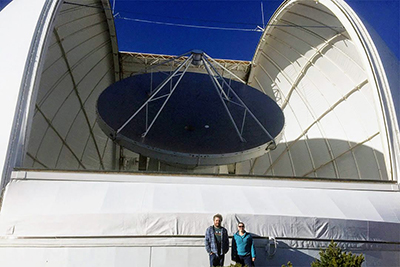
The epoch of reionization is also being studied in the sub-mm with the Tomographic Ionized-Carbon Mapping Experiment (TIME), a multi-pixel cryogenic grating spectrometer using superconducting bolometers. TIME will make line intensity maps of the redshifted 158 micron line of singly ionized carbon emitted by early galaxies as a result of star formation processes. A technique called line intensity mapping allows TIME to reach galaxy populations fainter than that of other instruments, and detect crucial ionizing systems such as dwarf and dust-obscured galaxies that may have been missed in other surveys. TIME is set to return to the KP12m telescope (photograph below with V. Bulter and M. Zemcov) in winter of 2026 for a dedicated science run with a full set of 2000 detectors.
FURTHER READING
The Sunyaev-Zeldovich Effect describes the scattering of cold cosmic microwave background photons off hot gas in the atmospheres of galaxy clusters. The SZ signal changes brightness with the mass of the cluster, but does not change as a function of redshift. This makes it an excellent tracer of large structures in the Universe, since it can be used to characterize the properties of a cluster at any distance.
An important property of the SZ effect is that, because on average the CMB photons gain energy when scattered, the spectral shape of the SZ effect is a decrement in the temperature of the CMB at low frequencies, and an increment at high frequencies, crossing through a null at around 217 GHz. This behavior is exhibited in the figure below.
The Spectrum of the SZ Effect

Our group specializes in making measurements of the SZ effect in the sub-mm regime where it is an increase in the CMB temperature. Since there are very few ways to make small cold spots on the CMB background, but many to make small hot spots (including all of the galaxies in the Universe), these are challenging measurements. However, the potential payoff is important: subtle changes in the scattering physics due to the state of the electrons in the galaxy cluster atmosphere cause changes in the electromagnetic spectrum of the SZ effect. Though small, these changes can allow measurement of the temperature and velocity flows within the cluster medium, and even a measurement of the velocity of the cluster with respect to the CMB rest frame. These are shown in the figure above in the gold and blue lines; the region where this effect is largest is in the SZ increment. Though still an emerging field, these kinds of measurements provide tight constraints on structure formation in the Universe which are independent of other measures.
We are currently leading efforts to measure the SZ effect using instruments like Herschel-SPIRE. The ultimate goal of this work is to map the SZ effect spectrum in many clusters, which will allow measurements of the spectral corrections to the SZ shape. Not only will this yield astrophysical and cosmological information, but also inform new instruments and measurement strategies as we progress.
FURTHER READING
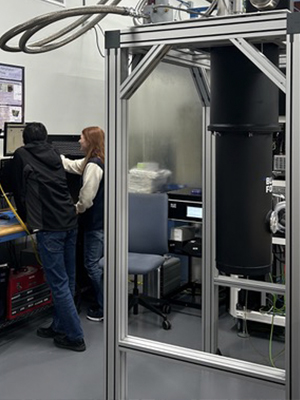
Our group is involved in a variety of efforts to improve technology for astrophysical and other applications for wavelengths ranging from visible light to radio. To this end, the National Science Foundation recently funded the development of a Dilution Refrigerator testbed system to enable testing of on-chip THz spectrometers and other quantum technologies in our lab. The capabilities of the system are summarized below. RIT researchers interested in running experiments on this system to test their technologies can submit a Proposal for time on the system.
Base Temperature: 20 mK (unloaded)
Hold Time at Base Temperature: Continuous Cycle
Cooldown Time: 12 hours
Available Input Ports: Blank: THz broadband and optical in development
Available Detector Readout: 7 channel RF, 24 channel DC electrical
Senior Group Members

Michael Zemcov is a research professor in the School of Physics and Astronomy and director of RIT's Experimental Astrophysics Laboratory. His research centers on instrumentation for cosmological observations, including the cosmic microwave and infra-red backgrounds. He develops instruments and data analysis methods for a variety of platforms, including ground-based, sub-orbital rockets, and orbital observatories. Currently, his scientific focus is on the epoch of reionization, secondary anisotropies in the cosmic microwave background, and studies of the history of the star formation in the Universe using novel techniques and experiments. He has extensive experience with instrumentation, observation and data analysis for astrophysics throughout the electromagnetic spectrum from the optical to the radio, with particular emphasis on the infra-red and sub-mm/mm regimes. His research group is currently involved in a number of projects in a variety of roles, ranging from technology development to the scientific interpretation of data from mature instruments.
Candice is a Researcher on staff in our group who works on a variety of projects. She is currently working on systematics and pipeline development for SPHEREx and setting up the KID testbed in the DR, along with supporting our various funding proposals. She earned her Ph.D. in physics from the University of Rochester where she researched the development of long-wave infrared HgCdTe detectors for space-based astronomy under the guidance of the late Judith L. Pipher. After many years post-graduate degree of serving as a physics professor at neighboring Roberts Wesleyan University, Candice joined our group bringing both her experience in laboratory testing and device characterization and a wealth of teaching experience to the role. Since then she has worked on CIBER-2 instrumentation, SPHEREx data analysis, and setting up the KID testbed. Her research interests involve advancing the technology that enables groundbreaking astronomy, including astronomical instrumentation and detector development.
Daniel is currently a PhD student in the Astrophysical Sciences and Technology Program. He graduated with a B.A. in Physics and Astrophysics from UC Berkeley in 2021 and worked at both Lawrence Berkeley National Laboratory and the Giant Magellan Telescope Organization before entering the PhD program in 2023. He is currently working on a project to measure the Sunyaev-Zeldovich Effect and the presence of dust in Galaxy Clusters with Herschel-SPIRE observations.
Liza is currently a Postdoctoral Associate developing methods to reduce atmospheric noise in the TIME analysis pipeline. She earned her Ph.D. in Astrophysical Sciences and Technology from the Rochester Institute of Technology, where she developed a scalable and physically interpretable machine learning framework for analyzing Active Galactic Nuclei spectra under the guidance of Dr. Andrew Robinson.
Kazuma is currently a Ph.D. student in the Astrophysical Sciences and Technology program. He received his Bachelor's in physics from Kwansei Gakuin University in Japan in 2022. He is currently analyzing CIBER-2 third flight data, and is working to measure its correlation with CIBER-1 and SPHEREx data.
Jonathon is currently a BS/MS student in the Astrophysical Sciences and Technology Program. He is in his fourth year of his BS and transitioning into his first year of his MS. He has been an undergraduate researcher working with the Zemcov Research Group for over a year. He has worked on a variety of projects including TIME and CIBER2. He is currently working on a project aimed at deploying readout electronics and developing a test bed for KID devices.
Ryan is a Ph.D. student in Astrophysical Sciences and Technology at RIT, where he also earned his B.S. in Physics with a minor in Astronomy in 2020. His current work primarily focuses on measuring the extragalactic background light at ultra-violet and near infra-red wavelengths in order to learn about the processes producing photons in both the near and distant Universe.
News
-
August 20, 2025

Student-led NASA project takes flight on balloon mission
A years-long student-led NASA project that develops technology to help guide rockets will near its final destination this month on board the Balloon Optimization Opportunity Platform!, or BOOP!
-
February 26, 2025

Ph.D. student gets a look into her future as part of astronomical experiment team
Dunn is part of the Tomographic Ionized Carbon Mapping Experiment (TIME), a project that is studying the early universe by mapping the emission of ionized carbon from distant galaxies.
-
February 21, 2025

NASA mission to explore the origins of the universe ready to launch with help from RIT
Associate Professor Michael Zemcov is a co-investigator of NASA’s SPHEREx Observatory, which will provide an all-sky spectral survey of galaxies and stars providing scientists with data never before received. SPHEREx also will explore the origin of water in planetary systems.
-
October 23, 2023

An astrophysicist explains why even if you were right next to the Voyager probes 15 billion miles from the sun you could still see them
Business Insider talks to Michael Zemcov, associate professor in the School of Physics and Astronomy, about how bright light from the sun would be at 15 million miles away.