Paul Craig Research Group
Developing computational approaches to teaching and learning biochemistry.
Overview
 My name is Dr. Paul A. Craig and I am a Professor of Biochemistry and Bioinformatics at the Rochester Institute of Technology located in Rochester, New York. I am a computational biochemist with a pedagogical focus.
I am deeply interested in increasing the computational component of undergraduate biochemistry education. This includes computational approaches to teaching the biochemistry lab (BASIL), development of separations simulations using Python and JavaScript (JBF), and increasing computational literacy among biochemistry and molecular biology faculty (PyBMB).
BASIL
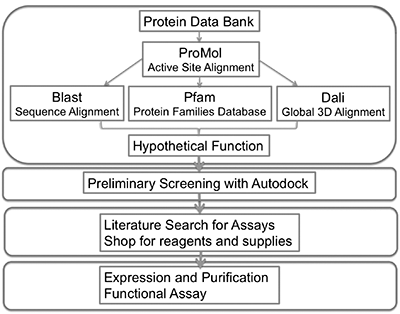 BASIL is an acronym for Biochemistry Authentic Scientific Inquiry Lab. In the BASIL curriculum, our aim is to get students to transition from thinking like students to thinking like scientists. Students will analyze proteins with known structures but unknown functions using computational analyses and wet-lab techniques. BASIL is designed for undergraduate biochemistry lab courses but can be adapted to first-year (or even high school) settings, as well as upper-level undergraduate or graduate coursework. It is targeted to students in biology, biochemistry, chemistry, or related majors.
The curriculum is flexible and can be adapted to match the available facilities, the strengths of the instructor, and the learning goals of a course and institution. These lessons are often used as part of upper-level laboratory coursework with at least one semester of biochemistry as a pre-requisite or co-requisite. The lab has been designed for classes ranging from 10-24 students (working in teams of two or three) per lab section.
Electro2D-Tandem MS
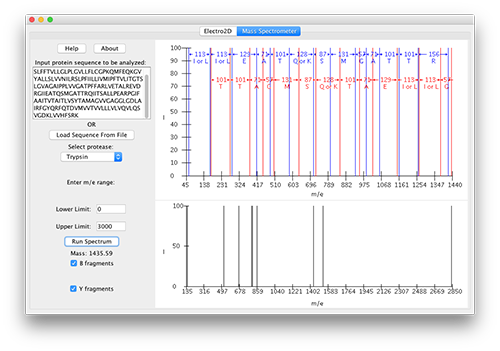 Electro2D-Tandem MS is a simulation of two-dimensional electrophoresis (2DE) - tandem mass spectroscopy (tandem MS), a tool that is used to separate and identify proteins from complex mixtures. This program was created entirely by students from programs in chemistry and computer science at RIT and is written in Java. Three notable contributors are Janine Garnham, who wrote the initial code for protein separation by 2DE; Jill Zapoticznyj, who started from Janine's code to build the graphical user interface for the simulation, and Amanda Fisher, who updated the code to make it work on any operating system and then integrated the protein separation by 2DE with Tandem Mass Spectrometry, which performs protein sequencing that can be used for protein identification and bioinformatics searching. The attached graphic (please include the one that is currently posted) demonstates how a protein with a known sequence can be digested with a protease, fragmented in the first dimension of mass spectrometry (lower right image) and sequenced in the second dimension of TandemMS (upper right image).