From RIT Math to Predicting Delta Flights: A Career Takes Off
From RIT applied math to Delta Air Lines, Theodore Johnston ’20 forecasts demand, works with the FAA, and uses predictive modeling to keep flights and passengers on track.
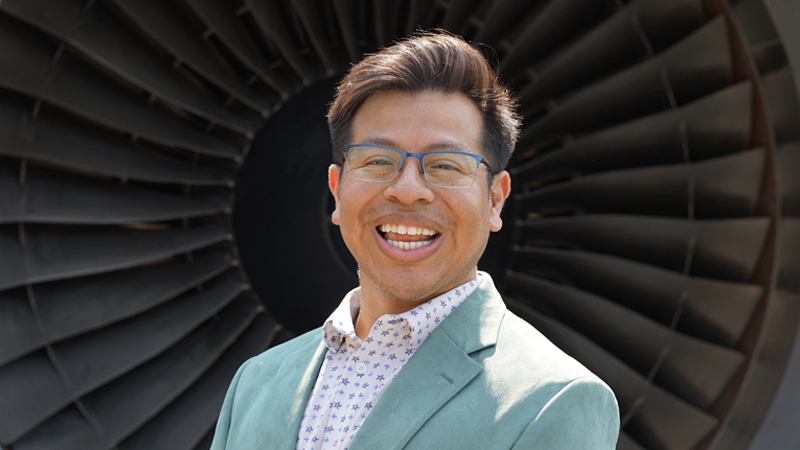
As a teenager weighing his career options, Theodore Johnston ’20 noticed a pattern in his interests. Chemistry, physics, engineering, and statistics were all different fields, but they had one thing in common: math. Finding the common thread connecting his interests is ultimately how he ended up in RIT’s applied mathematics program.
Today, Theodore is a technical product owner in Air Traffic Management at Delta Air Lines in Atlanta. He leads predictive modeling efforts to forecast traffic demand and impacts at Delta hubs, working with a team of data scientists to identify airport configurations that affect traffic flow and, in turn, delays. “The slower the traffic, the higher the delays,” he explains. “Being able to predict allows our operation to plan better.”
He also manages technology that impacts more than 400 flights daily, including an optimization engine that balances customer needs, crew schedules, and airplane rotation. This is especially critical during irregular operations (IROPs) when the FAA assigns delays. “If all goes well for the customer, Delta has the least amount of disruption while maintaining the integrity of our airplane and crew rotation. On high-disruption days, it’s hard to tell, but trust me, it can always be worse.”
Theodore’s role also involves close collaboration with Federal Aviation Administration (FAA) facilities to shape policies, refine procedures, and share feedback from the most challenging days. With Delta operating about 3,000 flights daily, he says, “Collaboration between controllers, Delta, and other carriers is paramount to success.” Theodore describes his work as blending technical depth with strong interpersonal skills. “Understanding users and decision-makers is key to building effective tools,” he says. At the heart of it, he sees a parallel to his academic roots: “At the end of the day, we focus on how we can do the best for our customer while maintaining the integrity of the operation, which is often very similar to solving differential equations.”
Theodore says the skills he gained at RIT have played a key role in his success. The support and encouragement from RIT’s community prepared Theodore to take on new challenges, including research. Under Dr. Ephraim Ayingi, he explored the growth and decay of wound epidemiology, studying diabetic and non-diabetic ulcers. The experience taught him patience: "I learned that time is your friend. Not everything needs or should be done quickly. You need to step back to see the bigger picture."
His time at RIT also included two semesters of co-op at Excellus BlueCross BlueShield, which eventually became his first full-time role. Theodore credits that experience with laying the foundation for his career and teaching him the value of building strong professional relationships.
In addition, Theodore cites communication as essential to his success. "My immersion in communications has been just as important as my technical skills," he explains. "Problem-solving and math make up half the job, but without the communication tools I gained at RIT, I wouldn't be here." His courses taught him to think critically and logically, while presentations and small group work strengthened how he connects with people.
Theodore also built his skills outside the classroom, taking part in RIT's vibrant campus life. He joined the Model Railroad Club, hit the slopes with the freestyle ski and snowboard team, and was a TEDxRIT organizer. According to Theodore, "RIT fosters a quirky, welcoming culture that brings together people with all kinds of interests. It helped me build meaningful relationships with students in business, photography, industrial design, math, communications, and more."
His advice for students is to be patient, build relationships, and stay flexible, especially in industries like aviation which can change overnight. He encourages future students to "show up ready to learn and take the time to connect with as many people as you can. Everyone's path is different. Things won't always happen quickly, but the foundation RIT provides is incredibly strong. And if anyone wants to talk about aviation, math in industry, or pretty much anything, I'm always happy to help."
More Featured Profiles and Work
Dr. Tony Wong