Ke Xu earns NSF CAREER Award to research edge computing and AI technology
When a prompt is entered into an AI system, the request often travels from a phone or computer to the cloud, where powerful servers in a large data center process the information before sending a response back. However, if there is an issue connecting to the cloud, the user is left without a reply.
For everyday AI uses, that would be an inconvenience. For more advanced applications like wearable health monitors, autonomous sensors and robots, losing access could be critical.
RIT Assistant Professor Ke Xu is working on edge computing for AI, an approach that processes data near its source, through a National Science Foundation (NSF) CAREER Award. This technology can reduce reliance on the cloud and uses less energy to complete tasks.
CAREER Awards are the NSF’s more prestigious awards in support of early-career faculty who have the potential to serve as academic role models and to lead advances in the mission of their department or organization. The awards span five years and must promise a strong combination of research and education.
“With edge computing for AI, you can process the information and make decisions in real time within a very tight energy budget,” explained Xu, who is in RIT’s School of Physics and Astronomy and is also a faculty member in the School of Chemistry and Materials Science and the microsystems engineering Ph.D. program. “In edge computing scenarios, you want devices to be really compact and smart enough to work on their own.”
Ke Xu
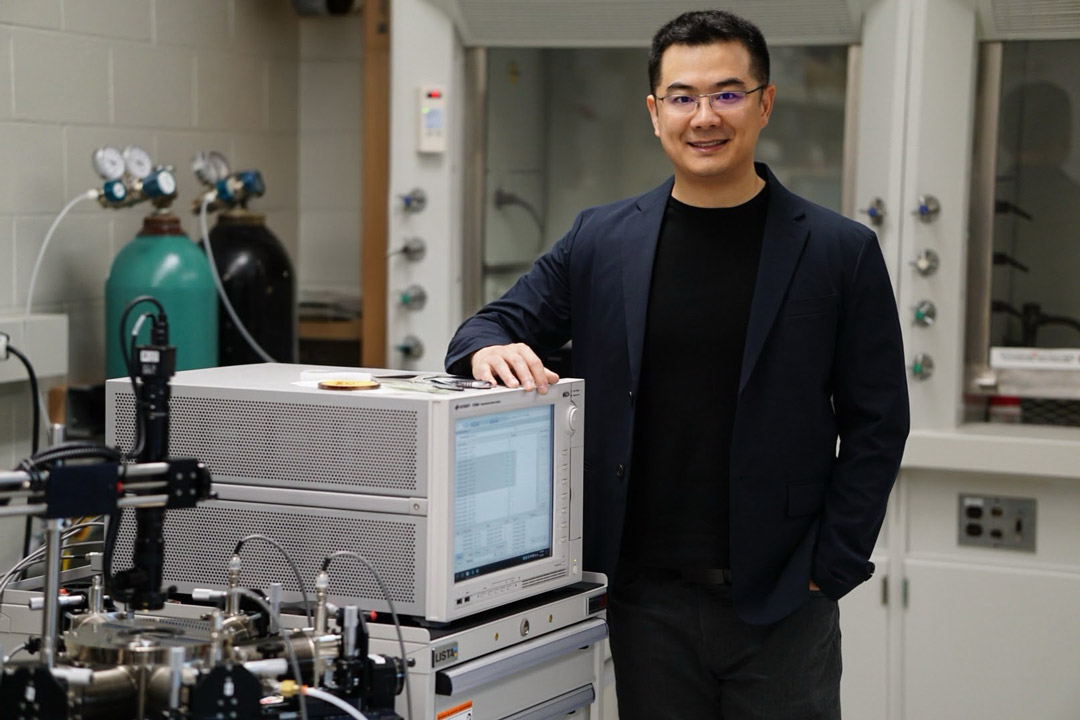
Assistant professor Ke Xu is shown in his lab where he will work closely with students to research edge computing for AI through an NSF CAREER Award.
Data centers that rely on cloud computing require large amounts of water to keep the computers cool. They also take up land and electricity usage. The environmental impact of data centers and AI usage is a highly contested current issue. Edge computing could help reduce some of those environmental concerns by allowing more data to be processed locally and more energy efficiently.
“With edge AI you can imagine really smart devices consuming only the power needed for the task,” said Xu. “That means less energy is needed, less heat is generated, and you do not need the heavy-duty cooling systems required by large data centers.”
A requirement of CAREER Awards is incorporating students into research. Xu will have help from both undergraduate and graduate students across various disciplines for this project.
“This project will allow students to develop at the intersection of disciplinaries and really have an understanding of physics, materials science, and electrical and computer engineering, and how to combine them in AI hardware that can be useful for their future careers,” said Xu.
Xu understands the importance of interdisciplinary research from his own academic experience. He received a bachelor’s degree in optical engineering and optoelectronics and a Ph.D. in electrical engineering. Prior to joining RIT, he was executive director of the Pittsburgh Quantum Institute and research assistant professor at the University of Pittsburgh. His research has always branched across various scientific and engineering areas.
“Interdisciplinary research is always my interest because you get to work with a lot of people from different backgrounds,” said Xu. “We all come to the same project with a different mindset. Good ideas come out of those kinds of discussions.”