A conversation with honorary degree recipient Mohammed Al Zarooni
Carlos Ortiz/RIT
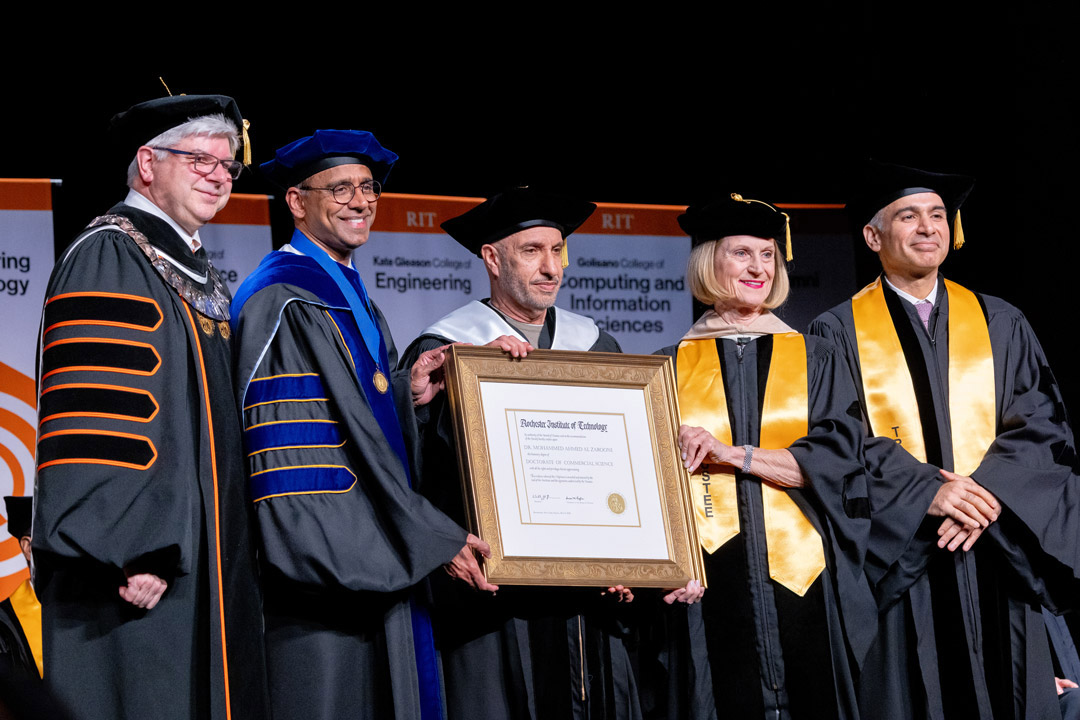
Mohammad Al Zarooni, center, was recognized during Academic Convocation on May 8, receiving an Honorary Doctor of Commercial Science degree. Joining him on stage, left to right, was RIT President Bill Sanders, RIT Provost Prabu David, RIT Trustee Vice Chair Susan Holliday, and RIT Trustee Darshan Hiranandani.
Mohammed Al Zarooni received an Honorary Doctorate of Commercial Science degree during RIT’s 2026 Academic Convocation on May 8. He is considered one of the world’s top free zone influencing leaders and holds prominent positions in numerous organizations and boards.
You serve as the executive chairman of the Dubai Integrated Economic Zones Authority and you are a member of RIT Dubai’s Board of Directors. As a prominent figure in leading and developing free economic zones, what does this mean for the economic health of the Dubai economy and the Gulf region?
In fact, the concept of free trade zones and economic zones have proven to be powerful enablers of economic growth across the world, not only in the Gulf region, but in advanced emerging economies alike, including the United States. They serve as strategic platforms to facilitate trade, attract foreign investments and foster innovation.
In Dubai, this model has been instrumental in reinforcing the emirate’s position as a global hub for trade, investment, and innovation, while contributing to the broader economic resilience of the UAE and the Gulf region.
Through the Dubai Integrated Economic Zones Authority, we have developed a cohesive and complementary model that brings together three specialized zones under a unified strategic vision, the Dubai Airport Freezone, Dubai Silicon Oasis and Dubai CommerCity. Each zone plays a distinct yet interconnected role—Dubai Airport Freezone as a global gateway for trade and logistics, Dubai Silicon Oasis as a hub for knowledge, innovation and advanced technologies, and Dubai CommerCity as a dedicated platform for digital commerce.
Together these zones form an integrated ecosystem that enhances value chain connectivity, supports high-growth sectors, and offers investors a seamless, business-friendly environment driven by smart services and progressive regulatory frameworks.
Dubai Silicon Oasis is also home to RIT Dubai, where I serve on the Board of Directors. This creates a strong link between academia and industry, enabling us to align academic outcomes with real market needs and develop a future ready talent pipeline that supports the digital economy.
Ultimately, this model of integration, which brings together infrastructure, investments, regulation, and education is what helps make Dubai’s economic competitiveness, drives diversification, and positions the emirate as a leading benchmark for sustainable growth across the UAE and the wider region.
Dubai Silicon Oasis has evolved into a fully integrated technology district that brings together innovation, business, and community living. How does this model differentiate it from other technology hubs, and what role do strategic partnerships play in advancing its ecosystem? Looking ahead, how do you see Dubai Silicon Oasis evolving as a center for innovation and talent development?
Dubai Silicon Oasis, a member of Dubai Integrated Economic Zones Authority, is distinctive because it operates as a fully integrated district, where innovation is not confined to business activity alone, but embedded across the entire environment—from research and development to everyday living.
What sets it apart is the deliberate design of an ecosystem that enables collaboration at multiple levels. We have developed strong partnerships with global technology companies, startups, and specialized innovation centers, creating a platform where ideas can move efficiently from research to commercialization. Academic institutions such as RIT Dubai are a key part of this model, helping bridge the gap between education and industry while supporting the development of highly skilled talent in critical fields.
Looking ahead, the focus is to scale the impact of this ecosystem, by deepening industry-academia collaboration, attracting more high-value technology investments, and enabling emerging sectors to grow within a supportive and future ready environment. The ambition is not only to expand, but to continuously evolve Dubai Silicon Oasis as a leading destination for innovation-driven enterprises and talent.
RIT Dubai, while launched in 2008, opened a new campus in 2021. Now, you are in phase two, with construction completion set for 2027. Tell us about the progress and what we can expect with the expanded campus.
RIT Dubai has evolved significantly since its launch in 2008, and the opening of our new campus in 2021 marked a major step forward in establishing a strong and permanent presence in Dubai Silicon Oasis. Today, Phase Two represents the next stage in that journey.
The expansion is progressing steadily and reflects both growing student demand and our long-term ambition for RIT Dubai’s role in the UAE. Upon completion in 2027, the expanded campus will allow us to accommodate up to 4,500 students, more than doubling our current capacity.
The expansion will introduce advanced laboratories, modern classrooms, and collaborative spaces designed to support experiential learning, innovation, and research. It will also enable us to expand our academic offerings, particularly in areas that are critical to the UAE’s future such as engineering, artificial intelligence, computing, and emerging technologies.
Importantly, this is not just a physical expansion. It reflects our commitment to strengthening partnerships with industry, enhancing research capabilities, and ensuring that our graduates are equipped with the skills needed to contribute meaningfully to the UAE’s knowledge economy.
By 2027, we expect the expanded campus to strengthen RIT Dubai’s contribution to talent development, innovation, and the wider growth of Dubai and the UAE.
Since you sponsored RIT as the exclusive educational institution to support the mission of Dubai Silicon Oasis, are you pleased with the quality and services that RIT has provided?
Yes, we are pleased with the progress RIT Dubai has made and with the role it continues to play in supporting the broader vision of Dubai Silicon Oasis. From the outset, the objective was to establish a high-quality institution aligned with the innovation and technology focus of the ecosystem, and RIT Dubai has delivered strongly on that vision.
The university has demonstrated strong academic quality, industry engagement, and programmes aligned with market needs, particularly in engineering, computing, and emerging technologies. Its focus on experiential learning ensures graduates are well prepared for the workforce.
Importantly, RIT Dubai supports the Dubai Silicon Oasis strategy by developing a future-ready talent pipeline and strengthening collaboration between academia and industry. This contribution also supports Dubai and the UAE’s broader goals of economic diversification, digital transformation, and a knowledge-based economy.
As the university continues to expand, particularly with Phase Two, we expect it to play an even greater role in supporting both the Silicon Oasis ecosystem and the UAE’s long-term vision.
RIT Dubai was established to provide world-class university programs. What has changed since those early days?
Since our early days, RIT Dubai has evolved significantly in both scale and scope. We have expanded our academic portfolio well beyond the initial programmes to include disciplines such as computer science, artificial intelligence, data analytics, cybersecurity, and design. These are areas that are closely aligned with the evolving needs of the UAE and global economy.
Equally important is how we deliver education. We have strengthened our focus on experiential learning, research, and industry integration. Today, our students benefit from internships, co-op opportunities, and direct engagement with companies, ensuring they graduate with both academic knowledge and practical experience.
Our student body has also become more diverse, reflecting our position as an international university attracting talent from across the region and beyond.
Overall, RIT Dubai has grown from a relatively focused academic offering into a broader, more established institution with stronger industry links and a wider role in the UAE’s education landscape.
Finally, what opportunities do you see for RIT students and faculty members here in the United States to take advantage of if they visit RIT Dubai?
RIT Dubai gives students and faculty from the U.S. the opportunity to experience a different regional context while remaining part of the wider RIT network. For many, it’s a chance to experience how innovation, business, and government come together in a global hub like Dubai.
For students, this translates into hands-on opportunities through internships, co-op placements, and industry projects with companies operating across the Middle East, Africa, and South Asia. It provides a different market perspective and prepares them to work in increasingly global and interconnected industries.
For faculty, RIT Dubai opens doors to applied research and collaboration with both industry and government partners, particularly in fields where the UAE is investing heavily, such as advanced technologies, sustainability, and smart cities.
More broadly, spending time at RIT Dubai allows students and faculty to expand their global perspective, build international networks, and experience a region that is playing an increasingly important role in the global economy, all while remaining part of the wider RIT system.