RIT alumni are shaping new careers: 3D heart mapper
Electrophysiology expert thrives in a profession that didn’t exist a generation ago
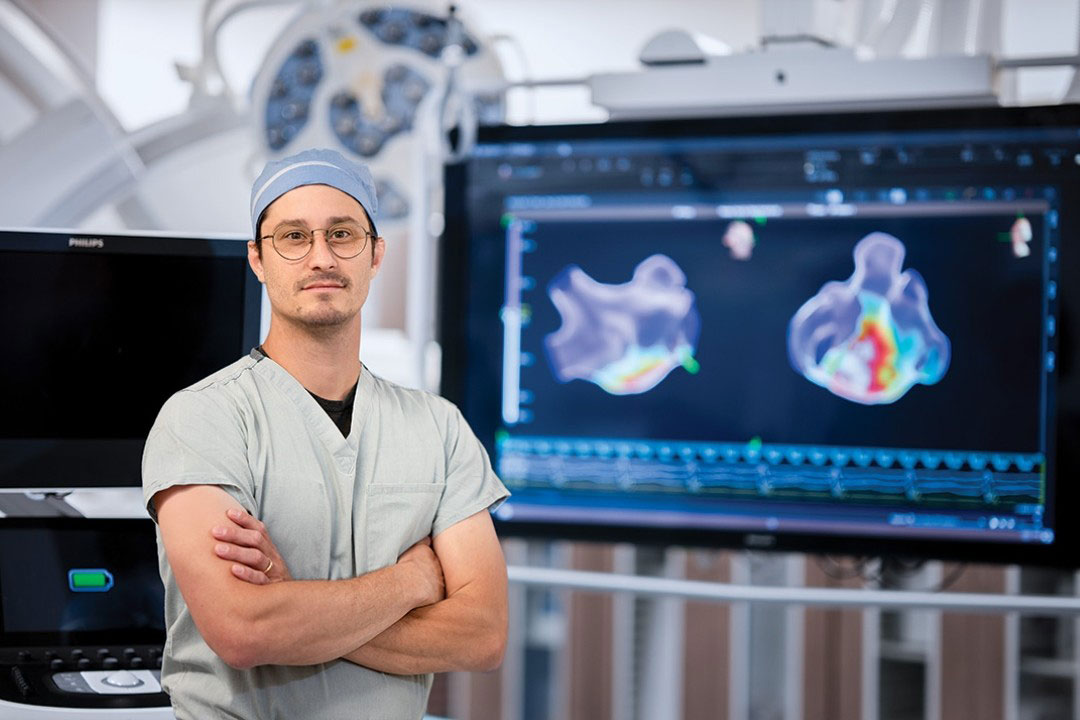
Alket Pateqi/Abbott
Through electrophysiology, or cardiac mapping, Michael Kormos ’17 helps physicians locate the origins of a patient’s heart arrythmia to manage abnormalities.
Michael Kormos remembered the day well. As a service engineer for Abbott in Detroit, he had just installed new cardiovascular diagnostic equipment in a Detroit hospital operating room.
Through a glass partition into the next room, he watched drama unfold as a patient was coding. An entire clinical team of physicians, nurses, and technicians began performing highly coordinated actions to save that patient’s life.
“It made me realize there’s more I wanted to do,” said Kormos ’17 (biomedical engineering). “I literally and figuratively wanted to be on the other side of that glass.”
Today, Kormos is on the other side of that glass as a clinical specialist. He provides electrical anatomical mapping to locate and navigate heart arrhythmias and tissue damage. This important information is relayed to surgeons performing ablations, the process of destroying heart tissue causing erratic heartbeats.
“There isn’t a moment when I’m calm,” Kormos said. “It’s a lot of analyzing and assessing the timing and shape of signals. When the physician is performing the ablation procedure, we are in constant contact.”
Today’s physicians seek engineers with biology expertise like Kormos. Electrophysiology is its own subspecialty in the diagnosis and treatment of cardiac arrhythmia. The catheter readings, ultrasound imaging, and electrical signal capture are combined to pinpoint exact locations of damage in an accurate 3D model.
Kormos said that working with people from different disciplines prepared him to collaborate on surgical teams and to balance his role as a team member and patient advocate. It’s not uncommon for the physicians he works with now to read articles about new procedures and ask him to assess possible implementation, sometimes just before a scheduled procedure.
“I think that is one of the things that is unique to the RIT program: you had to be able to build on an information set and apply it with a very quick turnaround,” said Kormos. “There are new techniques being developed, so we are always learning.”
Shaping new careers
The Fall 2026 RIT University Magazine highlighted alumni who are thriving in professions that didn’t exist a generation ago.
RIT’s new Strategic Framework promises to prepare graduates for the opportunities and challenges of tomorrow—including careers in fields yet to be imagined. That’s a promise grounded in experience. Alumni are already building professions in fields that were unthinkable a generation ago.
Meet some more of them.
- Lauren Tamburro ’04 (biochemistry), a cannabis food scientist
- Malcolm Zale ’23 (motion picture science), a 3D-workflow and technology specialist
- Hema Madaka ’22 Ph.D. (sustainability), a life cycle assessment manager
- Ben Garvey ’21 (applied arts and sciences), an esports country club founder
- Laura Faria ’16 (mechanical engineering), ’17 MS (science, technology, and public policy), a cybersecurity incident commander at Cisco
- Sohil Shah ’15 MS (computer science), an agentic AI engineer at PayPal
- Olivia Svrchek ’11 (biomedical sciences), a concierge nursing executive


