News
-
November 18, 2019

Researcher Karin Wuertz-Kozak awarded over $250K from the Swiss National Science Foundation
Degenerative disc disease (DDD) is the painful degeneration of the intervertebral disc due to dysregulated inflammation and the primary cause of back pain. The project hopes to identify miRNA candidates that are associated with TLR2 and establish their functional role in degenerative disc disease.
-
November 8, 2019

RIT conducts clinical trial on metabolic syndrome
RIT is seeking individuals diagnosed with metabolic syndrome to participate in a national clinical trial. The study will evaluate a wellness program designed to reverse conditions leading to heart disease, Type 2 diabetes and stroke.
-
October 21, 2019

Parenting app for mothers being developed at RIT
Research is underway at RIT to create an app that will serve as a resource to help young mothers answer questions about raising a child, connect them with programs and resources, as well as foster a virtual parenting community.
-
October 21, 2019

RIT researcher receives NSF grant to help build a synthetic neuron and neural network
Researchers from RIT and six other universities are teaming up to build synthetic neurons and a programmable network of such neurons in an effort to better understand the rules of life. The project is part of the National Science Foundation’s “Big Ideas” initiative— 10 bold, long-term research and process ideas that identify areas for future investment at the frontiers of science and engineering.
-
October 15, 2019

RIT wins $1.4M to help homeless with opioid addiction, mental illness
Making addiction treatment and mental health services accessible to homeless people via TeleHealth is the focus of a federally funded program at RIT.
-
September 5, 2019

Podcast: Toilet Seat Measures Heart Health
Intersections: The RIT Podcast, Ep. 22: Heart failure costs the U.S. $34 billion a year, with most of those costs due to repeated hospitalization. David Borkholder, RIT’s Bausch and Lomb Professor of Microsystems Engineering, talks with Nicholas Conn, a postdoctoral fellow and founder of Heart Health Intelligence, about a new invention that could help patients easily monitor their health in the privacy of their own bathrooms.
-
August 15, 2019

Podcast: Electronic Cigarette Research
Intersections: The RIT Podcast, Ep. 21: Are electronic cigarettes really a healthier alternative to tobacco products? Risa Robinson, head of RIT’s Department of Mechanical Engineering, talks with Edward Hensel, associate dean, about their unique research methods into how these devices are used and how they affect users’ health.
-
July 12, 2019

Professor honored with Presidential Early Career Award for Scientists and Engineers
RIT computing professor Linwei Wang, whose research is advancing non-invasive personalized healthcare for heart diseases, is receiving the Presidential Early Career Award for Scientists and Engineers, the highest honor bestowed by the U.S. government on outstanding scientists and engineers who are beginning their independent research careers and show exceptional promise for leadership in science and technology.
-
July 1, 2019

Professor wins award for excellence in advising
John Edlund, associate professor of psychology, has received the Regional Faculty Advisor Award for the Eastern region of Psi Chi, the International Honor Society in Psychology.
-
June 24, 2019

Infrared imaging technology being developed to better detect breast cancer
Faculty and student researchers at RIT, and physicians from the Rochester Regional Health System (RRHS), developed a non-invasive process using infrared imaging to better detect cancerous tumors.
-
May 29, 2019

RIT researchers receive NSF award to develop new diagnostic tool for cardiac disease
Researchers at RIT are providing a better map to the human heart. They are developing a critical tool that will help clinicians identify damaged areas in the heart to more accurately diagnose cardiac disease.
-
May 2, 2019
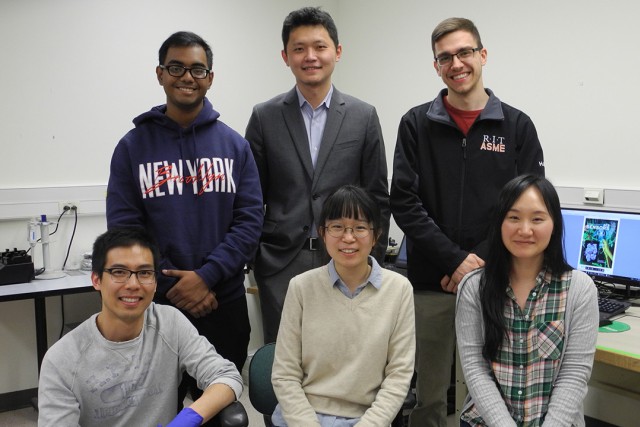
RIT professor develops device to better detect Ebola virus
A faculty-researcher at Rochester Institute of technology has developed a prototype micro device with bio-sensors that can detect the deadly Ebola virus. With this type of device, those infected can be treated earlier, and the early detection process can potentially decrease the spread of infections.